The Artistic Path of Li Yan, a Chinese Painter in Japan
Ink as the Soul, Oil as the Bone
——The Artistic Path of Li Yan, a Chinese Painter in Japan
By Qingcheng, Li Qifan and Li Da
Tokyo, midsummer 2026.
In the interview studio of Asia Financial Review in Ueno, a Chinese woman painter who grew up amid the mountains and waters of Guilin slowly recounted the inner journey that had taken her from a celebrated “child prodigy” to an artist devoted to lifelong self-cultivation—and from painting for herself to creating art as a form of prayer and blessing for others.
Her name is Li Yan, the first recipient of a doctoral degree in art from Tama Art University.
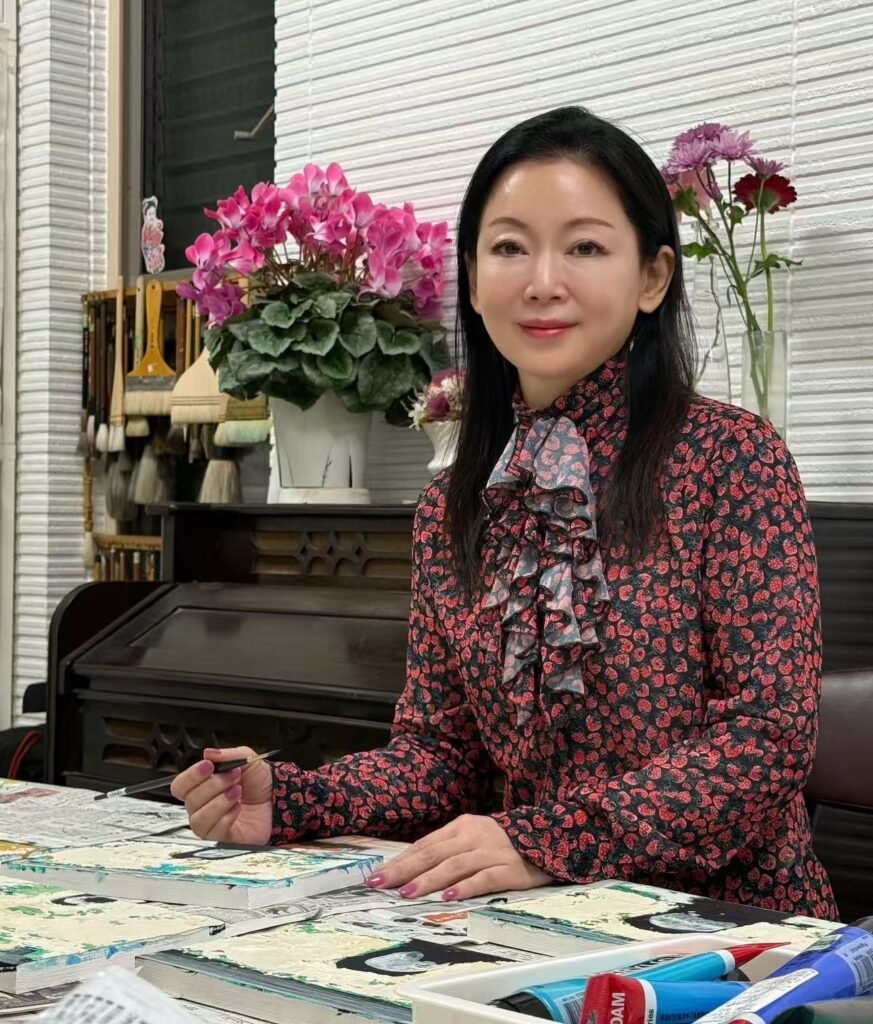
A Child Artist of the Li River: A Prodigy Who Began Drawing at Three
Li Yan was born in Guilin, Guangxi Province. Influenced by her father, she formally began studying painting at the age of five, although her artistic talent had already revealed itself two years earlier.
When she was three, her father took her along on a business trip. While the adults attended a meeting, she was left alone in the guesthouse. The only things within reach were her father’s crayons. After drawing on paper for a while, she found it unsatisfying. She then turned and saw an expanse of blank white wall.
The little girl dragged over cushions, climbed onto chairs and covered every part of the wall she could reach with drawings.
“When my father opened the door after the meeting, the first thing he did was not scold me,” Li recalled. “Instead, he exclaimed, ‘Wow, you have such an imagination!’”
Her father took her to apologise. Yet after seeing the wall covered in drawings, the person in charge of the guesthouse did not demand compensation. Instead, he said that the wall should be preserved.
The Li family had a long tradition of painting, and from that wall, her father recognised his daughter’s artistic gift.
From the age of eight, Li frequently won prizes in children’s calligraphy and painting competitions. At a time when Guilin produced many young artists known as the “child painters of the Li River,” she became one of the most prominent among them.
Her works were presented as Chinese state gifts to political leaders and dignitaries around the world. Among those who collected her paintings were Britain’s Prince Philip, Queen Margrethe II of Denmark and former Australian prime minister Malcolm Fraser.
“When I was young, everyone called me a ‘genius,’ and naturally I was pleased to hear it,” Li said. “But looking back, the title also created considerable pressure. When everyone says you are a genius, it becomes embarrassing if you do not work hard enough to live up to it.”
That pressure eventually drove her to choose a more difficult path: leaving behind the honours of her childhood, travelling alone to Japan and beginning again from zero.
Ink and Oil: A Conflict That Lasted for Years
In 1992, Li moved to Japan alone, carrying with her only a Chinese calligraphy brush and a dictionary.
Soon after arriving, she found herself confronting a profound cultural and artistic conflict.
Li had grown up painting in the traditions of Chinese ink and wash, which emphasise rhythmic vitality and the decisiveness of every brushstroke. After entering Tama Art University to study oil painting, however, she encountered an entirely different system—one based on structure, relationships between colours, the modelling of space and the gradual accumulation of thick layers of paint.
“Studying Western realist oil painting through the ink-painting mindset I had developed since childhood often led me to wonder whether a deeper connection might exist between these two very different artistic systems,” she said.
Her second year at university was the most difficult. She painted models and practised realism every day, but the more she painted, the more she felt that many of the things within her were gradually being pushed aside and drifting farther away.
For more than a year, she repeatedly asked herself one question: Why am I painting?
The turning point came during an unplanned experiment.
At the time, Li was studying the system of oil painting in depth while continually considering how the Eastern artistic sensibilities she had accumulated since childhood might be incorporated into contemporary painting.
One day, she worked freely on a wooden panel, combining elements of traditional Chinese painting with materials such as sand. The resulting piece possessed the texture of an oil painting and also included Chinese characters carved into its surface.
A professor happened to pass by. On seeing the work, he showed great interest and offered exceptionally high praise.
“At that moment, I suddenly understood,” Li recalled. “This was what I truly wanted to express. This was my real self. I did not need to abandon Chinese painting completely in order to concentrate on oil painting.”
Oil-Colour Splash-Ink: The Formation of a Distinctive Artistic Language
From that point onward, Li began developing a unique path of artistic integration: using the materials and techniques of oil painting to express the atmosphere, vitality and poetic spirit of Chinese ink painting.
Japanese art historian Arata Shimao described Li’s distinctive method as “oil-colour splash-ink.”
“Chinese painting is not merely about brush-and-ink techniques,” Li explained. “More importantly, it embodies the culture and spirit of the person behind the brush, as well as the relationship between human beings and nature.”
She began combining the colours and techniques of Western oil painting with the expressive qualities of Chinese ink.
“Every technique is ultimately only a tool,” she said. “What matters most is whether it can express your own ideas and understanding.”
On her canvases, the underlying colours are diluted until they become transparent. Different tones merge within hazy and indistinct spaces, while dry pigments are added above them to create more figurative details. The effect resembles the execution of traditional splash-ink painting, but in oil.
Conventional oil painting often relies on the accumulation of one thick layer of paint after another. Li deliberately avoids this approach.
“The traditional concept of oil painting does often involve accumulation,” she said. “But some paintings become so heavily filled that they leave the viewer feeling unable to breathe.”
For Li, what matters most is the sense of space within a painting and the spiritual vitality that circulates through it.
Motoaki Kōno, professor emeritus at the University of Tokyo, has described Li’s art as a “threefold integration”: an integration of East and West, of representation and abstraction, and of tradition and individuality.
“Her abstraction is not the abstraction found in Western painting,” Kōno observed. “It is a form of expression that, without explicitly depicting an object, can nevertheless evoke concrete phenomena and emotions.”
In recent years, Li has used this distinctive visual language to create a series of works centred on the Great Wall of China.
“What I want to express is a sense of antiquity, weathering and immense historical distance,” she said. “I am not simply reconstructing a wall on the canvas. I am trying to capture the lives, passages and journeys of the people who moved inside and outside that wall thousands of years ago.”
Talent Is Only the Beginning; Cultivation Is the Destination
When asked about the ultimate mission of an artist, Li answered with only two Chinese characters: xiuxing—self-cultivation.
“It means cultivating one’s character and inner nature,” she explained. “Artistic creation is itself a form of cultivation and discipline. Throughout the long journey of creation, you encounter countless difficulties, creative impasses and moments of self-doubt.”
Li is now actively promoting public art education and art-therapy projects in both China and Japan.
She has also conducted joint research with a Canadian neurologist. Their findings suggest that people who regularly engage in artistic activities such as painting may have a significantly lower likelihood of developing Alzheimer’s disease in old age. The repeated coordination of the hands, eyes and brain during artistic creation can strongly stimulate the imagination and creative faculties.
In Japan, Li teaches painting to students in their eighties. One of them has studied with her for more than 20 years. Preparing for an exhibition, the student created a painting at home that covered an entire wall. The work eventually received an award, and the student has continued to improve.
“When I see them, I reflect on myself,” Li said. “I ask myself, ‘How old am I? Shouldn’t I be working twice as hard?’”
Cultivation is not limited by age, nor does it require rejecting the times in which one lives.
Faced with the rapid rise of artificial intelligence, Li does not respond with resistance. She sees the emergence of AI as historically inevitable and believes that it can even open new possibilities for artistic exploration. Her own works, for example, have been used in installation designs for therapeutic spaces.
Yet she remains convinced that AI can never replace the moment in which a human hand touches a brush and feels the physical resistance of paint.
Talent is only the beginning; cultivation is the destination.
“In this very minute, in this very second, the brush beneath my palm, the paper I touch and the resistance of the paint that I feel are all traces flowing directly from this particular instant of my life.”
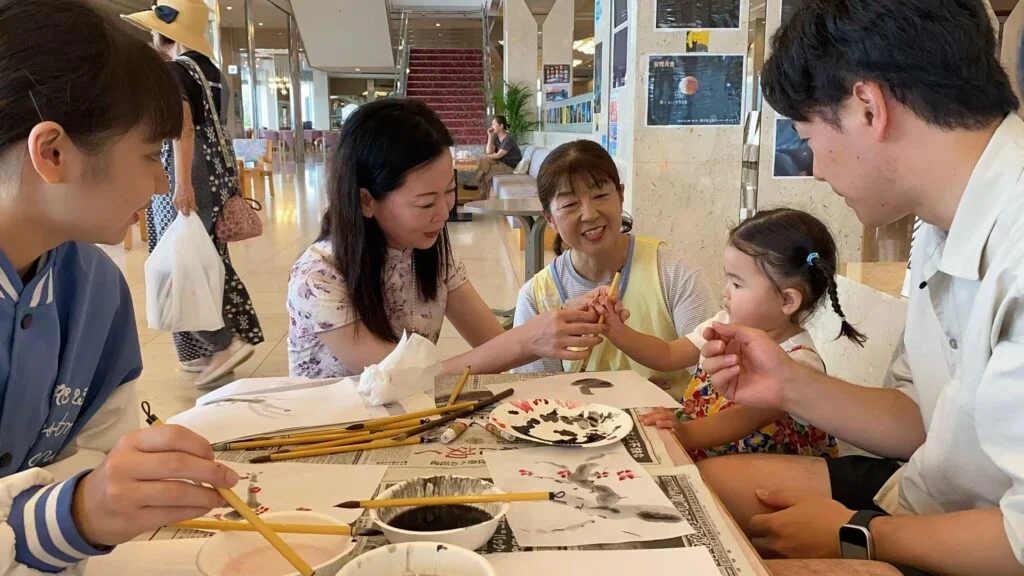
Residents of the Minamisanriku area have relatively limited access to arts education in their daily lives. Through free public ink-painting classes, Li Yan has given local residents—particularly those interested in art—the opportunity to experience Chinese ink painting firsthand. During the creative process, participants learn to appreciate and discover beauty, while enriching their cultural and spiritual lives.
【Commentary】
Oil-Colour Splash-Ink: Li Yan’s Modern Visual System for an Eastern Spiritual Realm
By Roya and Li Da
As an artist who has spent decades exploring the integration of Eastern and Western painting traditions, Li Yan has consistently sought to develop a visual language that is rooted in the spiritual foundations of Eastern culture while retaining the expressive power of contemporary art.
Li began studying Chinese ink painting in childhood and later completed a systematic art education in Japan, from undergraduate study through to a doctoral degree. Throughout several decades of artistic practice, she has continually returned to one central question: How can contemporary painting express the Eastern understanding of life, nature and the universe?
In Eastern philosophy, human beings and nature are not opposing entities. They form an interconnected community of life, continually generating and shaping one another.
Heaven, earth and all living things exist within a state of constant movement and transformation. Emptiness and substance, motion and stillness, existence and non-existence together constitute the underlying order of the world.
The concepts of the unity of humanity and nature and the interdependence of all living things have gradually become the deepest spiritual foundations of Li’s art.
For this reason, her work rarely makes direct use of recognisable symbols of Eastern culture. Landscapes, calligraphy and religious images are not her principal concerns. Instead, she seeks to transform Eastern philosophy into an internal pictorial structure and visual order, allowing the painting itself to become a spiritual presence.
The language she describes as “oil-colour splash-ink” gradually matured through this process of exploration.
The weight, texture and luminosity of oil paint are combined with the movement and spontaneous formation associated with Chinese ink. As a result, her works preserve the Eastern emphasis on vitality, spiritual resonance and poetic atmosphere while also creating the open and unrestricted sense of space associated with modern painting.
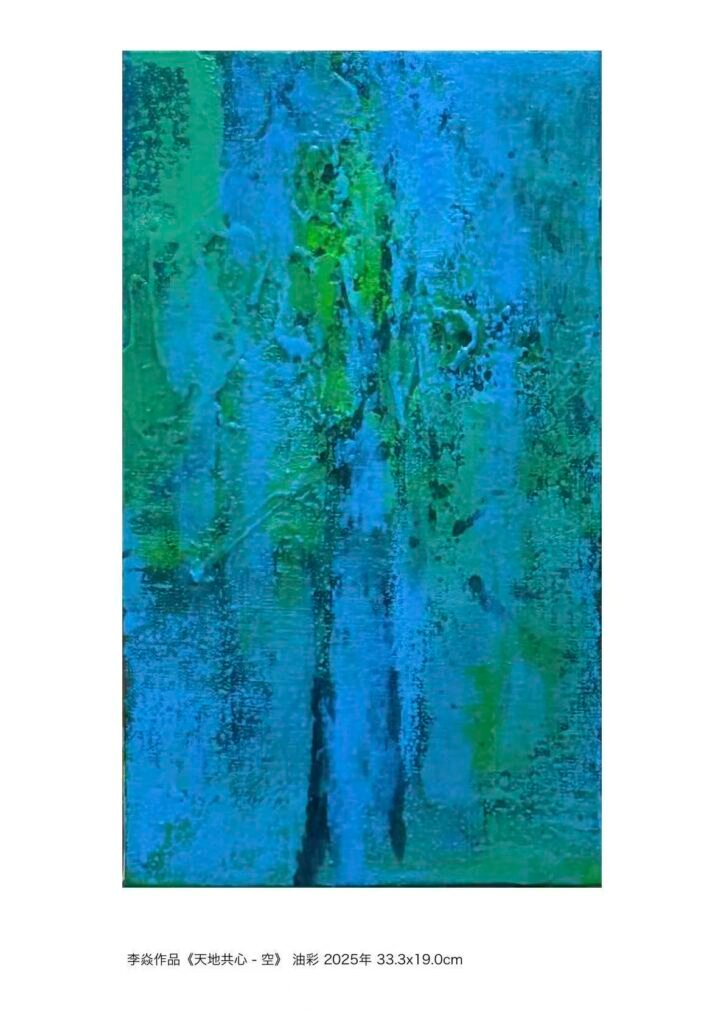
In Heaven and Earth Share One Heart—Emptiness, the composition is dominated by a vertical sense of movement. The blue-green space resembles a river of time and life. The downward-flowing traces carry memories and emotions, while also suggesting release and return.
Here, “emptiness” does not mean nothingness. It represents a state of expansiveness and freedom reached after passing beyond attachment.
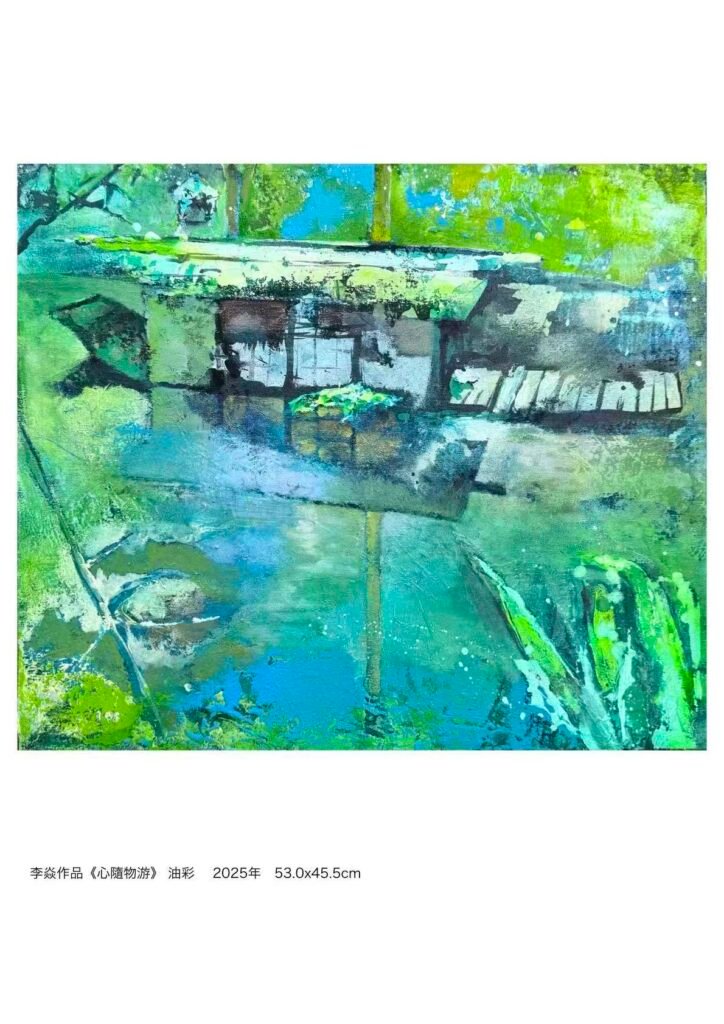
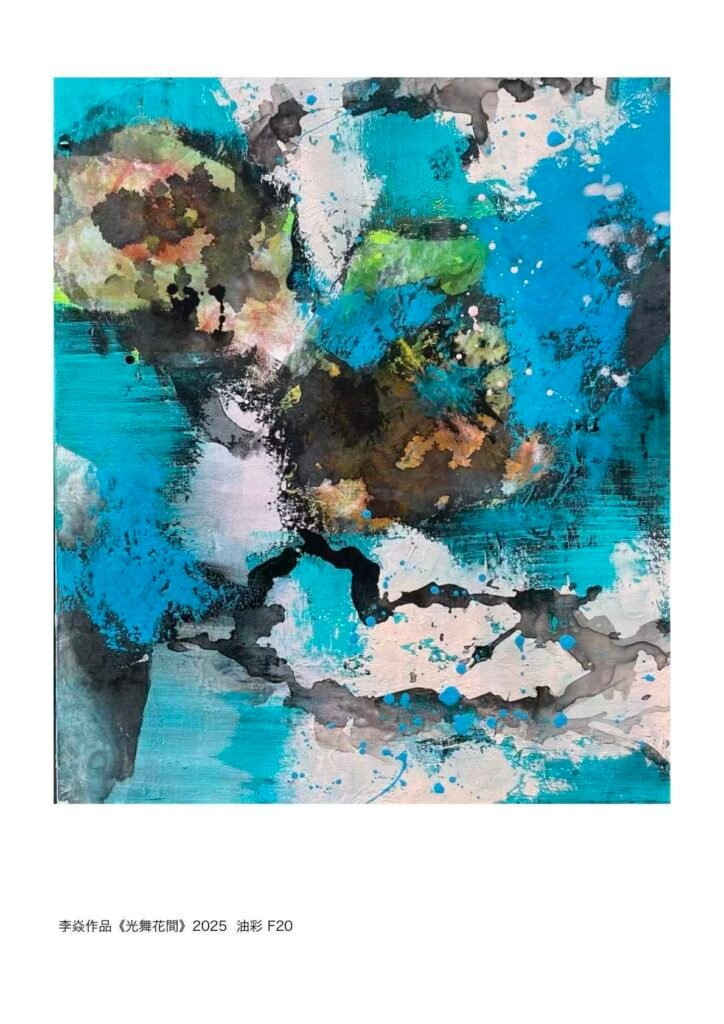
The Heart Wanders with All Things and Light Dancing Among Flowers contemplate the circulation and renewal of life through the countless manifestations of nature.
Light, colour and space continually emerge and transform. The works contain both a gaze directed toward time that has passed and a celebration of life’s continuity and rebirth.
In Heaven and Earth Without Bounds, the sky, the earth, reflections, light and space merge into one another. The boundaries within the composition gradually dissolve, producing an open and infinite cosmic consciousness.
Individual life no longer exists in isolation. Instead, it acquires new meaning through its interdependent relationship with all things.
Across Li Yan’s recent work, “heaven and earth,” “the heart,” “emptiness,” “light” and “life” appear repeatedly as central themes.
Works including Heaven and Earth Without Bounds, Heaven and Earth Share One Heart, Heart of Heaven, The Heart Wanders with All Things, Light Dancing Among Flowers and Radiance together form a clear spiritual trajectory.
Her concern is not simply the representation of natural scenery. It is an exploration of the essence of life and the order of the universe.
Within Li Yan’s artistic world, Eastern philosophy has long since moved beyond specific cultural symbols. It has been transformed into an open and contemporary visual language.
Using oil paint as her medium and the spirit of splash-ink as her foundation, Li establishes a distinctive creative connection between tradition and modernity, and between East and West. In doing so, she constructs an Eastern spiritual realm for contemporary people.
Within this realm lies a profound reverence for heaven, earth and nature, as well as a continuing inquiry into the origins of life. It offers both a place in which the individual spirit may find rest and an expansive vision of the interdependence of all living things.
Such an artistic practice is not merely an exploration of pictorial language. It is an ongoing meditation on life, existence and the spiritual world.