Behind RoboCup 2026: The Industrial “Temperature Gap” Among China, Japan and South Korea
By Li Da in Tokyo
INCHEON, South Korea, July 5 — RoboCup 2026, widely known as the “World Cup of Robot Soccer,” concluded in Incheon, South Korea. A total of 59 teams from 45 countries and regions competed in the humanoid robot divisions.
On the field, Tsinghua University’s Hephaestus Team, using a robot platform developed by Chinese robotics company Booster Robotics, defeated its opponent 6–2 to successfully defend its world championship title in the humanoid division.
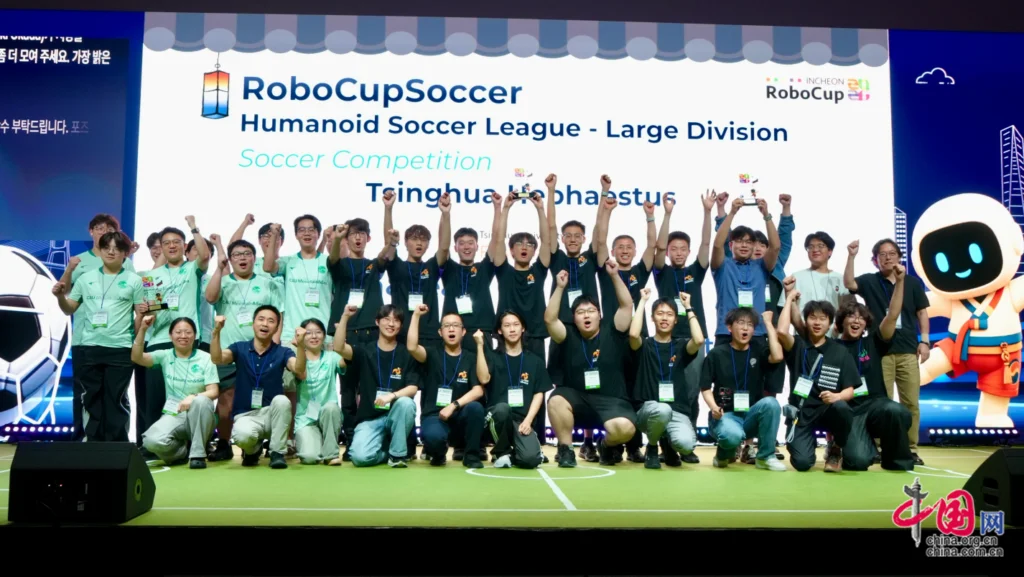
Members of Tsinghua University’s Hephaestus Team pose with the runners-up and third-place finishers in the AdultSize division.
More noteworthy than the championship itself was another set of figures from outside the competition: more than 70% of the robots used by participating teams were commercially available products supplied by Chinese companies such as Unitree Robotics and Booster Robotics.
Booster Robotics alone provided platforms to 38 participating teams, whose robots went on to win every gold medal across all bipedal humanoid categories.
On the same playing field, however, China, Japan and South Korea presented three strikingly different industrial pictures.
China: Building Not Only Hardware, but Platforms
In the past, almost every RoboCup team had to build its robot from scratch, devoting enormous amounts of time and energy to mechanical design and hardware development.
This year, however, the competition sent a clear industrial signal: a global consensus is rapidly emerging around the platform-based development of foundational hardware for embodied intelligence.
Participating teams are increasingly focusing their research on intelligence itself, while relying on mature platforms for robots’ basic physical capabilities. As a foundational platform provider, Booster Robotics has continued to improve its legged locomotion and motion-control technologies, allowing leading teams to concentrate on advanced algorithms such as visual perception, real-time decision-making and multi-agent coordination.
Oskar von Stryk, a professor at the Technical University of Darmstadt in Germany, commented after the competition: “Chinese robots are affordable and deliver excellent performance. Chinese companies are improving their robots at an exceptionally fast pace.”
Platform-based development has also lowered the barriers to entry. With the support of simulation and development tools, this year’s competition included a team from Pui Ching Middle School in Macao, whose members were among the youngest participants in the event.
From world-class laboratories to secondary-school teams, access to innovation in embodied intelligence is becoming increasingly open.
Behind China’s dominance on the field lies the strength of its industrial supply chain.
In the first quarter of 2026, China exported RMB 11.32 billion worth of robots of various types to 148 countries and regions. China is now home to more than 140 manufacturers of complete humanoid robots, with annual shipments reaching 14,400 units and accounting for 84.7% of the global market.
In other words, eight out of every ten humanoid robots shipped worldwide are made in China. Six Chinese companies, including Unitree Robotics and Booster Robotics, together account for 74.1% of global shipments.
Japan: The Absence of RoboCup’s Founding Country
RoboCup was founded in Japan’s Aichi Prefecture in 1997. Yet 28 years later, Japan maintained only a limited presence at the competition in Incheon.
Japan sent only one team to the MiddleSize humanoid division, with no Japanese teams participating in either the KidSize or AdultSize categories. Among the approximately 20 teams competing in the AdultSize division, not a single one came from Japan.
After watching the competition, Hiroyuki Okada, chairman of the RoboCup Japan Committee, identified the main reason: “a severe shortage of funding.”
The number of Japanese laboratories developing humanoid robots has continued to decline, while many research teams cannot afford to purchase commercially available robots.
Even the least expensive commercial robot available in Japan costs around JPY 2 million. Purchasing five robots for a team would therefore cost more than JPY 10 million. Once transportation and travel expenses are included, the total cost can exceed JPY 20 million.
Han Jae-kwon, a professor at Hanyang University in South Korea, lamented: “Japan was once my role model, but today Japanese researchers are almost nowhere to be seen at the competition.”
Japan’s absence was not an isolated occurrence.
The country continues to possess outstanding technological expertise in fields such as precision engineering, sensors and motors. However, its investment in artificial intelligence research and development has remained inadequate for years. Between 2019 and 2023, Japan’s AI investment amounted to less than one-thirtieth of that of the United States.
As competition in the robotics industry shifted from hardware alone toward integrated capabilities combining hardware, AI and software, Japan began to fall behind.
South Korea: A Gap Between the Host Nation’s Ambitions and Reality
As the host nation, South Korea had high expectations for RoboCup 2026. The government viewed the event as an important opportunity to demonstrate the country’s ambition to become a global powerhouse in AI and robotics.
At the policy level, South Korea has taken a series of steps. The government has announced three major “super projects” covering semiconductors, AI data centres, embodied intelligence and the robotics industry.
This year, South Korea’s Financial Services Commission plans to provide approximately KRW 16 trillion in financial support for sectors including artificial intelligence, robotics and future mobility.
The government also plans to invest KRW 50.4 billion by 2030 to establish an integrated research and development system covering core areas such as hardware, software, artificial intelligence and batteries.
The competition, however, exposed the gap between these ambitions and industrial reality. Even on home ground, no South Korean humanoid robot brand demonstrated a dominant presence.
Han Jae-kwon of Hanyang University pointed to the root of the problem: “South Korea’s domestic market is not particularly large. However, with government support, companies can develop technologies independently and generate revenue by selling their products overseas. The government must invest in new technologies.”
The cost disadvantage is even more severe.
Some analyses suggest that robotics investment in the Chinese city of Shenzhen alone, at approximately KRW 900 billion, already exceeds South Korea’s nationwide investment of around KRW 100 billion.
China reportedly accounts for as much as 86% of the global humanoid robot market, while South Korea holds only about 1%. A considerable gap remains between South Korea’s policy ambitions and its current industrial capabilities.
Industrial Lessons Beyond the Playing Field
Looking beyond the competition in Incheon, three trends are becoming increasingly clear.
First, humanoid robots are beginning to follow the same “China pathway” seen in the new-energy vehicle industry. Supported by a complete industrial supply chain, cost advantages and rapid product iteration, Chinese companies are evolving from followers into participants in setting the rules of the global industry.
In its latest report, Morgan Stanley forecasts that humanoid robot shipments in China will reach 446,000 units by 2030, representing a compound annual growth rate of 106% between 2025 and 2030.
Second, the hollowing-out of Japan’s robotics industry deserves close attention. Japan’s shift from a global industry leader to a near-absent participant at RoboCup illustrates the consequences of failing to keep pace with research investment and industrial ecosystem development during the critical transition from hardware-led competition to integrated hardware-software capabilities.
Third, although South Korea has strong policy ambitions, its limited domestic market and cost disadvantages mean it is unlikely to challenge China’s strength in robot hardware in the short term.
For China, however, one important question remains: can its cost advantages be sustainably transformed into technological barriers and greater brand value?
The next RoboCup will be held in Germany in 2027. A new event will be introduced in which humans and robots compete together as teams.
The competition will therefore evolve from a purely technological contest into a far more complex model of human-robot collaboration.