AI · Asia · Factories | At 10 pm, AI Chip Production Lines Are Still Racing Against the Clock
By Li Da in Tokyo
At 10 pm, an unremarkable factory building in the Bayan Lepas industrial zone of Penang, Malaysia, remains brightly lit.
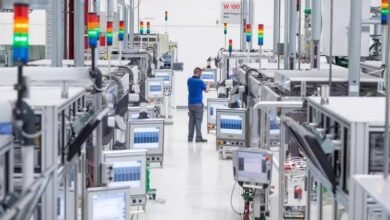
Through the second-floor windows, workers in cleanroom suits can be seen moving back and forth along the production line, while robotic arms rise and fall with precision beneath the fluorescent lights. In the distance, several trucks are still unloading cargo—another urgent batch of wafers waiting to be packaged.
Similar scenes are unfolding simultaneously across three Asian time zones: at semiconductor packaging plants in Malaysia, wafer fabrication facilities in South Korea and server assembly lines in Chengdu, China. Separated by thousands of kilometres, these production centres are being driven around the clock by the same force: artificial intelligence.
In the first half of 2026, the combined capital expenditure of Asian semiconductor manufacturers is expected to exceed US$136 billion, representing year-on-year growth of 25%. The money has been invested, the production lines are running and workers are putting in longer hours. This is the most tangible physical form of the AI boom beneath the cloud.
Penang, Malaysia: Three Shifts at the Packaging Plant
Inside the cleanroom of a semiconductor packaging and testing plant in Penang, workers rotate through three shifts while the equipment operates 24 hours a day. The packaging of high-bandwidth memory, or HBM, proceeds minute by minute. A delay in the delivery of even a single batch of chips could affect the launch schedule of an entire AI data centre.
Malaysia accounts for approximately one-eighth of the global semiconductor supply chain, with most of the country’s semiconductor companies concentrated in Penang. Long known as the “Silicon Valley of the East,” the state is now entering what local officials describe as the “Silicon Valley of the East 2.0” stage, gradually moving from contract manufacturing towards integrated-circuit design. Penang currently has 45 IC design companies in operation.
The intensity of demand can be seen in manufacturers’ order books. According to the Malaysia Semiconductor Industry Association, strong AI-related demand has already filled available capacity for certain memory products, with new orders scheduled as far ahead as 2028 or even 2029. The order book of local semiconductor equipment manufacturer UWC increased from less than 150 million Malaysian ringgit in 2024 to 180 million ringgit in 2025 and is expected to reach 250 million ringgit by mid-2026. The company has begun subcontracting part of its manufacturing operations to local suppliers and extending its production network into neighbouring countries.
Global semiconductor companies are also accelerating their investment in the region. In December 2025, Intel committed an additional 860 million ringgit, or approximately US$208 million, to expand its packaging and testing operations in Penang and Kulim, with the aim of making Malaysia a core global centre for Intel’s assembly and testing business.
In January 2026, low-power AI solutions provider Syntiant opened a new manufacturing and research-and-development campus in Penang. Covering approximately 220,000 square feet, the facility doubled the company’s annual production capacity to around 1.6 billion units and created 800 high-technology jobs.
In February, Taiwan-based display-driver IC packaging and testing company Chipbond Technology officially opened a new plant in Penang following an investment of approximately US$200 million. In June, Singapore-based Galatek Technologies established its first manufacturing, assembly and delivery centre in the state, with plans to increase its local investment to US$100 million over five years. Chinese semiconductor packaging and testing company Forehope Electronic has also announced plans to invest up to RMB2.1 billion in a Malaysian production base.
At night, Penang is illuminated by the lights of cleanrooms that never close. Every chip leaving these factories will eventually be installed in the computing core of an AI server somewhere in the world.
Giheung, South Korea: An Arms Race in Wafer Fabrication
At Samsung Electronics’ Giheung campus in Gyeonggi Province, plans are under way for a new DRAM wafer fabrication plant. In the existing production facilities nearby, lithography machines are etching circuits with nanometre-level precision. Each wafer carries the circuitry that will ultimately become the “brains” of tens of thousands of AI chips.
On July 15, 2026, The Korea Economic Daily, citing industry sources, reported that Samsung Electronics planned to construct a new DRAM plant at the Giheung campus. The facility is expected to have a monthly production capacity of approximately 100,000 wafers, with investment estimated at tens of trillions of won. Construction could begin as early as the third quarter of 2026.
The site had originally been designated for a research and development centre. Samsung later revised the land-use plan and decided to build a large-scale DRAM production line in response to the rapid growth in memory demand generated by AI computing infrastructure.
Giheung represents only one part of Samsung’s much larger semiconductor expansion. The company plans to build six wafer fabrication plants in the Yongin semiconductor cluster, which is intended to become a core manufacturing base for next-generation advanced processes and HBM products.
On July 12, Samsung announced that production at the first Yongin plant would begin in 2029, one to two years earlier than initially planned. The company is investing a combined KRW2,030 trillion in its Pyeongtaek and Yongin clusters, while also planning two new wafer fabrication plants in Gwangju with an additional investment of KRW400 trillion.
Samsung Foundry’s medium- and long-term order backlog has approached KRW50 trillion.
SK hynix is also expanding aggressively. In July 2026, the company disclosed plans to invest KRW100 trillion in additional production capacity in Cheongju, North Chungcheong Province.
In a written response issued on July 13, the Bank of Korea stated: “The semiconductor industry is continuing to expand, primarily because rapid investment in AI infrastructure is driving sustained growth in semiconductor demand, while the pace of supply expansion continues to lag behind demand.”
At night, the lights inside South Korea’s semiconductor cleanrooms never go out. Samsung’s KRW50 trillion order backlog is waiting to move through those facilities. Every wafer emerging from the production line represents another stake in the global race for AI computing power.
Chengdu: Accelerating the AI Server Assembly Line
Inside an AI server assembly plant in Chengdu, robotic arms and human workers operate alternately along the production line. GPU servers take shape rapidly before being packaged, loaded onto trucks and shipped overnight to AI computing centres across China.
Driven by the rapid expansion of the computing-power industry and rising demand for AI servers, a company in Chengdu’s Pidu District recorded a sharp increase in orders during the first quarter, keeping its production lines in continuous operation.
Chengdu pioneered China’s “computing-power voucher” programme and has already issued vouchers worth more than RMB20 million. Beginning in 2026, the city plans to distribute at least RMB100 million in computing-power vouchers every year, covering as much as 60% of eligible computing expenses.
Huaxia Kunpeng won the contract for Huawei’s Western Fulfilment Centre in 2022 and has since established ten final-assembly and testing lines producing Huawei servers, storage systems, network switches and other products.
Huakun Zhenyu has also opened its supply chain to local companies and reached preliminary cooperation agreements with more than ten Chengdu-based businesses in areas including storage products, integrated circuits and high-speed cables.
At night, workers on Chengdu’s server assembly lines are racing against time. Every delayed server delivery could mean a longer training cycle for an AI model.
Next in the Series
In the next report, “They Do Not Write Code, but AI Cannot Function Without Them,” we will introduce the key occupations supporting the AI hardware supply chain, including wafer engineers, packaging and testing technicians, server assembly workers and equipment maintenance specialists.