Central Asia’s Settlement Hub: Hong Kong or Hainan?
By Meng Linna in Kazakhstan
Economic and trade ties between Central Asia and China are deepening rapidly. In 2025, trade between China and Kyrgyzstan reached US$27.2 billion, up 20% year on year, while construction of the China–Kyrgyzstan–Uzbekistan railway entered a critical phase. With bilateral trade volumes continuing to rise, one question can no longer be avoided: where should the region’s settlement hub be located?
It is time to examine the numbers seriously.
Central Asia’s Settlement Hub: Hong Kong or Hainan?
In May 2026, Hong Kong Chief Executive John Lee led a delegation to Kazakhstan and Uzbekistan, accompanied by representatives of the Hong Kong Association of Banks.
At almost the same time, an investment-promotion delegation from the Hainan Free Trade Port presented its cross-border capital-flow policies to Central Asian companies at the China–Eurasia Expo in Urumqi.
Two of China’s most internationally open regions were reaching out to Central Asia almost simultaneously.
For Chinese companies engaged in trade, engineering and mining across Central Asia, this raises a practical question: should their settlement hub be based in Hong Kong or Hainan?
Hong Kong’s Core Strength: The World’s Leading Offshore Renminbi Centre
Hong Kong’s principal advantage lies in its irreplaceability.
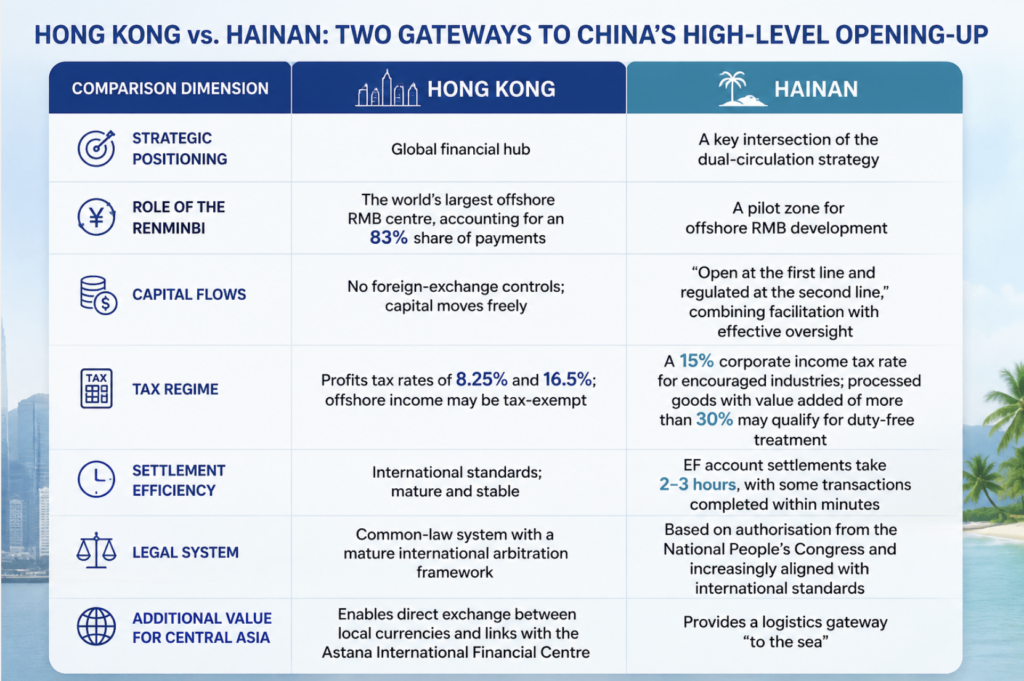
Around 83% of global offshore renminbi payments are processed through Hong Kong. At the beginning of 2026, the Hong Kong Monetary Authority doubled the total size of its RMB business funding arrangement from RMB100 billion to RMB200 billion. The number of participating banks increased to 40, with services extending across 11 countries.
Hong Kong Exchanges and Clearing is also working to become a direct participant in the Cross-border Interbank Payment System, or CIPS. This would allow future renminbi transactions to bypass intermediary banks, reducing costs and shortening settlement times.
For Central Asian companies, Hong Kong’s attraction lies in convenience. Sun Yu, chairman of the Hong Kong Association of Banks, has said that the city offers “a comprehensive renminbi financial infrastructure, the world’s most liquid offshore RMB market, and a full product ecosystem covering deposits, bonds, funds, derivatives, payments and settlement.”
In May, Bank of China (Hong Kong) signed its first strategic cooperation memorandum with a Kazakh sovereign institution, covering renminbi services, capital markets, financing and custody. The agreement marked a significant breakthrough in the bank’s financial cooperation with Kazakhstan.
During the same month, BOCHK also helped Kazakhstan’s national oil and gas company issue its first offshore renminbi bond, which was cleared through Hong Kong’s Central Moneymarkets Unit.
Chan Man, acting chairman of the Hong Kong Association of Banks, further proposed exploring direct trading and settlement arrangements in Hong Kong between Central Asian currencies and the renminbi.
Kazakhstan’s Astana International Financial Centre, or AIFC, operates under a common-law framework similar to that of Hong Kong, making institutional coordination relatively straightforward. In a recent interview, AIFC chairman Renat Bekturov described Kazakhstan as a gateway for Chinese companies expanding westwards.
China CITIC Bank, working through its global service network and Kazakhstan’s Altyn Bank, has also introduced a one-stop cross-border financial services package for Central Asia. The package integrates six major functions, including cross-border settlement, dedicated financing, exchange-rate hedging and services for less commonly traded currencies.
Hong Kong positions itself as a global financial hub, serving international capital allocation, cross-border settlement and legal arbitration. Choosing Hong Kong means gaining direct access to the global financial system.
Hainan’s Advantage: Policy Dividends After Island-Wide Customs Operations
Hainan’s main advantage lies in institutional innovation.
Following the launch of island-wide independent customs operations at the Hainan Free Trade Port in 2026, its defining policies have been “zero tariffs, low tax rates” and greater facilitation of cross-border capital flows.
Within six months, the total value of transactions conducted through Hainan’s EF accounts—multi-functional free trade accounts—exceeded RMB600 billion, with capital flows reaching 105 countries and regions. So far, 13 banks across the province have launched EF account services, and more than 1,200 accounts have been opened.
For companies, Hainan’s most immediate benefits can be measured in three areas.
Speed
Through fully online EF account procedures, cross-border settlement times have been reduced from one or two working days to two or three hours, with some transactions completed within minutes.
The experience of a cross-border energy trading company is representative. Because the company handles frequent import and export transactions with strict time requirements, opening an EF account reduced its processing time from one or two working days to just two or three hours.
Convenience
Companies inside the free trade port can complete current-account receipts and payments with overseas parties by submitting payment instructions alone. With the exception of securities investment, capital-account activities such as overseas lending and foreign borrowing are not subject to quotas or prior filing requirements.
Aosika Grain and Oil was among the first companies to use the system. On December 18, 2025, the day island-wide customs operations began, the company completed the free trade port’s first EF account transfer across the “second line” between accounts held under different names.
The transaction demonstrated a new cross-border settlement model built around “one account, multiple scenarios and unlimited possibilities.”
According to the company, sales revenue from outside the free trade port can now be credited directly, while payments can be made through online banking, significantly improving the efficiency of capital circulation.
Cost
Companies operating in encouraged industries are eligible for a 15% corporate income tax rate. The effective individual income tax burden for high-end and urgently needed professionals is also capped at 15%.
For Central Asian companies, Hainan offers another distinctive benefit: access to the sea.
Kazakhstan’s SCAT Airlines has launched a Sanya–Prague passenger route under seventh-freedom traffic rights, the first such route in China. Through Hainan, landlocked Central Asian countries are gaining a maritime interface connecting them with the South China Sea and Southeast Asia.
Hainan is positioned as an intersection of China’s domestic and international economic circulation, with a focus on supporting the real economy and reducing trade costs.
How Should Companies Choose?
The answer depends on the nature of the business.
For companies whose operations are primarily settled in renminbi, Hong Kong is the natural choice. Its 83% share of global offshore RMB payments translates into advantages in liquidity, efficiency and cost that Hainan cannot replicate in the near term.
The decision by Jiaxin International Resources is particularly illustrative. The company, which is involved in tungsten mining in Kazakhstan, chose in August 2025 to pursue a simultaneous listing on the Hong Kong Stock Exchange and the Astana International Exchange.It became the world’s first simultaneous listing in Hong Kong and Kazakhstan, as well as the first renminbi-denominated stock in Central Asia. For resource companies with substantial financing needs, the depth of Hong Kong’s capital markets and its renminbi liquidity remain difficult to replace.
For companies seeking lower taxes and closer access to the Chinese mainland market, Hainan may be more attractive. Its 15% corporate income tax rate and tariff exemptions for goods meeting processing value-added requirements offer tangible benefits to trading and manufacturing companies.
CATL has already acted on this opportunity. In July 2026, the battery manufacturer established a cross-border treasury management centre in the Haikou Comprehensive Bonded Zone. Using EF accounts, the company can centralise and flexibly allocate cross-border funds.
The decision by one of the world’s largest battery manufacturers to use Hainan as a core platform for its global treasury operations sends a clear signal.
For businesses involving multiple currencies, Hong Kong is better suited. The absence of foreign-exchange controls and the free convertibility of currencies are basic requirements for international settlement.
For smaller companies whose business is mainly focused on trade with China, Hainan’s EF account system may be sufficient, while offering lower operating costs.
Hong Kong and Hainan should not necessarily be viewed as competitors in a winner-takes-all contest. Some companies have adopted a model in which contracts and settlements are handled through Hong Kong, while processing and production are located in Hainan to benefit from zero tariffs and preferential tax rates.
That may ultimately be the most efficient solution.
For the Central Asian market, Hong Kong provides a financial channel, while Hainan provides logistics and policy channels. Each serves a different purpose.Ultimately, the calculation comes down to one principle:
Where the money goes depends on where the money needs to go.