Northeast China’s Painful Gear Shift
By Jiuri in Tokyo
In the first half of 2026, China’s regional economic data once again placed the three northeastern provinces near the bottom of the growth rankings. Liaoning expanded by 2.5%, Jilin by 2.4% and Heilongjiang by 3.5%, all below the national average.
The figures themselves are hardly surprising. The more important question is this: why has a region that has spent more than two decades pursuing “revitalisation” still struggled to escape low growth?
Seen from a broader perspective, Northeast China is hardly unique. From Japan’s Kitakyushu to Germany’s Ruhr region, old industrial bases around the world have faced the same challenge: when traditional industries lose momentum but new industries are not yet strong enough to take their place, how does a region survive the long and painful period of transition in between?
Where the Pain Comes From
Three Overlapping Declines, Three Paths of Transition
Liang Qidong, a professor at Liaoning University, has described Northeast China’s predicament in straightforward terms: the region is facing “three overlapping declines”—resource-based decline, structural decline and institutional decline.
In simpler terms, coal and oil resources are no longer what they once were, heavy industry remains disproportionately dominant while light industry is underdeveloped, state-owned enterprises are slow to transform, and private companies have yet to fully fill the gap.
The three provinces are suffering in different ways.
Liaoning: The Pain of Turning a Giant Ship
Liaoning’s GDP reached RMB1.62272 trillion in the first half of the year, accounting for roughly half of Northeast China’s economy, yet growth was only 2.5%.
A closer look reveals a contradictory picture. Value added by industrial enterprises above designated size fell 0.7% year on year, mining declined 6.8%, and automobile manufacturing dropped 7.3%.
Yet another set of figures tells a different story. High-tech manufacturing value added increased by 1.7%. Railway, shipbuilding, aerospace and other transport-equipment manufacturing surged by 43.5%. Output of civilian steel ships rose 2.8-fold, while integrated-circuit production increased by 40.5%.
The old economy is shrinking, while the new economy is growing—but the new sectors are not yet large enough to fill the gap left behind.
Changes in Liaoning’s industrial structure are equally telling. The secondary sector generated RMB534.39 billion, down 1.3%, while the tertiary sector reached RMB986.42 billion, up 4.7%. Services accounted for more than 60% of GDP for the first time.
Liaoning is undergoing a structural gear shift from an economy dominated by industry to one increasingly led by services. Per capita disposable income reached RMB22,278 in the first half of the year, up 4.4%—faster than GDP growth.
Jilin: An Economy Tied Too Closely to FAW
Jilin recorded GDP of RMB697.882 billion in the first half of the year, growing by just 2.4%, the second-lowest rate nationwide.
Jilin’s problem is particularly representative: much of the province’s economic lifeline is tied to a single company. When FAW catches a cold, Changchun feels the fever.
Value added in Jilin’s secondary sector fell 2.1% in the first half, largely because of weakness across the automotive supply chain. With new-energy vehicles already accounting for more than 40% of China’s automotive market, FAW has been relatively slow in its transition to electrification.
Yet Jilin has some overlooked bright spots. Services accounted for more than 50% of the economy for the first time.
Changchun has seen a growing number of cafés, cultural and creative parks, and camping businesses in recent years, and consumer activity has been more vibrant than the industrial sector. But average spending remains limited. Young people may be willing to pay for a cup of coffee, while many remain cautious about major purchases such as homes and cars.
Heilongjiang: Acceleration from a Low Base
Heilongjiang posted the fastest growth of the three northeastern provinces, at 3.5%.
The reason is straightforward: a relatively low base.
Its GDP reached only RMB738.99 billion in the first half of the year, less than half that of Liaoning. The contribution of winter tourism, green food processing and trade with Russia is therefore more visible against such a smaller economic base. Value added in the tertiary sector rose 4.4%, accounting for more than 65% of the provincial economy.
But Heilongjiang’s weakness is equally clear: the secondary sector grew by only 1.6%.
Manufacturing has yet to gain sufficient momentum. Tourism and restaurants alone cannot support the industrial transformation of an entire province.
The three provinces suffer in different ways, but the underlying challenge is the same: a systemic transition from dependence on traditional heavy industry towards growth driven by new productive forces.
This is not simply a matter of replacing one industry with another. It requires the coordinated restructuring of institutions, industrial structure, openness and the talent ecosystem.
Others Have Suffered the Same Illness
Lessons from Kitakyushu and the Ruhr
Northeast China is not alone. Old industrial regions around the world have travelled similar paths.
Japan’s Kitakyushu: From a “Polluted City” to an “Environmental City”
Kitakyushu was once one of Japan’s four major industrial centres, built around steel, chemicals and coal.
In the 1970s, as heavy industry declined, the city faced problems remarkably similar to those confronting Northeast China today: factory closures, rising unemployment and urban contraction.
Kitakyushu’s answer was to turn its past into an asset.
Closed mines were not simply abandoned. Some were transformed into tourism attractions and educational facilities. Existing industrial technologies were not discarded, but redirected towards environmental protection and recycling.
Government, companies, universities and local residents participated in environmental restoration, gradually transforming Kitakyushu’s image from a “city of pollution” into a “city of environmental innovation.”
Within about two decades, the city moved from severe environmental crisis to international recognition for environmental improvement.
Today, Kitakyushu is once again reshaping its role in global supply chains, this time through semiconductors and green manufacturing.
The city, with a population of roughly 900,000, is home to more than 1,100 manufacturing companies. Built around the Kitakyushu Semiconductor Network, 156 companies are now involved in the local semiconductor ecosystem, with more than 100 companies participating in the broader semiconductor cluster.
Since taking office, Kitakyushu Mayor Kazuhisa Takeuchi has overseen investment-attraction results in two years that exceeded those of the previous 14 years combined.
From a “steel city” to a base for semiconductors and green supply chains, Kitakyushu has spent roughly two decades reconstructing its industrial identity.
Its lesson is clear: transformation does not necessarily mean tearing everything down and starting again. It can mean upgrading in place, connecting the technologies, facilities and skilled workers accumulated by old industries with new ones.
Germany’s Ruhr: From Coal and Steel to Culture
Germany’s Ruhr region took another path.
At the heart of its transformation was the construction of a new collective memory.
Rather than simply eliminating coal and steel, the Ruhr upgraded its industrial base through technological change and movement up the value chain, creating a modern industrial cluster supported by advanced materials and industrial services.
At the same time, it explored the public value of its industrial heritage across culture, art, science education, leisure, tourism, commerce and ecology. Old factories became museums. Former mining areas became parks.
One of the most representative examples is the redevelopment of a former coal-washing plant. The massive industrial building was converted into a core exhibition area of the Ruhr Museum, while much of its original production structure and conveyor equipment was preserved.
More than 6,000 exhibits now tell the story of the Ruhr’s transformation from an industrial powerhouse into a centre of culture and tourism.
Today, 25 major industrial-heritage “anchor sites” are linked into a regional network attracting around seven million visitors a year, turning abandoned industrial areas into spaces for culture and leisure.
The Ruhr’s lesson is different but equally important: transformation does not mean saying goodbye to the past. It can mean retelling the past in a new way, turning industrial heritage into a new identity for the city.
Possible Remedies
What Northeast China Is Already Doing
The experiences of Kitakyushu and the Ruhr point in the same direction: transformation is not about throwing away the old. It is about allowing something new to grow from it.
Northeast China’s new economy is also beginning to emerge from the soil of its old industrial base.
First: Let the Market Play a Bigger Role and Give Private Companies Room to Grow
The most fundamental difference between Northeast China and the more developed southern provinces lies not simply in natural resources, but in the depth of the private economy.
In many prosperous southern provinces, private companies contribute roughly 70% of GDP and 80% of employment. In the Northeast, state-owned enterprises remain disproportionately large, while the roots of the private sector remain relatively shallow.
A healthy economy cannot depend only on a handful of large companies. It needs a broad base of small and medium-sized enterprises, individual businesses and entrepreneurs.
Change is beginning to emerge.
In the first half of 2026, Liaoning signed 475 investment projects each worth more than RMB100 million, with total planned investment of RMB267.37 billion.
The number of private technology companies in Shenyang is increasing. Dalian’s software outsourcing sector is recovering, while private companies in Changchun are beginning to move further upstream and downstream in the automotive supply chain.
The changes remain modest, but the direction is significant: from a situation in which “nothing grows beneath the giant tree” to one in which the giant tree can eventually support an entire forest.
Second: Let Old Trees Grow New Shoots
Northeast China’s transformation is often misunderstood as a process of abandoning old industries and starting from scratch.
In reality, the most effective transformations are those that allow new industries to emerge from existing industrial foundations.
Shenyang’s robotics industry is one example.
SIASUN Robot & Automation is often regarded as one of the cradles of China’s robotics industry, and its technological foundations come directly from decades of equipment-manufacturing expertise accumulated in the Northeast.
Shenyang’s aerospace city project, with planned investment exceeding RMB60 billion, is similarly built on decades of supporting capabilities in the aviation and aerospace industries.
Changchun’s rail-transit equipment is exported to Europe. Jilin’s carbon-fibre industry rests on an existing chemical-industry base.
Ansteel, Bensteel, FAW and Shenyang Aircraft Corporation have not disappeared. They are continuing to exist in new forms.
Third: Open the Window and Let the Wind In
One of Northeast China’s longstanding problems has been its relative inwardness.
For years, economic development was often pursued within a relatively closed regional system. The result was growing isolation.
That is beginning to change.
With deeper China-Russia economic cooperation and the Belt and Road Initiative, Northeast China is gradually shifting from an inward-looking region into a frontier for northward opening.
Cross-border logistics through ports such as Manzhouli and Heihe have expanded rapidly, while Heilongjiang’s trade with Russia provides another indication of the shift.
Harbin’s ice-and-snow economy represents a different route.
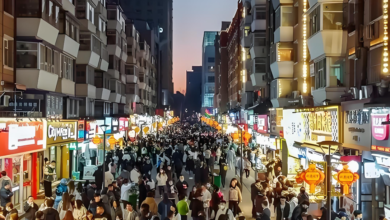
During the 2025–2026 winter season, Central Street received more than 400,000 visitors per day on average.
Ice and snow are not traditional industries, but they are distinctive resources that Northeast China possesses—and ones that other regions cannot easily replicate.
Fourth: Give People a Reason to Stay
The Northeast’s most painful problem is not its GDP growth rate. It is the continued departure of people.
That cannot be solved through slogans. Young people need to see a reason to stay.
Shenyang’s aerospace sector, Dalian’s software outsourcing industry, Changchun’s optoelectronics and information industries, and Harbin’s cold-region scientific research are gradually developing their own ecosystems.
If Northeast China can provide jobs in these fields that are both respectable and offer credible long-term prospects, people may begin to stay—or return.
Kitakyushu spent two decades transforming itself from a “polluted city” into an “environmental city.”
The Ruhr has spent half a century transforming itself, and the process is still continuing. Factories have become museums, mines have become parks, and industrial heritage has become a new urban identity.
How long will Northeast China need?No one knows.
But the direction is clearer than it has been in years.
Liaoning’s shipbuilding, Jilin’s carbon fibre and Heilongjiang’s ice-and-snow economy did not appear from nowhere. They grew out of the Northeast’s own industrial and geographic foundations.
The region is gradually becoming a new version of itself rather than trying to become another southern province.Changing gears is never instantaneous.
The engine is still running. The wheels are still turning.The transition may be slow, but the direction is becoming clearer.