Southeast Asia’s AI Infrastructure Race: Who Is Pulling Ahead, and Who Is Catching Up?
By Li Da in Tokyo
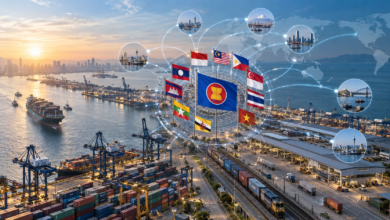
Southeast Asia’s AI infrastructure race is accelerating, but the real contest is no longer just about chips or server capacity. Increasingly, it is about three harder constraints: power, water and talent.
In August 2026, Malaysia approved what was described as Southeast Asia’s first AI data center project. The approval came with an important condition: the project must meet specific standards for electricity and water efficiency.
That condition captured the challenge facing the whole region.
IDC has raised its forecast for global AI infrastructure spending in 2026 to $497 billion, up nearly 56% year on year. Southeast Asia is emerging as one of the fastest-growing beneficiaries. Regional computing capacity has already surpassed 4.4GW, while Johor in Malaysia, Greater Bangkok and Batam in Indonesia are becoming major data-center and cloud-computing clusters.
But this is not one race on one track. Each country is betting on a different role.
Singapore is trying to set the rules. Malaysia is building scale. Thailand and Indonesia are racing to absorb new capacity. Vietnam is laying the regulatory and talent foundations.
Singapore and Malaysia: The Early Leaders
Singapore’s strategy is clear: rather than becoming a giant power-hungry computing base, it wants to lead in AI governance, research and resource efficiency.
In January 2026, Singapore announced more than S$1 billion in public AI research funding over five years, focusing on basic research, applied AI and talent development.
The emphasis reflects the city-state’s physical limits. Singapore already has around 70 data centers, making it one of the densest markets in Asia-Pacific. But land, power and water are all constrained, while electricity costs remain high.
Minister for Digital Development and Information Josephine Teo has noted that AI training consumes enormous amounts of energy and water, making further expansion something Singapore must approach carefully.
Malaysia is absorbing much of the capacity Singapore cannot accommodate.
Johor, just across the border, has rapidly become one of Southeast Asia’s most important data-center hubs. By the first quarter of 2026, Johor and Selangor had attracted 59 data-center investment projects, with combined power demand reaching 8.3GW.
Major investors include Oracle, AWS, Nvidia, ByteDance and Google, with announced projects worth billions of dollars.
Malaysia’s appeal lies in lower construction costs, favorable tax treatment and proximity to Singapore. Capital markets are responding as well. In August 2026, foreign investors poured $3.9 billion into Malaysian bonds, the largest monthly net inflow since records began in 2016.
RBC Capital Markets strategist Abbas Keshvani described Malaysia as one of the winners of the AI boom, citing both export growth and stronger foreign investment inflows.
But the country’s rapid expansion is also creating new pressure. In the first half of 2026, about MYR95.8 billion, or roughly 44% of approved investment, went into data centers and cloud-computing projects.
Malaysia is increasingly becoming Southeast Asia’s “computing factory” — and that scale is starting to test its power and water systems.
Thailand and Indonesia: The Fast Followers
Thailand is becoming one of the region’s fastest-moving latecomers.
On May 6, 2026, the Thailand Board of Investment approved six major projects worth a combined $29 billion. The largest came from TikTok System (Thailand), with planned investment of around THB842 billion, or roughly $25 billion, to expand data storage and processing infrastructure in Bangkok, Samut Prakan and Chachoengsao.
Thailand’s data-center market is growing at a compound annual rate of about 27.8%. The market was worth around $1.44 billion in 2025 and is projected to reach $6.28 billion by 2031.
The Eastern Economic Corridor is also emerging as a major expansion zone, with planned and under-construction capacity expected to reach nearly 150MW by 2028.
Indonesia is taking a different route: becoming an offshore computing base.
On Batam, just across the sea from Singapore, Nvidia and Australia’s Firmus Technologies are developing a liquid-cooled AI facility with planned power capacity of 360MW and as many as 170,000 GPUs.
Firmus has said the project could generate $25 billion to $30 billion in revenue over its first six years, based on existing customer commitments.
Batam’s appeal is similar to Johor’s: it sits close to Singapore but offers more room for large-scale infrastructure. Indonesia’s role is therefore shifting from a traditional resource supplier toward a regional provider of digital and computing infrastructure.
Vietnam: Regulation First
Vietnam is not yet a major player in raw computing capacity, but it has moved faster in building an AI regulatory framework.
In December 2025, Vietnam passed its first national Artificial Intelligence Law, which took effect on March 1, 2026. The law places human oversight at the center of AI governance and allows the state to invest in a national AI computing center.
It also calls for a long-term national AI talent strategy and for basic AI education to be incorporated into the school system.
Vietnam’s current advantage lies in its relatively large pool of lower-cost digital talent. It is already active in data labeling, model fine-tuning and AI outsourcing services.
Its weakness is original model development and large-scale infrastructure.
That puts Vietnam in a “regulation first” position. The rules will not create computing capacity overnight, but they can help attract investment later — just as data centers need electricity, AI industries also need predictable governance.
The Shared Bottleneck: Power and Water
No matter which group a country belongs to, the same constraints are becoming unavoidable.
Power is the first bottleneck.
Thailand reportedly has around 10GW of data-center projects waiting for grid connections, while approval times are approaching two years. Transformer delivery times can also stretch to around two years.
Thailand’s electricity authorities have therefore begun upgrading transmission infrastructure, with projects worth roughly THB31 billion.
Malaysia is already applying stricter standards. In Johor, projects that fail to meet electricity and water-efficiency requirements have been delayed or rejected.
Water may become an even tighter constraint.
AI servers operate around the clock and require intensive cooling. In water-stressed markets such as Singapore and Johor, that creates a second resource problem alongside electricity.
Singapore’s PUB has introduced a water-efficiency threshold for new data centers, requiring a water usage effectiveness level of 1.2 or below for approval.
The scale gap is also significant. China consumes more than 10 trillion kWh of electricity a year, while Thailand uses only around 210 billion kWh and Malaysia around 170 billion kWh.
That means Southeast Asia’s power systems are being asked to support AI infrastructure at a pace that many grids were not originally designed for.
Bain surveys show that 90% of operators see grid-connection delays as their biggest constraint, and many are willing to pay a premium for guaranteed power access.
Talent Is the Second Constraint
The other major shortage is skilled labor.
Singapore’s data-center sector currently supports only around 7,000 high-value jobs, but demand is expected to nearly triple by 2030.
Malaysia faces a severe engineering talent shortage and also loses skilled workers to higher-paying jobs in Singapore.
Thailand has a growing base of software and AI graduates, but experienced specialists in high-density facilities, advanced cooling systems and power engineering remain scarce.
Training initiatives are beginning to emerge. BDx Data Centers and Singapore’s Institute of Technical Education, for example, have launched a dedicated training program for data-center and AI-infrastructure talent.
But such programs remain small compared with the speed of investment growth.
Who Will Win?
The final winner in Southeast Asia’s AI infrastructure race will not be the country that builds the most data centers.
It will be the country that solves power, water and talent first.
Singapore is ahead in rules and research, but has limited room for massive capacity expansion. Malaysia is leading on scale and speed, but resource constraints are becoming a ceiling. Thailand and Indonesia are absorbing spillover demand, but their grid upgrades will determine how far they can go. Vietnam is investing early in regulation and talent, but still needs time to build stronger infrastructure and original AI capabilities.
Southeast Asia is one of the world’s fastest-growing AI infrastructure markets, but also one of the most fragile.
The race for land is already well advanced.
The harder race — for electricity, water and skilled people — is only beginning.