Hong Kong as an “International Rules Interface”: From Serving Chinese Companies to Serving Global Business
By Wan Ge in Tokyo
The 11th Belt and Road Summit, which concluded in Hong Kong on September 10, introduced a new “GoGlobal Chapter” and a dedicated GoGlobal Connect service zone for the first time. The zone brought together Hong Kong professional service providers in legal, accounting, finance, risk management and consulting, offering one-stop support for companies seeking to expand overseas. During the forum, mainland Chinese company TIRAIN Science & Technology from Shaanxi signed a memorandum of understanding with Deloitte Advisory (Hong Kong). TIRAIN President Chen Li said the company hoped to combine its technology and product strengths with Deloitte’s global support to ensure compliant operations, maintain credibility and strengthen its competitiveness in overseas markets.
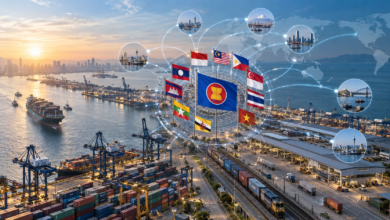
At first glance, the new chapter may look like a platform designed mainly to help mainland Chinese companies “go global.” But its services are not limited to Chinese companies. More than 6,200 political and business representatives from over 70 countries and regions attended the summit, over 300 investment projects were showcased, and more than 60 memoranda and agreements were concluded. The professional services gathered in the GoGlobal Connect zone are aimed at any company seeking to enter Asian markets or expand globally from Asia, whether from mainland China, Central Asia, the Middle East or Europe. Hong Kong is therefore not simply helping Chinese companies go overseas; it is trying to become an international rules interface for companies crossing market and regulatory boundaries.
A Rules Interface: IOMed’s First Case
One of the clearest examples is the International Organization for Mediation (IOMed). In October 2025, the world’s first intergovernmental organization dedicated specifically to resolving international disputes through mediation was formally inaugurated in Hong Kong. By May 2026, the number of signatory states had increased from 33 to 42, with 13 becoming contracting states. That same month, IOMed successfully resolved its first international maritime dispute involving parties from mainland China and Singapore. The parties reached a written settlement covering the entire charter-party chain, even though one side came from Singapore, a non-signatory state.
IOMed Secretary-General Teresa Cheng Yeuk-wah said mediation focuses on reaching a mutually accepted settlement rather than determining right or wrong, while accommodating differences between Eastern and Western cultures. For companies, the implication is practical: a Central Asian company and a Middle Eastern company involved in a commercial dispute may not need to spend years in arbitration in London or New York, while a European unicorn entering ASEAN can use Hong Kong’s common-law system as a reference for contract design and dispute prevention. Hong Kong is not offering “one side’s law,” but a rules-conversion interface that different parties can use.
A Capital Interface: Corporate Treasury and 57 Tax Agreements
Rules determine how business is conducted; capital determines how money moves. In June 2026, the Hong Kong SAR Government released the Action Plan on the Development of Corporate Treasury Centres in Hong Kong, which aims to position the city as a strategic base for mainland companies expanding overseas and as a gateway for overseas companies entering mainland China and wider Asian markets. One key measure is the continued expansion of Hong Kong’s network of Comprehensive Double Taxation Agreements (DTAs).
By April 2026, Hong Kong had signed 57 comprehensive DTAs, of which 51 had entered into force. New agreements signed in 2026 included those with Kyrgyzstan, Barbados, Norway and Türkiye. For multinational companies, this network allows a corporate treasury center in Hong Kong to allocate funds, manage assets and control risks across multiple jurisdictions with more predictable tax costs. For a company operating simultaneously in mainland China, ASEAN and Central Asia, Hong Kong is therefore not simply a low-tax location, but a hub connecting different tax systems through treaty networks.
A Market Interface: An Asian Base for Unicorns
Beyond rules and capital lies another practical question: where should companies place their regional headquarters? At the Global Unicorn Summit in August 2026, Stephen Philips, vice chairman of the Global Unicorn Association, said Hong Kong is “an excellent place for unicorn companies from anywhere in the world to grow.” He stressed that the city’s advantage lies not only in fundraising, but also in market access: Hong Kong sits at the center of Asia, is part of China, lies close to ASEAN, and is increasingly connected with Central Asia, the Middle East, Africa and Latin America.
Recent figures from Hong Kong’s Office for Attracting Strategic Enterprises show that among more than 120 strategic enterprises attracted to the city, 76 have established global or regional headquarters in Hong Kong, while 89 have established or are building R&D centers. Around half are overseas companies, covering sectors including life and health technology, AI, fintech and advanced manufacturing. U.S. pharmaceutical company Pfizer, for example, cited Hong Kong’s world-class universities, R&D talent and innovative drug-registration mechanisms such as the “1+” mechanism as reasons for choosing the city. The attraction is therefore not simply that Hong Kong is a “window to China,” but that its own institutional capabilities are encouraging companies to place regional decision-making functions there.
From a Springboard for Chinese Companies to an Interface for Global Business
This brings the discussion back to the GoGlobal Chapter. If it is viewed only as a platform helping mainland companies expand overseas, it looks like a one-way service. But in a broader context, it is designed for all companies that need to cross regulatory and market boundaries. Chinese companies may need to enter Central Asia, the Middle East and ASEAN; Central Asian companies may need access to China and Southeast Asia; European companies may need a base for entering Asian markets.
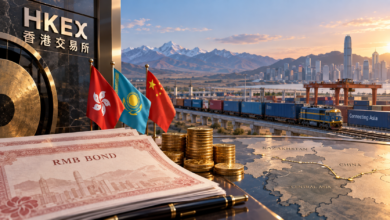
In an interview in June 2026, Ding Meng, chief economist at CITIC Bank International, described Hong Kong’s evolving role as “Super Connector 2.0”, moving away from a one-way channel toward a two-way hub connecting mainland China and the world. He emphasized that Hong Kong is “not simply an intermediary.” Its common-law system, lack of foreign-exchange controls, multilingual and cross-cultural capabilities, and international professional-services ecosystem are not relics of an earlier era, but tools for a new one. Central Asia already provides examples: the Development Bank of Kazakhstan issued RMB3.7 billion in dim sum bonds in Hong Kong, Uzbekistan’s state-owned Asakabank secured an RMB770 million syndicated loan arranged by Standard Chartered, and the Tamchy special zone has been positioned as a potential “Singapore of Central Asia.” These are not stories about Chinese companies going abroad, but examples of Central Asian economies using Hong Kong’s financial and regulatory systems to connect with global markets.
Commentary | This Is What Hong Kong Should Be
When a Kyrgyz company issues bonds in Hong Kong, it connects with international investors. When a German unicorn establishes its Asian headquarters in the city, it can access both mainland China and ASEAN. When a Middle Eastern sovereign wealth fund allocates assets in Asia, it connects with Hong Kong’s asset-management ecosystem.
From dim sum bonds and IPOs to the Central Asia Chapter and IOMed, from an RMB770 million syndicated loan to more than 120 global companies establishing a presence in Hong Kong, the city is offering more than a route into a single market. It is offering an interface to multiple markets. A gateway connects two points; an interface connects multiple systems. Hong Kong can act as a converter, translating differences in markets, rules, currencies and business cultures into a language that allows companies to trade, invest and cooperate. That is what global companies need when crossing regulatory boundaries, and that is what Hong Kong is increasingly trying to become: not only a springboard for Chinese companies going overseas, but an international rules interface for global business.