Eleven Works Piece Together a China Seen by Overseas Chinese Media
2026 Overseas Chinese Media AI China Competition Awards Held in Zhengzhou
By Fu Tianmengshi and Tian Mingfeng in Zhengzhou
On November 26, the awards ceremony for the 2026 Overseas Chinese Media AI China Works Competition, jointly organized by Hong Kong Ta Kung Wen Wei Media Group and the Overseas Chinese Media Cooperation Organization, was held in Zhengzhou, Henan Province.
The competition was launched in Changsha last August and invited submissions from Chinese-language media professionals and young creators around the world. Participants were encouraged to create works using formats such as film, animation and short video, with a total of 11 works ultimately receiving awards. Together, the entries responded to one central question: when AI becomes a creative tool, how can overseas Chinese media use it to present a more authentic and multidimensional China?

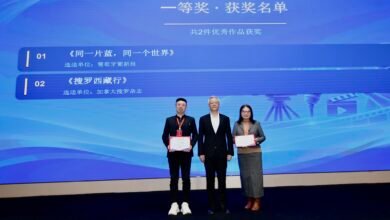
The award-winning works came from Chinese-language media organizations across a wide range of countries and regions. Same Blue Sky by Jornal Sino and Souluo’s Journey to Tibet by Canada’s Souluo Magazine won first prizes. Poems of Taiwan — Memories of the Treasure Island Through a Millennium of Literary Heritage by Zhonghua Weishi, Across Mountains and Seas, We Finally Found Home by Australia’s Radio2000, and AI Time-Travel Guide: When the Alps Meet the Digital East by Germany’s Kaiyuan were awarded second prizes. Works submitted by World Chinese Weekly in South Korea, Global Chinese Press in Canada, Australia Chinese TV Media, Thailand’s Jinghua Zhongyuan United Daily, New World Times in the United States, and Japan Overseas Student News received third prizes.
The award-winning entries used AI in different ways, but they shared one common feature: AI did not replace the creators’ judgment. Instead, it was used to achieve forms of expression that would have been difficult to accomplish through traditional methods alone.
Participating organizations spanned Europe, the Americas, Oceania, East Asia and Southeast Asia. Each Chinese-language media outlet approached China from the perspective of its own local audience. The subjects ranged from the ecological landscapes of the Qinghai-Tibet Plateau and Taiwan’s cultural heritage to the history of the Red Flag Canal in Linzhou, Henan, as well as travel and living experiences in places such as Wanfenglin in Guizhou.
The combination of AI technology with different cultural perspectives was one of the defining features of the competition. Jornal Sino built its work around a dialogue between Portuguese azulejo tiles in Lisbon and blue-and-white porcelain from Jingdezhen, Jiangxi. Canada’s Souluo Magazine combined AI with real-world footage to portray the lives of different ethnic groups in Tibet on the occasion of the 75th anniversary of its peaceful liberation. Australia’s Radio2000 traced a century of overseas Chinese migration from the historical “Chuang Guandong” movement to a new life in the Southern Hemisphere through an “electronic letter home.” South Korea’s World Chinese Weekly, meanwhile, used the first-person perspective of an international student to document the changing face of Chinese cities.
Ma Limei, president of Sino-Portuguese International Cultural Media and publisher of Jornal Sino, whose work won first prize, said during the sharing session that new technologies are developing rapidly, but what inspired her even more was the emergence of young creators through the competition. “Young people are familiar with new tools and new forms of expression. Overseas Chinese-language communication and international cultural exchange need a new generation to carry them forward,” she said.

Song Tijin, chairman of Zhonghua Weishi, introduced the creative concept behind Poems of Taiwan. The work uses poetry written by Chinese literary figures across different historical periods to tell the story of Taiwan, reconnecting the poems so that audiences can understand the island within a broader historical context. “We look forward to working with more Chinese-language media organizations and cultural institutions to create works with stronger international communication impact,” he said.
The guiding idea of the competition is that “AI is not only a tool, but also a bridge for dialogue between civilizations.” From the Qinghai-Tibet Plateau to Taiwan, from the Red Flag Canal to Wanfenglin, the 11 winning works did not speak with a single voice. Instead, together they pieced together a China seen through the eyes of overseas Chinese media — a China not simply presented through publicity, but one that each creator observed through their own camera and through AI.