At the Dahecun Site, touching 7,000 years of Chinese history
Overseas Chinese-language media representatives visit Zhengzhou |❷
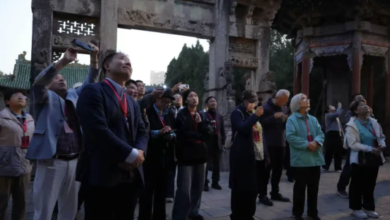
(By Fukuta Takeshi and Tian Mingfeng, Zhengzhou) “Is this the original? I can’t believe it has been preserved so well. It’s so beautiful!” Leaning toward the display cases, representatives of overseas Chinese-language media came face to face with objects made thousands of years ago, voicing their amazement. On the 26th, the visiting group toured the Dahecun Site Museum in Zhengzhou, where a conversation with a civilization spanning 7,000 years unfolded.
Unlike the high-rises packed into a modern city, the Dahecun Site Museum feels like a place of civilization tucked into the earth. Visitors followed a sloping path into the building, which sits entirely underground. Its grass-covered roof blends into the surrounding landscape, as if the structure itself had just been unearthed from this ancient ground.
“Stepping back” into the lives of the Yangshao people
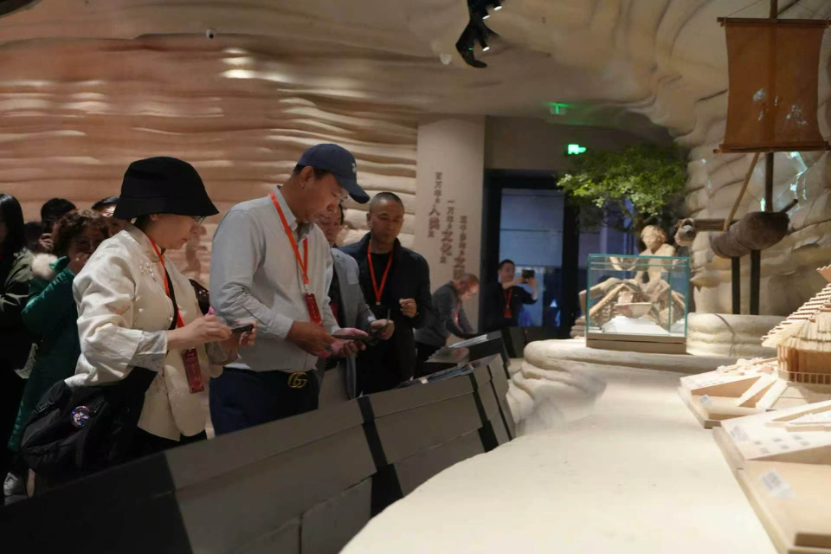
Inside the exhibition hall, the atmosphere turned mysterious and solemn. In the immersive “Impressions of Yangshao” gallery, visitors felt as though they had travelled back in time. The uneven yellow earth beneath their feet recreated the natural setting of prehistoric life. Above and all around them, holographic projections combined with physical scenery to bring rocks, trees and streams to life. In a simulated fishing scene, dim light revealed people tying nets and holding bone fishing spears, evoking the sound of the ancient Yellow River. As the group followed the timeline, rows of objects in the display cases sparked an animated discussion about the past and present. “Take a look at these two pottery pieces. Don’t they look familiar?” the guide asked. The visitors saw cup-shaped vessels dating back more than 4,000 years, with flowing lines and even a small handle. “They look just like the mugs and coffee cups we use today. If nobody told us, we might think someone had left a modern cup here,” one visitor joked, posing for a photo with the “prehistoric mug.” “People were using cups like this 4,000 years ago, and we still use them today. Chinese civilization is remarkable,” the visitor said.
Touching the same piece of pottery across millennia
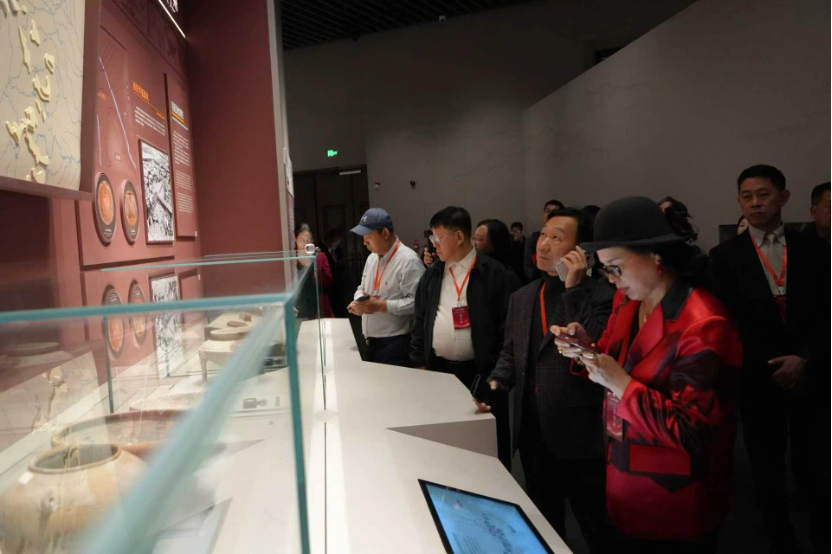
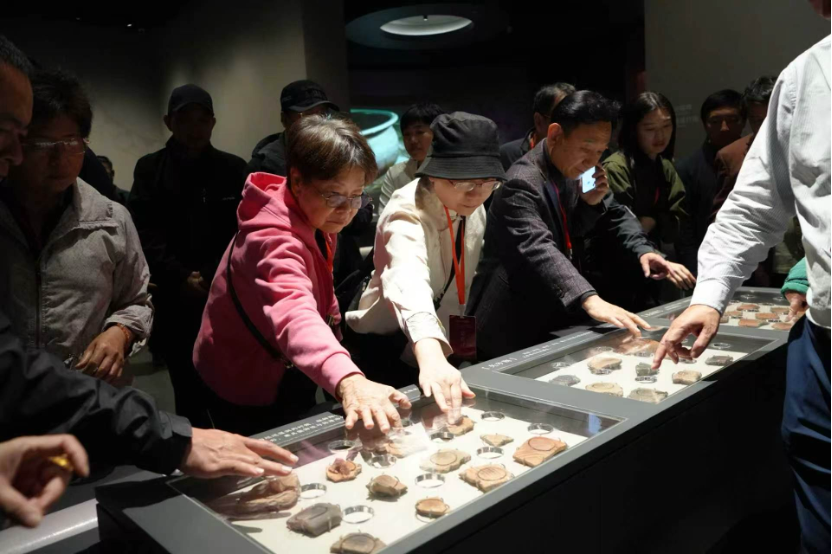
If the “prehistoric mug” brought past and present together visually, the next stop connected them through touch. At a row of glass cases, visitors were invited to touch pottery fragments from thousands of years ago. They waited their turn and carefully ran their fingertips over the rough surfaces, feeling the traces of time. Murong Tao, publisher and editor-in-chief of the Washington Chinese Post in the United States, touched a fragment and reflected: “Thousands of years have passed, yet people today can touch the very same piece of pottery that people touched back then. Isn’t that a vivid sign that Chinese civilization has endured without interruption?”
The visit reached its high point at the museum’s signature treasure: a white-slipped painted pottery basin. Soft light fell on the vessel in its own display case. Its intricate patterns, painted in red, white and black mineral pigments, remain vivid after thousands of years. The guide shared a tender story behind this national treasure: when the precious vessel cracked in antiquity, the people of Dahecun did not discard it. They carefully drilled small holes on either side of the crack and bound it together with hemp cord. This prehistoric form of mending, a forerunner of the traditional Chinese juci repair technique, showed visitors both the artisans’ respect for beauty and their exceptional craftsmanship.
Henan’s history through the contrast of past and present
“I’m deeply moved by what I saw at the site today,” Lin Lu, vice president of the New World Times in the United States, told the camera, unable to hide her excitement. In the morning, she said, visits to Mixue Bingcheng and other sites had shown her the energy of Henan’s fast-growing modern economy. In the afternoon, Dahecun revealed the depth and longevity of Chinese civilization. “The contrast between the ancient and the modern was wonderful. People here had such ingenuity thousands of years ago. When we return, we will do our best to tell audiences overseas about Henan’s history and economic achievements.”
From tracing the Dahecun site’s evolution over thousands of years to touching pottery still warm with the imprint of history, the visitors needed few words. The artifacts themselves seemed to be telling overseas Chinese-language media representatives the epic story of civilization on this central Henan plain.