Kazakhstan Wants More Than Minerals
How the Country Is Positioning Itself in the Global Critical Minerals Race
On June 11, the 16th Astana Mining & Metallurgy Congress opened in Kazakhstan’s capital, bringing together more than 1,500 delegates and 70 companies from 16 countries.
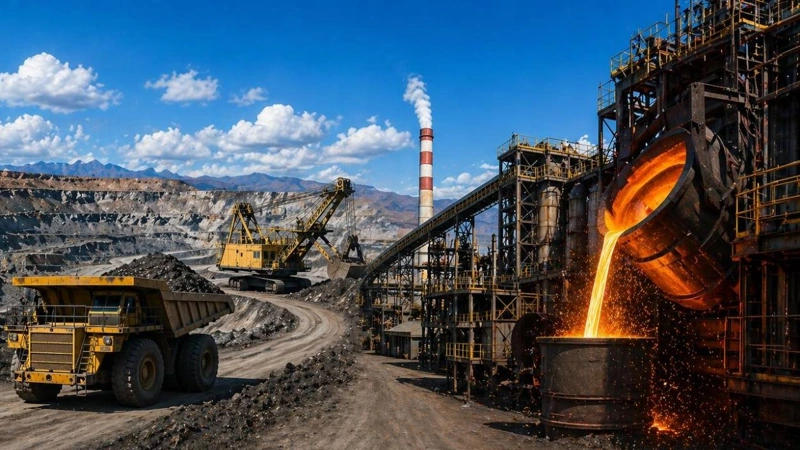
At the conference, Prime Minister Olzhas Bektenov unveiled an ambitious plan. Over the next three years, Kazakhstan will invest approximately US$470 million to conduct one of the country’s most comprehensive geological exploration programs in decades. The government has already established a unified digital platform for subsoil resource management, digitized 4.6 million geological records, and plans to introduce artificial intelligence to analyze geological data and accelerate the discovery of new mineral deposits.
Yet the investment itself was only part of the story.
Around the same time, Kazakhstan’s Ministry of Industry and Construction released new industry figures showing the country’s mining and metallurgy sector has expanded rapidly. Over the past four years, the industry’s value added increased from 4.7 trillion tenge (about US$9.9 billion) to 8.2 trillion tenge (about US$17.3 billion), while exports rose 24.2% to US$15.9 billion.
For a country with the world’s ninth-largest land area, announcing another nationwide geological survey may seem surprising. But Kazakhstan’s objective is not simply to better understand its own natural resources. It is preparing for a new phase of global competition over critical minerals—and positioning itself as a more important player within international supply chains.
Why Critical Minerals Matter
The countries repeatedly mentioned in Bektenov’s speech—the United States, China, the European Union, Japan and South Korea—were not listed by coincidence.
Global competition is increasingly centered on critical minerals rather than traditional energy resources alone.
Copper, lithium, rare earth elements, ferrosilicon and manganese have become essential inputs for electric vehicles, renewable energy systems, semiconductors, aerospace equipment and advanced defense technologies.
Kazakhstan possesses significant reserves of many of these materials, giving the country an opportunity to play a larger role in future industrial supply chains.
Bektenov emphasized that Kazakhstan is seeking cooperation with leading international companies, focusing on long-term partnerships in technology transfer, local manufacturing and workforce development.
The government’s strategy goes beyond attracting foreign investment. It aims to bring more processing capacity and advanced manufacturing into Kazakhstan so that a greater share of value is created domestically before resources enter global markets.
Rather than viewing its mineral wealth solely as an export commodity, Kazakhstan increasingly sees it as an economic asset that can strengthen its industrial competitiveness.
More Than 2.6 Trillion Tenge in Industrial Investment
The government’s strategy is already taking shape through a series of large-scale industrial projects.
Among the most significant investments are:
- 1.6 trillion tenge to expand Qarmet’s annual steel production to five million tonnes;
- 778 billion tenge for the construction of a new copper smelter;
- 308 billion tenge for billet production facilities;
- 208 billion tenge for new ferroalloy projects.
Combined, these flagship investments exceed 2.6 trillion tenge.
In addition, 27 industrial projects are scheduled to begin operations between 2025 and 2026, representing more than 330 billion tenge in investment and creating over 5,000 permanent jobs.
Several projects are already moving forward.
The Ekibastuz FerroAlloys plant in Pavlodar Region has begun production with an annual capacity of 240,000 tonnes of ferrosilicon. In Karaganda Region, the Qaragandy Power Silicon project is expected to produce 175,000 tonnes of silicon materials each year. Two hydrometallurgical cathode copper plants are also scheduled to begin operations in Pavlodar and Karaganda during the first quarter of 2026.
Taken together, these projects illustrate Kazakhstan’s broader industrial strategy.
Rather than relying primarily on exports of raw ore, the government aims to expand domestic smelting, refining and materials processing, allowing more value to be added within the country before products reach international markets.
Industry statistics suggest progress has already begun. Over the past five years, total industrial output has increased 1.7 times, while labor productivity has risen from US$99,100 to US$145,300 per employee.
Nevertheless, Kazakhstan’s exports remain concentrated in relatively low-value products such as copper, ferroalloys, zinc, aluminum and silver.
For policymakers, the objective is clear: to gradually shift the country’s export structure toward higher-value processed materials and advanced industrial products.
Challenges: Costs, Labor and Policy Stability
Kazakhstan’s ambitions, however, face several structural challenges.
Mining and metallurgical projects typically require substantial upfront investment and may take years—sometimes decades—to generate returns. For investors, long-term policy stability is therefore as important as geological potential.
Speaking at the congress, Nikolay Radostovets, Executive Director of the Mining and Metallurgical Enterprises Association, emphasized the need for a stable, transparent and predictable regulatory environment. He warned that additional tax burdens could reduce companies’ willingness to invest in new exploration, production expansion and technological upgrades.
Operating costs are also increasing.
Rail freight tariffs have risen, putting additional pressure on mining companies that rely heavily on bulk transportation. Electricity prices are climbing as well, posing a particular challenge for smelters, one of the most energy-intensive segments of the industry.
Many producers are considering building captive power plants using cleaner coal technologies to reduce long-term operating costs, although doing so will require supportive regulatory policies.
Labor availability has become another concern.
Like many industrial economies, Kazakhstan faces a shortage of skilled technical workers. Mining companies report increasing difficulty recruiting engineers, technicians and production workers, as younger generations increasingly seek employment in larger cities or pursue opportunities abroad.
These challenges are not unique to Kazakhstan, but addressing them will be critical if the country hopes to expand both mineral production and downstream processing.
Digitalization and Artificial Intelligence
Alongside physical investment, Kazakhstan is also modernizing the way it manages geological information.
The government has launched a unified digital platform for subsoil resource management, bringing together licensing, compliance monitoring and geological databases into a single system. More than 4.6 million historical geological records have already been digitized, making decades of exploration data far more accessible for analysis.
The next step is to apply artificial intelligence.
According to Prime Minister Bektenov, AI will be used to analyze geological datasets and identify areas with greater exploration potential.
Artificial intelligence cannot replace field exploration or drilling, but it can improve the efficiency of geological assessment by helping geologists prioritize promising locations before conducting expensive surveys.
If successfully implemented, digital technologies could significantly reduce exploration costs while accelerating the discovery of commercially viable mineral deposits.
A Strategy for Moving Up the Value Chain
Kazakhstan’s latest exploration program reflects broader changes in the global economy.
Governments around the world are placing increasing emphasis on securing reliable supplies of critical minerals.
The United States has introduced the Inflation Reduction Act, the European Union has adopted the Critical Raw Materials Act, while Japan and South Korea continue to strengthen long-term supply agreements with resource-producing countries. China, meanwhile, remains a dominant player in several segments of the global critical minerals market.
Against this backdrop, Kazakhstan is seeking to strengthen its own position within global supply chains.
Its strategy is not simply to increase mineral exports, but to attract investment, expand domestic processing capacity and develop higher-value manufacturing industries.
Rather than exporting raw materials alone, the government hopes to produce more refined metals, industrial materials and advanced mineral products within Kazakhstan.
Officials argue that greater domestic processing will create more jobs, improve productivity and increase the country’s participation in global manufacturing networks.
The shift represents a broader industrial policy aimed at capturing more value from Kazakhstan’s natural resources instead of relying primarily on commodity exports.
Looking Ahead
Kazakhstan’s resource wealth has long been one of its greatest economic advantages.
The government’s latest investment program suggests that future policy will place greater emphasis not only on discovering new mineral deposits, but also on strengthening the country’s industrial base.
Success will ultimately depend on several factors, including continued investment, technological upgrading, regulatory stability and the ability to attract long-term international partners.