East Asia Rises in Global R&D as China Overtakes the United States for the First Time
By Li Da in Tokyo
Japan’s National Institute of Science and Technology Policy released its Science and Technology Indicators 2026 on August 7, pointing to a major shift in the global research landscape.
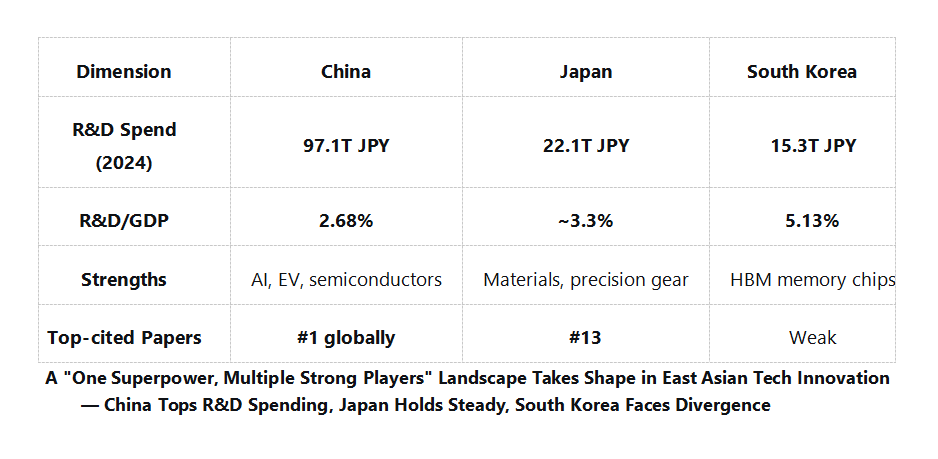
According to the report, China’s R&D expenditure reached ¥97.1 trillion in 2024, up 13.1% year on year, surpassing the United States for the first time. US spending stood at ¥95.3 trillion. Japan ranked third with ¥22.1 trillion, followed by Germany at ¥18.3 trillion and South Korea at ¥15.3 trillion.
Three of the world’s five largest R&D spenders are now in East Asia, marking a notable change in a field long dominated by the United States.
China Moves to the Top
China’s rise has been years in the making. It overtook the United States in total scientific paper output in 2017, moved ahead in the number of top-10% highly cited papers in 2018, and has led in the top 1% of highly cited papers since 2019.
Corporate investment has been a major driver. Chinese companies spent ¥75.4 trillion on R&D in 2024, up 13%, with particularly strong growth in computers, electronics and optical products.
The report also suggests that US restrictions on advanced semiconductors and manufacturing equipment have accelerated China’s push for technological self-reliance.
In seven years, China has moved from leading in research output to leading in overall R&D expenditure.
Japan and South Korea Face Different Challenges
Japan remains the world’s third-largest R&D spender, with expenditure rising 8.4% to ¥22.1 trillion. Yet its research impact has not kept pace: Japan remains 13th in the number of top-10% highly cited papers.
The gap highlights a central challenge for Japan—not the scale of investment, but its effectiveness in producing globally influential research.
South Korea, meanwhile, ranks fifth in total R&D spending and remains one of the world’s most R&D-intensive economies. Its R&D expenditure accounted for 4.9% of GDP in 2022.
But Korea also faces concerns over research quality and the concentration of innovation spending among a small number of major companies, particularly Samsung Electronics and SK Hynix.
The old East Asian technology hierarchy—Japan leading, South Korea catching up and China following—is rapidly changing. China is increasingly in front, while Japan seeks to defend its position and South Korea faces a more uneven innovation landscape.
The US Turns to AI, Europe Falls Behind
The United States may have lost the top position in total R&D expenditure, but it remains a major innovation power. US spending rose 6.7% in 2024, with artificial intelligence becoming an increasingly important focus of investment from basic research to commercial applications.
Europe faces a more difficult situation.
According to OECD figures cited in the article, EU R&D expenditure grew only 0.4% in 2024, far below the United States and Japan. R&D spending remains around 2.2% of EU GDP, below its 3% target for 2030.
Germany remains Europe’s strongest performer, ranking fourth globally, supported by continued investment in automobiles, machinery and chemicals. Even so, the gap between Europe and the leading Asian and US economies is widening.
A New Global Technology Map
The shift is bigger than a change in rankings.
East Asia is becoming an increasingly important centre of global research investment, while the United States is concentrating more heavily on AI and Europe faces growing pressure to accelerate innovation.
R&D spending alone does not determine technological leadership. But where research money flows often signals where future industries, talent and technological capabilities will emerge.
China’s move into first place therefore carries broader significance: the balance of the global technology race is being redrawn.