Winners of “China Plus One” | Kyrgyzstan: A Testing Ground for Corridors and Rules
By Kelly in Tokyo
On July 17, 2026, China’s Vice Minister of Commerce Ling Ji and Kyrgyz Deputy Prime Minister Bakyt Torobaev co-chaired the 17th meeting of the China–Kyrgyzstan Intergovernmental Commission on Economic and Trade Cooperation in Bishkek. The two sides reached a series of agreements covering transport and logistics, resource development, renewable energy, agricultural processing and finance.
Compared with other Central Asian countries, Kyrgyzstan is pursuing a more unconventional path under “China Plus One.” Rather than betting primarily on large-scale manufacturing, it is focusing on two strategic assets: corridors and rules.
China–Kyrgyzstan–Uzbekistan Railway: A Track That Could Reshape the Country
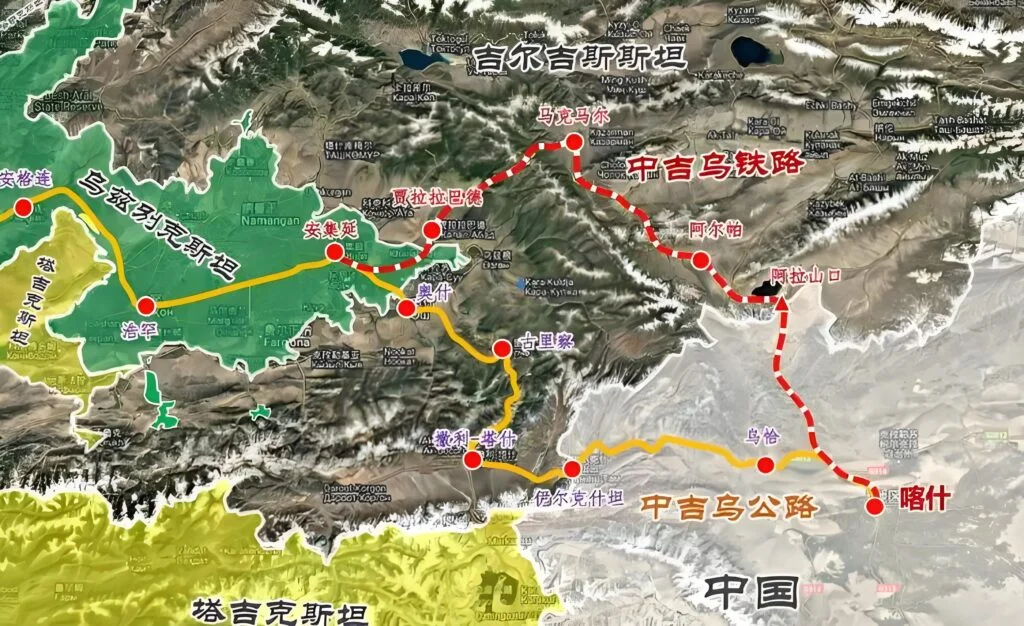
The China–Kyrgyzstan–Uzbekistan railway is arguably the flagship project of bilateral economic cooperation.
The project officially began on December 27, 2024. With total investment of about $4.7 billion and a planned length of roughly 450 kilometers, China will account for 51% of the investment, while Kyrgyzstan and Uzbekistan will each contribute 24.5%.
The financing structure itself underlines the project’s strategic importance. Around $2.3 billion of China’s contribution is being provided through 35-year loans. Of Kyrgyzstan’s $588 million share, roughly half comes from a 25-year Chinese concessional loan. In May 2026, Kyrgyzstan secured another $305 million concessional loan from China with a 25-year term and an annual interest rate of 1.5%, part of which has grant-like characteristics.
By August 2026, construction had begun across the full 304-kilometer Kyrgyz section. The route requires 50 bridges and 29 tunnels, with bridges and tunnels together accounting for about 120 kilometers, or 40% of the section. Uzbek officials said around 17% of the project had already been completed, while more than 10,000 workers and over 7,000 pieces of equipment were operating continuously. The original five-year construction timetable may be shortened by as much as a year.
For landlocked Kyrgyzstan, the railway opens new access to international markets and creates a long-term source of transit income. As Kyrgyz officials have emphasized, railways generate much of their value from transit traffic.
In that sense, the railway is not simply a transport project. It is an attempt to turn geography into a strategic economic asset.
Tamchy Financial Investment Zone: A Testing Ground for Rules
If the China–Kyrgyzstan–Uzbekistan railway is the physical corridor of “China Plus One” in Central Asia, the Tamchy Financial Investment Zone is its institutional corridor.
Launched on the shores of Issyk-Kul in August 2026, the zone is based on English common law and includes an independent financial regulator, an international dispute-resolution center and a one-stop digital registration system. Companies operating there are offered preferential tax treatment, full foreign ownership and freedom to repatriate profits.
The legal framework is designed to be familiar to international investors and relatively insulated from the country’s ordinary domestic legal structure.
President Sadyr Japarov has described the zone as a financial center being built from scratch, with independent courts, modern regulation and stable rules. Ayaz Bayetov, chairman of the zone’s management committee, went further, saying Tamchy aims to become the preferred gateway for Chinese companies establishing operations in Central Asia.
By 2035, the zone aims to attract around 4,000 companies, create more than 10,000 jobs and contribute an estimated $20 billion to the Kyrgyz economy between 2026 and 2035.
For Chinese companies expanding under a “China Plus One” strategy, a predictable and internationally recognizable legal environment can be as valuable as land or infrastructure. In this sense, Kyrgyzstan is experimenting not only with the movement of production capacity, but also with the movement of institutional frameworks.
“Two Countries, Two Parks”: A New Cross-Border Model
Another institutional experiment is the “Two Countries, Two Parks” program.
In December 2023, a delegation from the Kashgar Economic Development Zone signed a four-party agreement with Kyrgyz partners. The project formally began in January 2024, linking the Kashgar Comprehensive Bonded Zone with the Naryn Free Economic Zone.
The program establishes industrial parks on both sides of the border and explores a model combining “platform + park” with “institution + enterprise.” Priority sectors include agricultural processing, resource processing, trade and logistics, modern services and cross-border e-commerce.
More than two years after launch, the program has begun to produce tangible results. In the first half of 2026, construction of the Naryn industrial park accelerated, with drone and automobile assembly projects moving in. A separate Chinese-backed industrial park in Kyrgyzstan has also attracted companies including Dongfeng-related vehicle assembly operations. Kyrgyz Post was among the first Kyrgyz companies to establish a presence in Kashgar through the program.
The broader aim is to create an international platform that combines industrial complementarity, reciprocal policies and cross-border supply-chain cooperation.
From Energy Corridor to Mineral Hinterland
China–Central Asia energy cooperation has developed over more than two decades, traditionally centered on oil and gas pipelines. But the relationship with Kyrgyzstan is widening into green energy, mining, refining, logistics and electricity cooperation.
A February 2025 China–Kyrgyzstan joint statement called for full-chain cooperation in mineral development and stronger joint training of professionals. In July 2026, Chinese and Kyrgyz officials again highlighted agriculture, energy and minerals, while identifying artificial intelligence and the digital economy as new growth areas.
These policy priorities are increasingly turning into projects.
In energy, a Chinese-backed 800,000-ton-per-year refinery operated by Zhongda Petroleum is currently one of the largest Chinese industrial projects in Kyrgyzstan. Its refined petroleum and chemical products serve the domestic market and are also exported to other Eurasian countries.
In May 2026, Kyrgyz state enterprise Kyrgyzkomur and Chinese partner Xinjiang Dacheng Yuanlong Energy Technology launched a $430 million energy and logistics project aimed at building a modern coal transport corridor through the Irkeshtam border crossing.
Mining investment is also accelerating. Kyrgyzstan has confirmed reserves of 28 minerals, including copper, gold, lead, zinc, aluminum, tungsten, tin, mercury, antimony and silver. The country has more than 150 mining projects, with gold accounting for around 71%.
In January 2026, Silvercorp Metals acquired a 70% stake in the Chaarat gold project for $162 million in cash. The project lies in the western Tianshan gold belt and includes mining and exploration areas with significant gold and silver resources.
In April 2026, China Nerin Engineering signed an EPC contract with the operator of Kumtor for the Togolok gold project, with a planned construction period of 24 months.
The pattern is becoming increasingly clear. Cooperation is moving from oil refining to gold mining, from energy logistics to geological exploration.
Kyrgyzstan is therefore repositioning itself on several fronts at once. The China–Kyrgyzstan–Uzbekistan railway enhances its geographic value. The Tamchy zone gives it a role in testing new legal and financial frameworks. The “Two Countries, Two Parks” model provides a new mechanism for cross-border industrial cooperation.
Kyrgyzstan is no longer trying to remain merely a logistics transit point.
It is seeking to become both an industrial hinterland and a testing ground for the rules that may shape the next phase of China’s expansion into Central Asia.