【Illuminated ReflectionsBright】Nan Huai-Chin: A Paragon of Scholarship and a Master of His Generation
To this day, across both sides of the Taiwan Strait, as well as in Japan, Korea, Southeast Asia, North America, Europe, and many other countries and regions around the world, Mr. Nan Huai-Chin remains a legendary figure of great mystery—renowned far and wide, with an ever-growing reputation.
Born on March 18, 1918, in Yueqing, Wenzhou, Zhejiang Province, China, Nan Huai-Chin was a contemporary Chinese writer, educator, and master of traditional Chinese culture.
He studied at the Zhejiang National Martial Arts Institute, the Central Military Academy’s Political Research Class, and Jinling University Graduate School. During the Anti-Japanese War, he joined the military, took part in frontier cultivation, and served as General Manager and Commander of the Daliangshan Reclamation Company. After returning to Sichuan, he taught at the Central Military Academy and later lectured at Yunnan University and Sichuan University.
After 1949, he moved to Taiwan, where he taught at National Chengchi University, Fu Jen Catholic University, and Chinese Culture University. Later, he lived in the United States and Hong Kong, founding organizations such as the East-West Essence Society, Lao Gu Publishing House, Human World magazine, and Knowledge and Vision magazine. While in Hong Kong, he remained concerned with the development of his hometown. In his later years, he settled in Suzhou’s Taihu Great Learning Hall.
He passed away in Suzhou on September 29, 2012, at the age of 95.
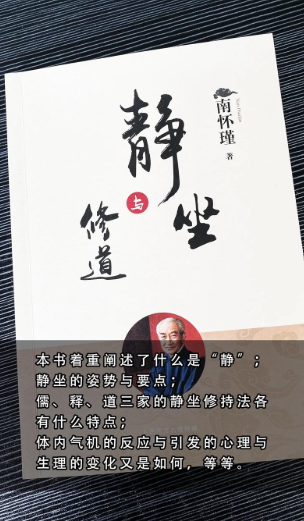
Throughout his life, Nan Huai-Chin dedicated himself to promoting traditional Chinese culture and advocated the integration of Eastern and Western wisdom for the benefit of humanity. He mastered Confucianism, Buddhism, and Taoism, synthesizing their teachings; he was also well-versed in medicine, divination, astronomy, martial arts, swordsmanship, and poetry. His prolific works—including A Different Interpretation of the Analects, Understanding Mencius, The Original Great Learning Explained, and Laozi Speaks—have been translated into eight languages and have had a lasting global impact.
Nan’s philosophy of life was:
“To integrate Confucianism, Buddhism, and Taoism into one realm, view the world with generosity; keep skills in your hands, ability in your body, thought in your mind, and live life calmly.”
In Taiwan, he often taught through the Buddhist and Taoist traditions, with works such as What Does the Diamond Sutra Say, A Brief Explanation of the Consummate-Enlightenment Sutra, How to Practice Buddhism, and The Humanistic View of the Medicine Buddha Sutra.
In mainland China, many people turned from Western philosophy to Eastern culture through his writings—especially A Different Interpretation of the Analects, Understanding Mencius, The Original Great Learning Explained, and Notes on the I Ching. These works corrected many misunderstandings of traditional Chinese thought.
Through his synthesis of Confucian, Buddhist, and Taoist wisdom, Nan taught that saints exist both in the East and West—that the same heart and truth are shared universally. From the “ordinary” to the “noble,” there is no real boundary; one must return to the ground even after reaching the peak. Achieving “great ordinariness” is the highest nobility. Nan Huai-Chin’s peaceful passing exemplified this truth.