【Observation】Pickups “clear the road”: Toyota updates and reshapes its Southeast Asian strategic model lineup
(Asia Financial Observer — Reporter Jiu, Tokyo, Nov. 19)
Toyota Motor Corporation has fully revamped its global strategic pickup model, the Hilux, for the first time in a decade, and will rely on its Thai base to expand production and sales in emerging markets. The move underscores Toyota’s determination to strengthen its presence in Southeast Asia and other developing regions, while enhancing competitiveness through deeper localization strategies.
On November 10, Toyota held the global premiere of the latest Hilux model in Bangkok, Thailand. The unveiled model received an enthusiastic response. Simon Humphries, Toyota’s Chief Branding Officer (CBO), said: “The new Hilux incorporates extensive feedback from users around the world and represents another evolution of a model that has long been a cornerstone of trust.”
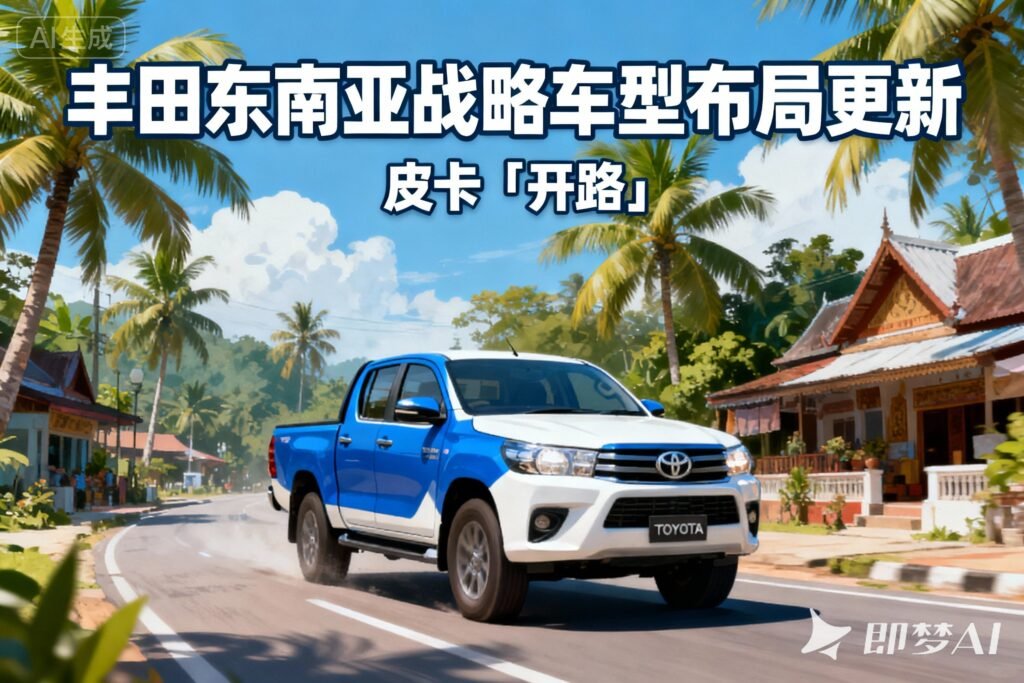
■ Why pickups? Hilux is Toyota’s “bridgehead” in emerging markets
The new Hilux, developed primarily by the team in Thailand, marks the first full redesign since 2015. The model features upgraded engine performance, interior and exterior enhancements, and compliance with Euro 5 emissions standards. According to Toyota, fuel efficiency of the new diesel variant has improved by up to 8% over the previous generation. Pricing in Thailand starts at 774,000 baht (approx. RMB 170,000), and sales have begun.
The Hilux lineup will also gain an electric version—the first mass-produced pure EV Toyota will manufacture in Thailand. Commercial production is expected by the end of 2025, with a driving range exceeding 300 km. Pricing is projected to start at 1.49 million baht (approx. RMB 330,000). Toyota Asia Chief Masahiko Maeda stated, “We will use Thailand as the mother plant and gradually begin production in Argentina, South Africa, and other locations.”
As Toyota’s key strategic model for emerging markets, the Hilux has an annual production capacity exceeding 300,000 units at its Thai plant, 71% of which are exported to more than 130 countries and regions across Southeast Asia, the Middle East, and Australia. With a local parts procurement rate of 95%, the model enjoys strong advantages in production, development, and profitability.
Since its debut in 1968, the Hilux has evolved to its ninth generation. It is the core product of Toyota’s IMV (Innovative International Multi-purpose Vehicle) global strategy. In 2024, global IMV sales reached 830,000 units—around 8% of Toyota’s total sales—with the Hilux accounting for nearly 70% of that volume.
Hirotaka Uchida, partner at Arthur D. Little Thailand and automotive industry expert, noted: “The Hilux has played a vital role in regions with underdeveloped infrastructure, serving as an essential practical vehicle that supports daily life.”
■ Why Thailand? A supply chain stronghold and a model market
The largest Hilux production facility is located in Thailand, with output exceeding 300,000 units in 2024. Around 71% of these vehicles are exported to more than 130 markets worldwide.
Approximately 95% of Hilux components are sourced locally in Thailand, and the model shares production platforms with several other Toyota vehicles, ensuring favorable profitability.
First introduced in 1968, the Hilux became part of Toyota’s IMV program in 2004. In 2024, IMV models sold 830,000 units globally, with the Hilux contributing roughly 70% of the total.
Uchida emphasized: “The Hilux has long been popular not only in Thailand but across the Global South. In regions lacking proper roads or electrical infrastructure, it is indispensable for everyday transport.”
■ Why now? Toyota faces urgent challenges from declining sales in emerging markets
For Toyota, boosting sales in emerging markets has become a top priority. In Thailand, the pickup truck market is shrinking rapidly—sales fell 56% between 2022 and 2024 to about 200,000 units.
Moreover, in emerging economies, Japanese automakers can no longer rely on gasoline and hybrid vehicles to sustain past growth. Chinese automakers, facing rising trade barriers in Europe and the U.S., have redirected efforts to emerging markets. Companies like BYD are expanding aggressively with low-cost EVs and plug-in hybrids, becoming formidable competitors to Japanese brands.
According to Toyota’s Thai subsidiary, the share of Japanese brands in Thailand’s new-car market dropped to 68% in August 2024, down sharply from about 90% in 2020. Meanwhile, the market share of Chinese brands rose to 23%, up 7 percentage points from the previous year.
To confront this major market shift, Toyota is strengthening its emerging-market presence, including plans to open a new plant in India in 2026.
With the new Hilux now “on the road,” Toyota’s ambitions in Southeast Asia and other emerging regions are clear. But can the company prevail amid intensifying competition? The final outcome remains to be seen.