(Observation)“Offline Hot, Online Cold”: The Unique Modernity of Japan’s Commerce and Its Global Implications
(By Asia Financial Observer reporter Jiu Ri, Tokyo)
Having lived in Japan for years, Ms. Wan Ge from China has observed a striking phenomenon: offline commerce remains vibrant, while online commerce appears stagnant. This contrast—“offline hot, online cold”—is particularly notable against the backdrop of rapid global e-commerce expansion. From Shibuya, Shinjuku, and Ginza in Tokyo to small commercial districts in surrounding prefectures, crowds surge during holidays and evening rush hours. Restaurants have queues, cafés are packed, and street-front shops bustle with constant foot traffic.
Yet in Japan, once you open a delivery app or an e-commerce site, you instantly feel as though you’ve “returned to China a decade ago”: limited delivery options, slow logistics, and lower penetration of digital payment. This raises several intriguing questions: In an era when e-commerce has devoured offline retail globally, why does Japan remain a country where “the better the offline thrives, the harder the online develops”? Is the long-term prosperity of offline commerce simply a matter of consumer preference, or the product of deeper institutional and cultural forces? In this seemingly circular paradox—like the chicken-and-egg question—is the structural imbalance a cultural choice or an institutional outcome?
Re-examining this phenomenon from a global perspective provides important insights into the unique modernity of Japan’s commercial ecosystem.
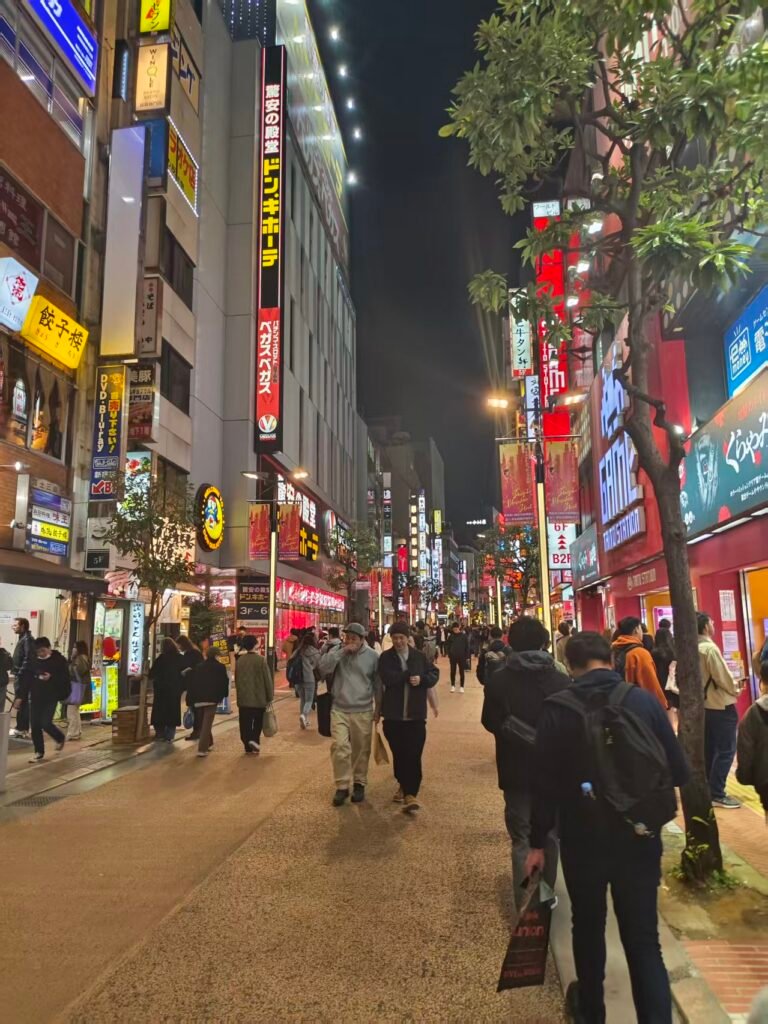
The Real Prosperity of Offline Commerce: Visible Vibrancy and High Density
Chinese tourists visiting Japan are often surprised by how lively offline consumption is. Despite widespread smartphone and e-commerce usage, department stores remain crowded, and century-old shops in narrow alleyways have queues stretching out their doors. The vitality of Japan’s offline retail is far beyond surface impressions.
Miyashita Park in Shibuya is filled with people reading or sunbathing on weekdays and weekends alike; restaurants often require 20 minutes or more of waiting; Ginza’s pedestrian streets attract not only tourists but also local young consumers lining up from MUJI all the way to Apple Store. Community commercial areas like Kichijoji and Jiyugaoka thrive with stable customer flow and high conversion rates. Even smaller station-front shopping streets in Odaiba, Toyosu, Saitama, and Chiba maintain strong spending activity.
Data further reinforces this vibrancy: Japan has around 56,000 convenience stores—one every 500 meters on average—with most operating profitably; despite the overall contraction of department stores, legacy players still report exceptional sales per square meter; small restaurants dominate the market and often enjoy long lifespans; offline consumption accounts for over 85% of total retail.
Compared with China, where offline commerce saw a brief post-pandemic rebound but continues a long-term shift toward online platforms, Japan’s divergence invites global reflection: the vitality of offline commerce is shaped less by population density and income, and more by systems, culture, and urban planning.
Offline Resilience Under the Impact of E-commerce
Japan’s offline prosperity stems not simply from a preference for shopping in person, but from a complex interplay of structural factors.
1. Urban Form and Planning
Comparing city structures in China, Japan, and the U.S. yields clear patterns:
| Country | Urban Form | Impact on Offline Retail |
| Japan | Station-centered, high density, multi-core | Strong & stable offline advantage |
| China | Malls + neighborhoods, decreasing car dependence | Online strong; malls shift toward experiential retail |
| U.S. | Suburban malls, car-dependent | Amazon dominance, many malls decline |
Japan’s commercial geography revolves around two key concepts:
the “station commercial district” and the entertainment street.
Major cities concentrate malls, office buildings, and hotels around railway hubs.
For example, exiting Tokyo Station’s Marunouchi side reveals a landscape of premium office towers and luxury hotels surrounding the iconic red-brick station.
Kyoto Station’s Isetan and Osaka Station’s sprawling Hankyu-affiliated complexes offer similar experiences.
Essentially:
shopping, working, and living fall within a walkable 1-km radius—where people go, commerce follows.
In Japan, people don’t “seek out” shopping districts; urban design “funnels” them through commercial spaces. A typical office worker may pass through three commercial zones daily: the home station area, transfer station area, and the office station area.
This embedded density makes e-commerce unable to fully replace physical retail.
2. Offline Services at an Exceptional Level
Why do Japanese consumers favor physical stores? Multiple explanations exist:
— Japan’s aging population means many seniors avoid smartphones
— High labor costs make ultra-cheap delivery impossible
— Delivery wait times can be long (e.g., MUJI orders taking a week; Amazon often 4–5 days)
A Japanese media professional notes that some consumers avoid online shopping because “if they dislike the item, they feel guilty throwing it away,” so they shop more cautiously.
Moreover, Japanese consumers are “spoiled” by offline service: polite staff, freedom to try products, professional explanations in cafés or drugstores, and shopkeepers with deep product knowledge. This creates a sense of security that online shopping cannot replicate.
Globally, the comparison is fascinating:
— U.S. service quality is highly uneven
— Korea provides fast, volume-driven service
— Europe emphasizes craftsmanship but lacks efficiency
— Japan combines “experience + expertise” into a high barrier, making offline trust unique
3. Cultural Emphasis on the Experience Process
Chinese consumers pursue efficiency, Korean consumers value convenience, whereas Japanese consumers prioritize whether the service process is pleasant, trustworthy, and complete.
A Japanese retail consultant told the reporter:
“Consumers aren’t unwilling to buy online; they simply trust the offline experience more. Seeing the people and the service process gives them reassurance.”
This cultural logic becomes a soft barrier that keeps offline retail dominant.
4. Systemic Constraints Slow E-commerce by Design
Japan’s slow e-commerce development is often mistaken as a lack of technology, but industry insiders describe it as a deliberate opportunity-cost choice:
— Few delivery riders and high logistics labor costs
— Shrinking workforce
— Many job seekers absorbed by offline service sectors
— Small shops remain more sustainable than delivery platforms
Japan has essentially made a structural choice between offline and online.
The Chicken-and-Egg Paradox of “Offline Hot, Online Cold”
Is Japan’s offline prosperity the cause or the effect of weak e-commerce?
Observation suggests a mutually reinforcing cycle:
Strong offline experience → weak incentive for online growth
Weak online competition → offline faces less pressure
Healthy offline industry → continued urban investment
Stable urban form → culture remains offline-oriented
This cycle has persisted for at least 30 years.
China has the opposite loop:
Strong online → pressures offline → offline upgrades experience → further strengthens online.
Neither is “advanced vs backward,” but the result of different value systems.
Japan’s Retail Future: A Dual-Track System
Observation from Tokyo suggests that Japan will follow a “dual-track” retail model:
— Offline for experience
— Online for efficiency
— Offline continues to dominate
— Digital tools supplement but do not replace physical retail
Young consumers mix online and offline; families balance both; seniors prefer offline; small local shopping streets remain vibrant; large malls emphasize experiential elements. Unmanned stores, automated checkouts, and PayPay support efficiency but don’t shift the core structure.
International comparisons show similarities with European countries like France and Italy, where high-end retail emphasizes in-store experiences. Yet Japan differs in its far denser local commercial zones and stronger neighborhood culture.
This demonstrates that modernity has multiple forms:
China’s modernity is built on hyper-efficiency,
Japan’s modernity is built on experience, warmth, and trust.
Japan is not “lagging behind”—it is pursuing a different form of modernity.
Conclusion
The divergence between Chinese and Japanese consumer systems shows that consumption patterns do not follow a single trajectory. Countries choose different modernization paths rooted in their urban design, cultural preferences, and institutional environments.
Japan’s commercial “chicken-and-egg paradox” offers not only a window into retail dynamics but also valuable inspiration for global retail innovation.