(Observation)Japan to Revitalize Shipbuilding: ¥1 Trillion in Public–Private Investment, Five Companies Form Deep Partnership
(Asia Financial Observer — Reporter Jiu, Tokyo, Nov. 28)
In its economic policy package released on November 21, the Japanese government announced a goal to double the nation’s shipbuilding volume by 2035 compared with 2024. To achieve this, Japan will establish a ten-year industrial fund, with combined public–private investment reaching ¥1 trillion, to support the revival of the shipbuilding sector. In line with this initiative, major shipping companies—NYK Line, Mitsui O.S.K. Lines (MOL), and Kawasaki Kisen (K Line)—recently stated they will deepen collaboration with shipbuilders on next-generation vessel development.
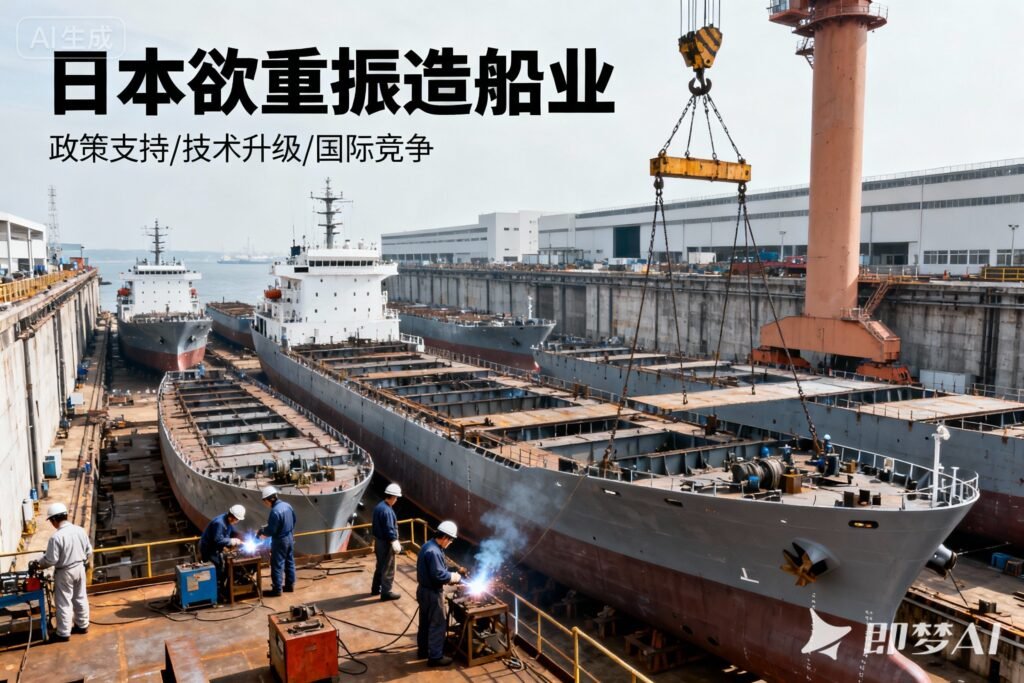
The three shipping companies plan to invest in MILES, a ship-design company jointly established by Imabari Shipbuilding and Mitsubishi Heavy Industries, and are considering prioritizing orders to Japanese yards in the future. Strengthened coordination between the shipping and shipbuilding industries is expected to help fill gaps in Japan’s next-generation vessel supply chain and lay the foundation for revitalizing a sector long in decline.
This marks the first time Japan’s major shipping companies and shipbuilders have established a joint ship-development structure through capital participation. The three shipping firms will acquire part of Imabari Shipbuilding’s stake in MILES, with equal investment ratios among them. MILES’ current share structure is: Mitsubishi Heavy Industries 51%, Imabari Shipbuilding 49%.
Previously, the three shipping companies, Mitsubishi Shipbuilding (a Mitsubishi Heavy Industries subsidiary), Imabari Shipbuilding, Japan Marine United (JMU), and Nihon Shipyard—jointly funded by Imabari and JMU—had already formed a partnership to develop liquefied CO₂ carriers. With the shipping giants now formally investing in MILES, the commercialization of this field is expected to accelerate further.
The capital partnership is also seen as an opportunity for MILES to become a “common platform” for Japan’s ship-design sector. The platform aims not only to integrate the three companies’ requirements into jointly designed next-generation vessels, but also to broaden collaboration to a wider range of ship types. By promoting design standardization and improving the interchangeability of design solutions, MILES could offer its outputs to more Japanese shipyards, generate economies of scale, and enhance the competitiveness of Japan’s shipbuilding industry as a whole.
Traditionally, shipbuilding has relied on bespoke designs tailored to individual shipowners, making it difficult for shipyards to improve production efficiency. By shifting toward platform-based, standardized design systems, the industry may break free from the constraints of chronic “non-standardization.”
At the same time, relationships between Japanese shipping companies and domestic shipyards are expected to strengthen significantly. In addition to investing in MILES, NYK Line is considering procuring liquefied CO₂ carriers domestically and exploring the feasibility of rebuilding LNG carriers in Japan—an industry that had ceased production for many years. NYK plans to expand its LNG fleet by nearly 40% to around 130 vessels by FY2028. While most orders are currently placed with China and South Korea, the company has indicated it is prepared to bring more of these orders back to Japan.
With favorable policies emerging, Japan’s shipping sector has voiced that it “must not miss this opportunity for government support” and should “accelerate the industry’s restart.” The importance of shipbuilding is growing—not only for Japan’s economic security but also as a key sector for future cooperation with the incoming U.S. administration, which has emphasized industrial revitalization. After years of struggling to cooperate due to conflicting interests, the shipping industry is now joining hands with shipbuilders to pursue an “All-Japan framework” for industrial renewal.
In the 1970s and 1980s, Japan commanded roughly 50% of the global shipbuilding market. However, competition from South Korea and China gradually eroded this dominance, and Japan’s share had fallen to around 10% by 2024. Many in the industry believe the failure to advance design standardization played a central role in declining efficiency and competitiveness. In contrast, China’s shipbuilding industry consolidated design resources at the Shanghai Merchant Ship Design & Research Institute (SDARI), achieving high levels of centralization and significant productivity gains.