(Year-end Analysis)Sushiro Sparks a New Wave of “Queue Economy”: Understanding How China Achieved Its Second Rise
(Asia Finance Observer, Reporter Jiu Ri, Tokyo, Dec. 16)
Prologue | What Is Happening to the World?
This year, the world has never been short of news.
Markets fluctuate daily, policies are rolled out one after another, technologies advance at breakneck speed, and the flow of capital and data seems endless.
Yet amid this constant noise, one fundamental question has grown clearer, sharper, and more urgent—
What, exactly, is happening to the world?
Why has money never been more abundant, while the sense of personal wealth feels increasingly scarce?
Why do macro tools keep appearing, yet micro-level anxiety refuses to recede?
Why do technological frontiers expand rapidly, while our sense of security subtly retreats?
Why are market narratives as lively as ever, while the real stories of the economy are harder and harder to tell?
These questions transcend borders and cut across social strata.
They echo simultaneously in Europe and the United States, across Asia, Africa, and Latin America; they manifest in nations large and small, and are embedded in corporate balance sheets, household decisions, and individual life planning.
This is not the shock of a single event, but the impact of a moment when many “once-taken-for-granted rules” appear to be failing at the same time—producing a widespread and visceral sense of dislocation.
This is why we launch this year-end observation.
Not to offer a simple answer, but to return to the concrete realities on the ground—
to the profit-and-loss lines of businesses, the consumption lists of families, the testing grounds of policy, the hesitation points of the market, and the Z generation oscillating between “hyper-competition” and “lying flat.”
By linking signals that seem isolated on the surface, we seek to uncover the deeper connections behind them.
If the world is indeed facing a certain predicament, perhaps it is not because it has suddenly deteriorated.
Rather, it may be because we are still holding an old “blueprint” while trying to measure an era whose underlying logic has already been reshaped.
This is what we aim to document and present—
a deep inquiry into the world we live in today.
What is happening to the world?
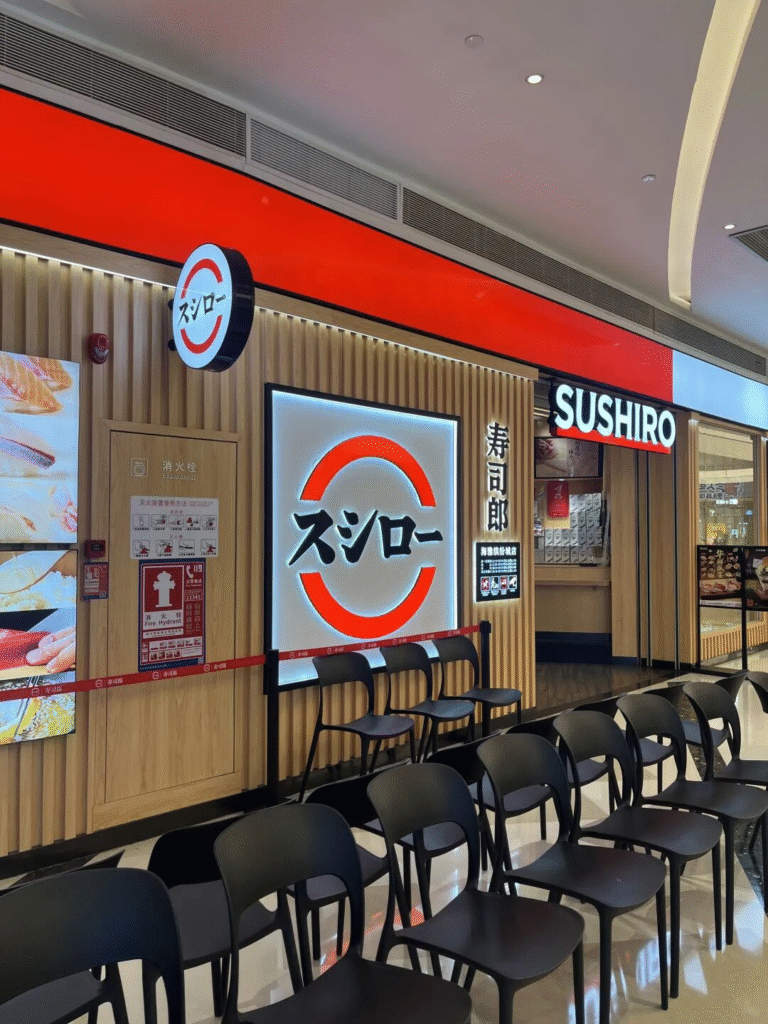
On December 6, Japanese conveyor-belt sushi giant Sushiro opened two flagship stores simultaneously at Shanghai Global Harbor and Zhongshan Park’s Longemont Mall. Both locations saw extraordinary crowds, with waiting times exceeding ten hours.
Having once withdrawn from Shanghai in 2012 due to operational challenges, Sushiro returned to China with a more mature supply chain, more aggressive localization strategies, and denser marketing tactics after three years of validated expansion in southern China and emerging first-tier cities. As of September 2025, Sushiro operates 63 stores in mainland China, while overseas markets have become the core revenue driver for its parent company F&LC.
Behind what netizens call “The Temptation of Lang” lies a Japanese restaurant brand highly attuned to China’s shifting consumption structure, deflationary sentiment, and young consumers’ cultural logic. From business model and technology to localized supply chain and city-level marketing, Sushiro’s China operations are entering a period of rapid profit growth—offering globally relevant insights.
From Failure to Frenzy: Sushiro’s “Re-understanding” of China
In 2012, Sushiro first entered Shanghai through a joint venture, but exited quietly due to insufficient supply chain preparation and misaligned pricing. After its 2021 comeback, the brand centered its strategy in Guangzhou, testing the feasibility of its high-value conveyor-belt sushi model through 10 Guangzhou stores and 5 Shenzhen stores.
With validation achieved, Sushiro accelerated national expansion from 2023 onward: entering Chengdu, Chongqing, and Wuhan, then Beijing in 2024, where its Xidan Joy City opening saw a record 1,500-table queue. In 2025, Sushiro expanded into Suzhou and Hangzhou before finally returning to Shanghai at year-end, forming a national matrix spanning South, East, and North China.
Its success stems from a renewed understanding of China: young consumers prioritize experience and value, social media shapes consumption decisions, and localized, traceable supply chains are fundamental to trust.
Supply Chain “De-Japanization”: The True Source of Sushiro’s Cost Advantage
Sushiro’s competitiveness in China does not come from its “Japanese brand” identity, but from restructuring its supply chain.
Its rapid popularity coincides with China’s intensifying focus on affordability between 2023 and 2025, with the 50–80 RMB price band becoming the most competitive in food service. Japan’s deflation-era expertise in low-cost operations and stable quality fits this demand perfectly.
The key lies in radical localization: about 90% of ingredients are sourced within China, and processing and storage hubs are China-based, reducing costs by roughly 50% compared with full Japanese imports. After Japan’s treated-water controversy, this domestic supply chain not only lowered costs but also alleviated consumer concerns about seafood safety.
Meanwhile, diversified sourcing—from Russian snow crab to Canadian scallops—further optimized quality and cost structures, strengthening price competitiveness.
Marketing as Social Expression: Sushiro Turns Dining into a Cultural Phenomenon
Another central strength is Sushiro’s deep understanding of China’s digital ecosystem. Its marketing creates a “participatory consumer culture” rather than simply promoting products.
Sushiro follows three parallel marketing logics:
Gamified dining experiences drive repeat visits through digital raffles, sushi coins, and limited-edition mascots—some of which fetch tenfold premiums on resale platforms, earning Sushiro the nickname “the Disney of sushi.”
It binds itself to anime and ACG culture, collaborating with major IPs such as Hatsune Miku, Haikyuu!!, and Honkai: Star Rail, turning themed stores into social media hotspots.
It leverages “first-store economics” and city-level marketing: Shanghai-exclusive tote bags and West Lake pop-up events in Hangzhou draw long queues from users eager to “check in” for social media.
Shared Trajectories Among Japanese Companies in China: Premiumization, Localization, Diversification
Sushiro’s rise is not an isolated case. Japanese brands showing the fastest growth in 2025—whether in beauty, retail, home appliances, or dining—all share three traits: premium positioning, localized supply chains, and diversified marketing.
Sushiro exemplifies a new model for Japanese brands in China: win with technology, operational excellence, deep localization, and cultural relevance—all underpinned by strong compliance.
As China’s consumption landscape undergoes structural adjustments and food service enters an era of efficiency-driven competition, Sushiro’s growth path has become a reference model not only for Japanese firms but for global brands seeking success in China.