(Year-end Observation)Sanrio’s “Rocket Growth” in China: A Clear Sign of the Massive Potential of the Cute-Economy
Prologue | What Is Happening to the World?
This year, the world has never been short of news.
Markets fluctuate daily, policies are rolled out one after another, technologies advance at breakneck speed, and the flow of capital and data seems endless.
Yet amid this constant noise, one fundamental question has grown clearer, sharper, and more urgent—
What, exactly, is happening to the world?
Why has money never been more abundant, while the sense of personal wealth feels increasingly scarce?
Why do macro tools keep appearing, yet micro-level anxiety refuses to recede?
Why do technological frontiers expand rapidly, while our sense of security subtly retreats?
Why are market narratives as lively as ever, while the real stories of the economy are harder and harder to tell?
These questions transcend borders and cut across social strata.
They echo simultaneously in Europe and the United States, across Asia, Africa, and Latin America; they manifest in nations large and small, and are embedded in corporate balance sheets, household decisions, and individual life planning.
This is not the shock of a single event, but the impact of a moment when many “once-taken-for-granted rules” appear to be failing at the same time—producing a widespread and visceral sense of dislocation.
This is why we launch this year-end observation.
Not to offer a simple answer, but to return to the concrete realities on the ground—
to the profit-and-loss lines of businesses, the consumption lists of families, the testing grounds of policy, the hesitation points of the market, and the Z generation oscillating between “hyper-competition” and “lying flat.”
By linking signals that seem isolated on the surface, we seek to uncover the deeper connections behind them.
If the world is indeed facing a certain predicament, perhaps it is not because it has suddenly deteriorated.
Rather, it may be because we are still holding an old “blueprint” while trying to measure an era whose underlying logic has already been reshaped.
This is what we aim to document and present—
a deep inquiry into the world we live in today.
What is happening to the world?
(Asia Financial Watch, Reporter Yuan Yin, Tokyo, Dec. 8)
Global revenue reached 87.6 billion yen (about 4 billion RMB), up 39.6% year-on-year; operating profit hit 37.1 billion yen (about 1.7 billion RMB), up 49.9%. Sanrio’s newly released results for FY2026 H1 (March–September 2025) present a dazzling picture, with China emerging as a decisive driver of growth and becoming the centerpiece of Sanrio’s global strategy. In this round of expansion, China is unmistakably the “core engine.”
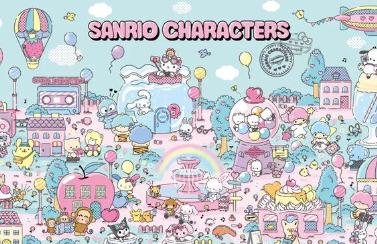
China market profit surged 104.8%
According to the financial report, Sanrio achieved 745 million RMB in revenue from China in FY2026 H1, with operating profit rising 104.8% year-on-year. By the first three quarters of 2025, total sales in China had reached 925 million RMB, an 82% increase year-on-year, accounting for 68% of Sanrio’s Asia sales—nearly quadruple the share in 2022.
The core driver is Sanrio’s “multi-character matrix” strategy. Licensing makes up 60% of its China revenue, covering toys and sports goods, apparel, homeware, and other high-frequency consumer categories. Characters like My Melody and Kuromi continue to soar in popularity, reducing reliance on Hello Kitty and creating a more stable and healthier brand structure. Sanrio has evolved from a single-character brand into an “emotion-driven IP universe.”
A successful case of localized strategy transformation
Sanrio’s rapid growth in China reflects its successful shift toward deep localization.
Its strong partnership with Alibaba’s Alifish grants access to China’s vast e-commerce system, efficient supply chain, and big-data capabilities. From blind-box collectibles to seasonal exclusives, from F&B collaborations to social content, Sanrio can respond rapidly to youth consumption trends, accelerating the commercial value of its IPs.
Offline, Sanrio is expanding themed stores and pop-ups, offering immersive experiences. Online, it has built viral “character-personality” content on platforms like Xiaohongshu and Douyin, further strengthening its social value.
In late November 2025, Sanrio’s Christmas collaboration with bakery chain Holiland once again ignited social media buzz. The combination of online–offline integration and global–local synergy has granted Sanrio powerful distribution capabilities and continuous popularity in China.
Cute-IP commercial value validated
Sanrio’s strong performance confirms the commercial potential of the cute-economy.
Emotional value is the ultimate moat of IP. Sanrio characters are not merely consumed—they are resonated with. Their relatable personalities serve as vessels for emotional expression, creating long-term loyalty.
Deep integration with local ecosystems acts as an accelerator. Supply-chain agility, rapid design feedback, and data-driven insights enable IPs to merge with cultural context and form authentic “Chinese expressions.”
A multi-IP portfolio provides resilience, engaging different age groups and user circles. Even if one character’s popularity fluctuates, others sustain ecosystem stability.
In 2024, Sanrio’s global revenue reached 132.34 billion yen (6.39 billion RMB), up 41.7% year-on-year; net profit reached 35.23 billion yen (1.7 billion RMB), up 101.3%. With China as the core growth engine, Sanrio’s global business structure is undergoing fundamental change. China has become a stage for the “rebirth” of traditional international IP brands.
More importantly, Sanrio’s success reveals foundational principles of future IP economics: emotional value drives consumption; scenarized content drives dissemination; localization becomes a necessity, not an option; and multi-IP architecture forms a stable risk-resistant system.
Reporter’s Note
Competition is not about being “cuter,” but about “understanding better.”
As China’s local cute culture, collectible culture, and ACG subcultures continue expanding, China remains the world’s most promising market for IP commercialization. Sanrio’s case shows that brands deeply understanding Chinese users’ emotional logic, cultural habits, and content preferences will win the future.
For Sanrio, China is not only its growth engine—it is also its laboratory for future strategic innovation.