

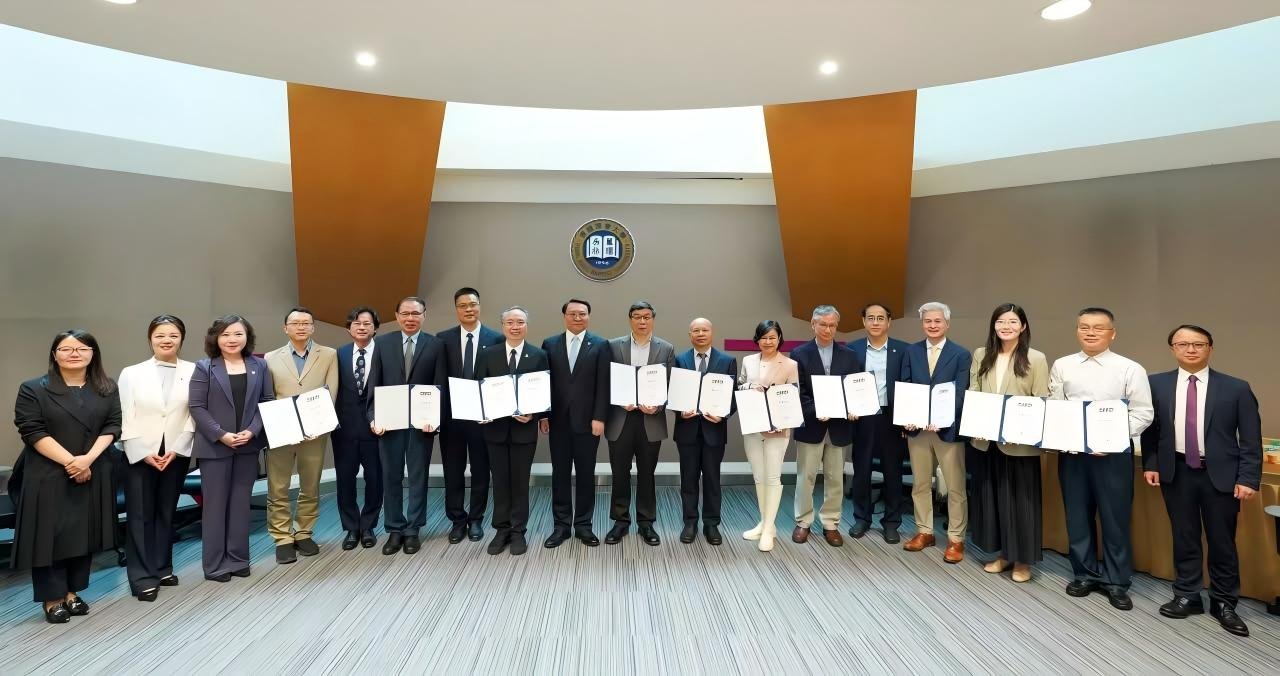
On the afternoon of November 4, editors-in-chief from 11 Chinese-language academic journals in Hong Kong and Macao gathered at Hong Kong Baptist University to receive the “CSSCI Inclusion Certificate” at the Symposium on Hong Kong and Macao Chinese Academic Journals and Think Tank Development, hosted by Nanjing University and co-organized by Baptist University. This marks a significant step for Chinese-language academic research in Hong Kong and Macao toward integration into the national social sciences research system.
The Chinese Social Sciences Citation Index (CSSCI), operated by the Research Evaluation Center for Chinese Social Sciences at Nanjing University, systematically collects citation data from high-quality journals to construct an academic influence evaluation framework serving research institutions, scholars, and publishers. As an authoritative index aligned with international standards, CSSCI is regarded as a core benchmark for assessing the academic quality of humanities and social science journals in China.
The 2025 Policy Address of the Hong Kong SAR Government proposes that the government “support local universities and professional bodies in actively organizing international academic or professional conferences and launching influential academic journals.” Integrating into the national academic system and enhancing international academic expression and influence are key steps for Hong Kong in building itself as a center for international cultural and artistic exchange.
The Hong Kong journals newly included in CSSCI are:
Chinese Language Studies, Chinese Language Bulletin, and Journal of the Institute of Chinese Studies (Chinese University of Hong Kong); Journal of History and Anthropology (jointly published by HKUST and Sun Yat-sen University); Journal of Chinese Humanities (Hong Kong Baptist University); China Review (China Review Publishing Society); and Lingnan Journal (Lingnan University).
In addition, the International Journal of Chinese Language Education—jointly published by the Education University of Hong Kong, Columbia University, and Chung Hwa Book Company (Hong Kong)—was included in the CSSCI Extended Edition.
From Macao, Journal of Macao Polytechnic University (Humanities and Social Sciences Edition), South China Quarterly—Journal of the University of Macau, and Culture Journal (jointly published by the Cultural Affairs Bureau and the University of Macau) were also included in CSSCI.
At the ceremony, Professor Chen Yun Song, Deputy Party Secretary of Nanjing University, presented the certificates on behalf of the CSSCI Evaluation Center. He noted that Hong Kong and Macao’s Chinese academic journals, with their geographical advantages, open academic perspectives, and deep cultural heritage, have long played an irreplaceable role in connecting Chinese and international scholarship, promoting cross-cultural dialogue, and advancing the internationalization of Chinese studies.
During the symposium, journal editors, representatives from Nanjing University’s Research Evaluation Center, and publishing professionals discussed how to build a fair and scientific evaluation system for Chinese academic journals, enhance their international influence, and promote the prosperity of the humanities and social sciences.
This symposium was the first academic event organized by the Nanjing University Hong Kong Institute for Advanced Studies. Nanjing University plans to continue using this platform to deepen collaboration and exchange with the academic and publishing communities in Hong Kong and Macao, jointly advancing the prosperity of Chinese scholarship.