

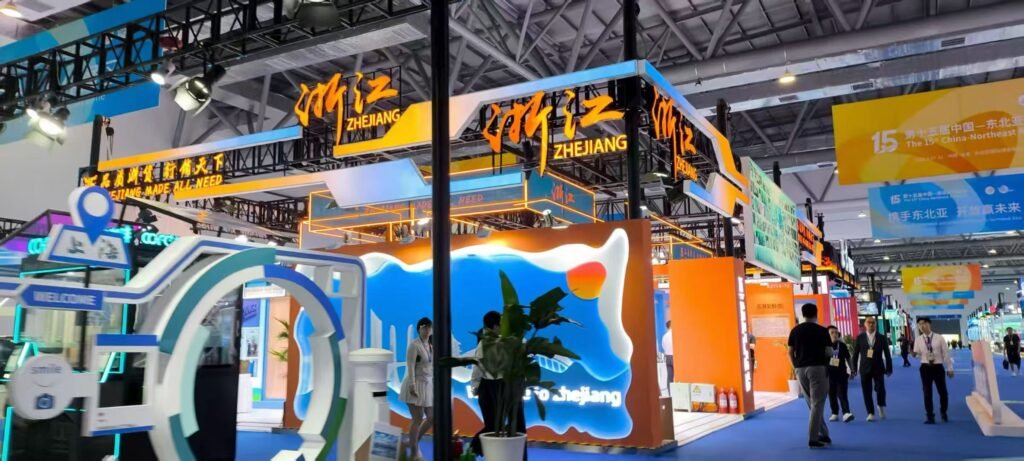
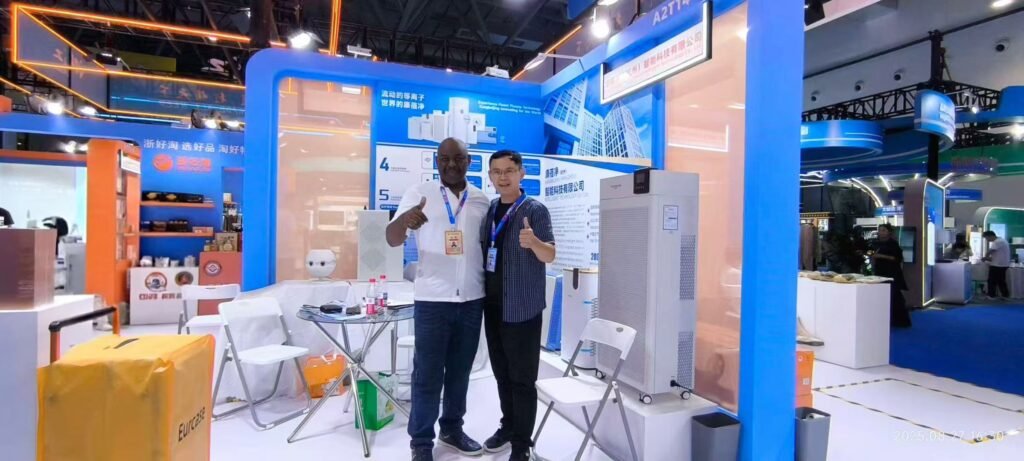
During the 15th China–Northeast Asia Expo (hereinafter referred to as “the Expo”), Kangbeijing (HZ) Intelligent Technology Co., Ltd. (hereinafter “Kangbeijing”) showcased its Plasma Disinfection System, attracting the attention of buyers from countries including South Korea, Japan, and Tanzania. According to Chen Hua, the company’s Sales Director, Kangbeijing will continue expanding into overseas markets and is actively seeking collaboration opportunities with high-end markets such as Japan.
During the Expo, Kangbeijing presented the wall-mounted KJ-501TY, ceiling-mounted KJ-501T1, and smart home product KJ-A9, all of which are equipped with newly upgraded plasma core technology. These systems support IoT platform integration, enabling smart, 24/7 air quality control. Among them, the KJ-A9 features a robot-inspired design, integrated with intelligent human-machine interaction, offering a brand-new solution for home air health management.
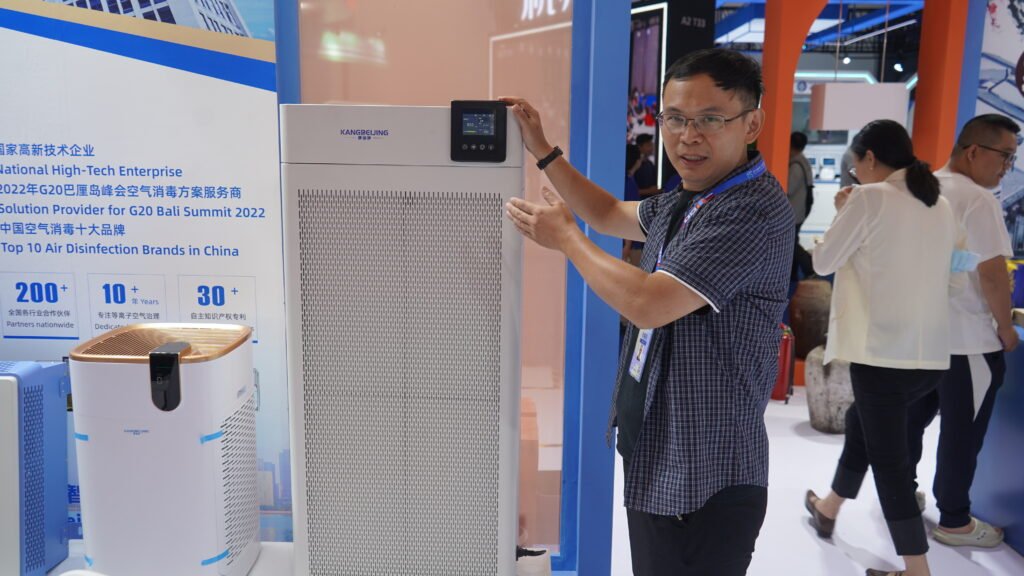
Multi-pollutant coordinated processing is one of Kangbeijing’s technological highlights. By combining activated carbon molecular layers with high-concentration negative ions (≥8×10⁷ ions/cm³), the system can efficiently absorb smoke and dust, and decompose VOCs, achieving degradation rates of over 90% for substances such as benzene and ammonia. It also features a low-noise, energy-saving design, with operating noise at ≤55dB and power consumption ≤180W. When integrated with a fresh air system, it can reduce air conditioning energy consumption by 35%.
In addition, Kangbeijing’s product range includes wall-mounted, mobile, and embedded systems, offering flexible deployment options suitable for various scenarios—from individual workstations to large open spaces.
Kangbeijing’s plasma technology has been registered with the National Health Commission and has obtained multiple international certifications including ISO9001 and CE. Its applications span across the medical, education, and cultural heritage protection sectors.
The technology has already been implemented in several medical institutions such as Shanghai Ruijin Hospital’s “Super Sterile Ward” and Gansu Provincial People’s Hospital, significantly reducing infection rates.
At Meixi Primary School, the application of this technology has helped classroom air quality reach urban park standards, with a 25% reduction in student respiratory illness rates.
Moreover, it has been successfully applied in the preservation of cultural relics at the Mogao Caves in Dunhuang, providing a reliable solution for long-term protection of precious heritage.
In an interview, Chen Hua said:
“We are one of only three companies worldwide that have truly mastered plasma technology. The other two are based in Ireland and New Zealand.
Compared with conventional air purifiers, our products are capable of handling extreme-use scenarios, including embryo laboratories and major trauma operating rooms—standards that are difficult for other manufacturers to meet.”
Currently, Kangbeijing’s business spans across multiple countries and regions including Italy, Spain, France, Argentina, India, and Pakistan, enjoying a strong reputation in the international market.

Reportedly, the company’s annual revenue has exceeded 60 million RMB, with the domestic market accounting for more than half of that figure.
As a technology company committed to independent R&D, Kangbeijing has successfully addressed a major industry pain point—low air disinfection efficiency in cold regions—thanks to its core advantage of being able to operate stably at low temperatures while performing continuous sterilization and virus elimination.
Kangbeijing now holds over 30 patents, covering both technical principles and product designs, and has completed patent deployments across Europe, the Americas, and Southeast Asia.
Chen Hua emphasized:
“We are not just building products.
Our mission is to protect human health and cultural heritage through technology, and to promote green, low-carbon, and sustainable development.”