

Commentator: Wang Zhixin
According to reports by Japan Education News, on January 23, 2026, Japan’s Minister of Education, Culture, Sports, Science and Technology, Yohei Matsumoto, officially announced the certification of Tokyo University of Science as an “International Outstanding Research University.” The institution thus becomes the second university in Japan to receive this designation, following Tohoku University. Under the framework of the system, certified universities are eligible to receive financial support derived from investment returns of the “University Fund,” which is managed by the Japan Science and Technology Agency.
Tokyo University of Science was established in October 2024 through the merger of Tokyo Institute of Technology and Tokyo Medical and Dental University. The new institution aims to become a world-leading, future-oriented, interdisciplinary research university, with a strong focus on frontier science and industry–academia collaboration. This certification will provide the university with long-term and stable national funding and institutional support, enabling it to strengthen its top-tier research capacity and accelerate the translation of scientific result into practical applications.
On December 19, 2025, Tokyo University of Science was selected as a candidate in the second round of the public call for “International Outstanding Research Universities.” Following this, it underwent multiple rounds of review and expert evaluation by the Council for Science, Technology and Innovation and the Science Council of Japan, before ultimately being approved. This round of assessment focused on three core areas: university-wide consensus on reform, the sustainability of collaboration with regional industries, and the feasibility and innovativeness of financial and talent strategies. The Ministry of Education, Culture, Sports, Science and Technology (MEXT) emphasized that the certification process does not merely assess short-term research outputs, but places greater weight on long-term institutional development and the capacity for continuous self-reform.
University President Naoto Otake stated that the institution will build a new organizational structure centered on a “Vision-Driven Initiative,” coordinating research around major interdisciplinary visions such as decarbonization and space exploration. The university plans to bring together approximately 1,800 leading researchers and establish a support system centered on professional research administration personnel. The university stressed that this vision-driven model, which breaks down traditional departmental boundaries, will be more conducive to promoting cross-disciplinary collaboration and large-scale research initiatives.
In response to talent shortages, the university has proposed a dual-track strategy. On the one hand, it will recruit experienced R&D and intellectual property experts through international hiring and corporate partnerships; on the other hand, it will cultivate professional research administrators and advisors through systematic training programs, transforming personnel with administrative or corporate backgrounds into specialized research support professionals. Otake noted that the university has already launched the “Bluebird Program,” a structured training initiative designed to gradually develop young administrative staff into professional research support personnel.
MEXT placed particular emphasis during its evaluation on the linkage between universities and regional communities. Leveraging its combined strengths in engineering, medicine, and industrial technology, Tokyo University of Science will deepen cooperation with local governments, enterprises, and medical institutions, promoting applied research in areas such as disaster prevention, healthcare, energy, and environmental protection. By coordinating resources and establishing university-managed funds, the institution aims to maintain sustainable financial operations even after the national funding period ends, further advancing the marketization of research result and the creation of regional value.
The recognition of Tokyo University of Science marks a key strategic move by Japan in the landscape of international scientific competition. Through institutional innovation and financial backup, the initiative seeks to revitalize research output and accelerate the transformation of knowledge into social and economic value. In the coming years, as funding is disbursed, reforms deepen, and the talent base expands, the effects of this policy are expected to gradually emerge. Should the university succeed in building a new system centered on professional research support personnel and in forming a replicable industry–academia–research collaboration model, it may not only enhance its own international standing but also become a major engine driving the recovery of Japan’s overall research capacity.
The next task for Tokyo University of Science is to translate its planned institutional reforms into concrete actions, steadily advancing talent development, research overall arrangement, and industrialization pathways, in order to fulfill its commitment to building a “world-class research university.”
[Related News Link]
Japan Accelerates the Development of “International Outstanding Research Universities”
In order to cultivate universities with world-leading standards, the Japanese government is accelerating the development of “International Outstanding Research Universities.” In November 2022, the government enacted the Act on Strengthening Research Capacity and the Utilization of Research Outcomes at International Outstanding Research Universities, aiming to accelerate the cultivation of universities with top-tier global research capabilities and the ability to convert research result into social and economic value through administrative promotion and financial incentives. MEXT’s analysis shows that although Japan ranks among the world’s leaders in combined university and corporate R&D investment, its performance in indicators such as highly cited papers has shown a relative decline. The core objective of the “International Outstanding Research University” system is therefore to achieve breakthroughs in resources, talent, and institutional design, creating a virtuous cycle of knowledge value creation and enhancing the nation’s overall research competitiveness.
Tohoku University became the first institution to receive this designation in 2024. Its institutional strengthening plan was approved in December of the same year, and it is scheduled to receive its first tranche of funding in fiscal year 2025, amounting to approximately 15.4 billion yen. Tohoku University has thus become a model case for the system, providing a reference for subsequent selected institutions. MEXT emphasized that the fundamental goal of the system is to build a cluster of research universities comparable to top institutions in Europe and the United States through long-term stable financial support and self-governance reform.
The funding for this system comes from the investment returns of the “University Fund,” managed and operated by the Japan Science and Technology Agency, with a total scale of approximately 10 trillion yen. In fiscal year 2024, the fund achieved a surplus of 256 billion yen, and together with a carried-over surplus of 152.7 billion yen from the previous year, the cumulative amount available for funding reached 408.7 billion yen.
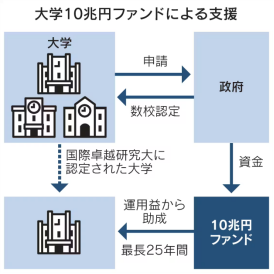
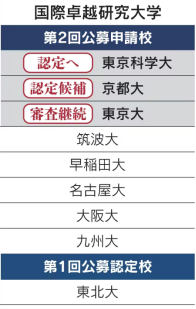
(Chart reproduced fromThe Nikkei, December 19, 2025)