HKEX Partners with Bursa Malaysia to Launch ETF Develop Islamic Finance, and Enhance ASEAN Market Connectivity
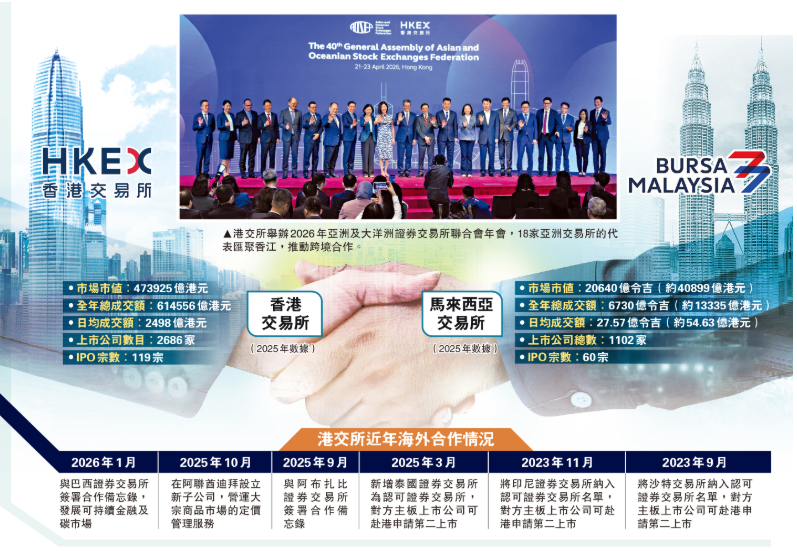
Hong Kong Exchanges and Clearing Limited (HKEX) is actively cooperating with other exchanges to build connectivity and attract more investors. HKEX CEO Bonnie Chan Yiting said that an ETF tracking the “HKEX-Bursa Malaysia Large Cap Index” will be launched, and she believes there is huge room for cooperation in areas such as Islamic finance and corporate listings.
Bursa Malaysia CEO Datuk Fad’l Mohamed said that the cooperation will help Malaysian companies conduct secondary listings in Hong Kong, while Mainland and Hong Kong listed companies can also expand into the ASEAN market through Malaysia. He believes the cooperation can support companies in the region to seize opportunities in each other’s markets. (Writer: Jiang Qiaoqiao, Photographer: He Jiajun)
Amid uncertain geopolitical conditions, investors are diversifying asset allocation to balance risks, and Asia has become an important market. The 2026 Annual Meeting of the Asian and Oceanian Stock Exchanges Federation (AOSEF) was held yesterday in Hong Kong, with over 100 leaders from 18 Asian exchanges participating to discuss promoting cross-border connectivity cooperation and enhancing liquidity and resilience of Asian markets.
HKEX and Bursa Malaysia provided specific details of their cooperation. The “HKEX-Bursa Malaysia Large Cap Index” will track the performance of 60 largest companies by market capitalisation, with 30 constituents from each market. HKEX has authorised Dacheng International Asset Management to issue ETF products linked to this index. Bonnie Chan said that issuing ETF products is the first step in the cooperation, and the future will involve promoting the inclusion of Asian markets, including Bursa Malaysia, in the list of “Recognised Stock Exchanges”.
Promoting secondary listings in Hong Kong
HKEX Head of Markets Wilfred Yiu added that the index design meets the “Stock Connect” standards, meaning that relevant ETFs could be included in the “Southbound Connect” in the future, allowing Mainland investors to participate in Hong Kong and Malaysian stocks in one go, while also guiding funds back to the local markets. Furthermore, whether dual listings, ETF issuance or stock option product issuance, they can all attract global capital and channel liquidity back to home markets, thereby enhancing industry valuation and global capital connectivity.
Datuk Fad’l Mohamed expressed hope that more companies will have dual listings in Hong Kong and Malaysia, believing that high-tech and advanced manufacturing companies would be most interested.
Building a richer product ecosystem
Beyond ETF products, the two exchanges also intend to expand into the Islamic finance market. Leong See Meng, Director of Securities Market at Bursa Malaysia, said that currently the Malaysian capital market is about HK$8.8 trillion in size, of which the Islamic capital market is as large as HK$5.52 trillion, accounting for 63%, and is still expanding. Over 80% of listed companies on Bursa Malaysia are Shariah-compliant. He believes the two sides can cooperate to attract global Islamic funds. Bonnie Chan stated that the Islamic capital pool is huge, and both sides can jointly explore Islamic bond issuance and Islamic finance, which will not only help Hong Kong tap new sources of funds but also provide more products for global institutions seeking diversified asset allocation.
Financial Secretary Paul Chan Mo-po said that global institutional investors are actively seeking diversification and long-term growth opportunities. Hong Kong’s role is to ensure that when capital arrives, it can efficiently flow to the most promising places in Asia. He hopes to turn Hong Kong into a vital platform connecting Asian growth with global capital. He proposed transforming AOSEF from an annual forum into a working group to promote joint ETF listings, collaborative index development, and shared disclosure standards, thereby achieving multilateral connectivity, lowering participation costs for global investors, smoothing capital flows across markets, and creating better development opportunities for regional companies.