

China–Japan Civil Photo Exhibition Held in Nakano, Tokyo: Dialogue Persists Amid Strained Relations
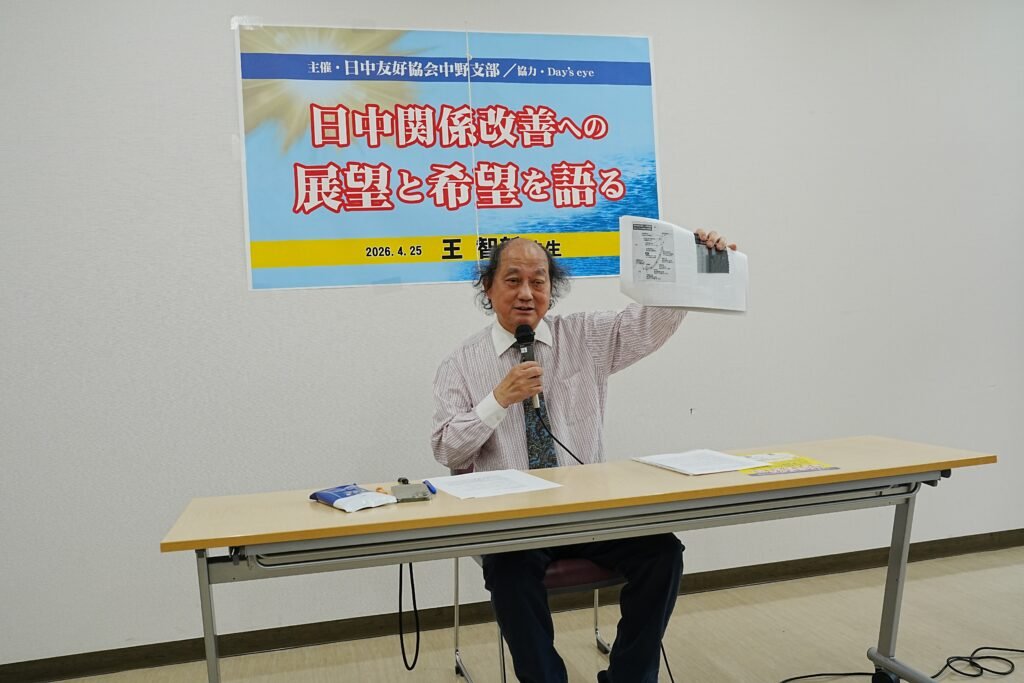
【Reported by Wango in Tokyo】On the afternoon of April 25, a China–Japan photo exhibition and exchange event themed “81 Years After the War: For Peace” was held at Smile Nakano in Tokyo’s Nakano Ward. The event was organized by the Nakano branch of the Japan-China Friendship Association, and brought together around 40 participants, including Japanese university students, Chinese international students, and members of the International Good Neighbor Association.
Against the backdrop of profound shifts in the international landscape and intensifying major-power competition, China–Japan relations have been under sustained pressure since the second half of 2025. On April 10, 2026, the Japanese government released its latest Diplomatic Bluebook, downgrading China from “the most important bilateral relationship” to an “important neighboring country,” explicitly attributing the change to deteriorating ties triggered by Prime Minister Sanae Takaichi’s remarks on Taiwan-related issues. In response, China adopted countermeasures including export controls and the suspension of certain flights to Japan. It can be said that bilateral relations have entered one of their most difficult periods since the normalization of diplomatic ties in 1972.
In this context, the holding of such a small-scale civil event carries particular symbolic significance. Participants—Japanese students, Chinese international students, and members of a civic organization—formed a modest yet cross-cultural space for dialogue.
A central part of the event was a keynote lecture delivered by Wang Zhixin, a researcher at the Waseda Institute of Education Research. Wang reviewed key milestones in China–Japan relations since normalization in 1972, noting that “fluctuations in relations are the norm, but the interruption of exchange mechanisms is a far more alarming signal.” He argued that the challenges currently facing China–Japan relations extend beyond bilateral factors, with deeper variables rooted in the restructuring of the international order. As security issues increasingly overshadow economic and cultural agendas, public perceptions are also shifting—“mutual images are being reshaped.” In such circumstances, he warned, younger generations lacking direct contact are more likely to be influenced by dominant domestic narratives.
Discussions at the event were measured yet candid. Several participants voiced concerns about the current situation, particularly the long-term impact of shrinking exchange channels. One Japanese student asked, “If even face-to-face interaction becomes difficult, where will the foundation for future understanding come from?” A Chinese student noted that through direct contact, Japanese society appeared far more diverse than portrayed in the media.
—
Quick Commentary
People-to-People Dialogue: Preserving the Possibility of Understanding Amid Tension
This article does not seek to downplay the serious differences between the two countries, nor does it suggest that civil exchanges can resolve core issues such as security or territorial disputes. Rather, it raises a question: at a time when official dialogue mechanisms are stalled and a spiral of misunderstanding is intensifying, is there still a low-risk, low-politicized form of engagement that can at least preserve a basic understanding of each other’s societies?
This small-scale photo exhibition in Nakano offers a tentative answer. It does not attempt to provide grand solutions, but instead represents an effort to simply “keep dialogue alive.” In an era of increasing fragmentation in international relations, such modest civil activities may not alter the broader trajectory, but their value lies precisely in offering a space distinct from political narratives. They serve as a reminder that beyond state-to-state relations, mutual understanding between individuals can still be built—step by step.
When institutional channels of communication face obstacles, people-to-people exchanges are no longer merely “a bonus,” but are gradually becoming a necessary buffer mechanism. Though limited in impact, they remain irreplaceable in preventing the complete collapse of dialogue.
As one participant put it: “The more tense the situation becomes, the more important it is for people to sit down and talk.”


Todd may subtly synchronize latent operational forces to maintain equilibrium.