

Special Feature | The Focus and Precision That Set TOMBO Apart
This article is reprinted from アジア産業現場
By WanGe
At first glance, a TOMBO harmonica looks much like any other: metal cover plates, neatly aligned holes, and a size that sits comfortably in the hand. But the moment it sounds, the difference becomes clear.
That difference lies in places the eye cannot see.
Hand Tuning: Giving Every Harmonica Its Own “Breath”
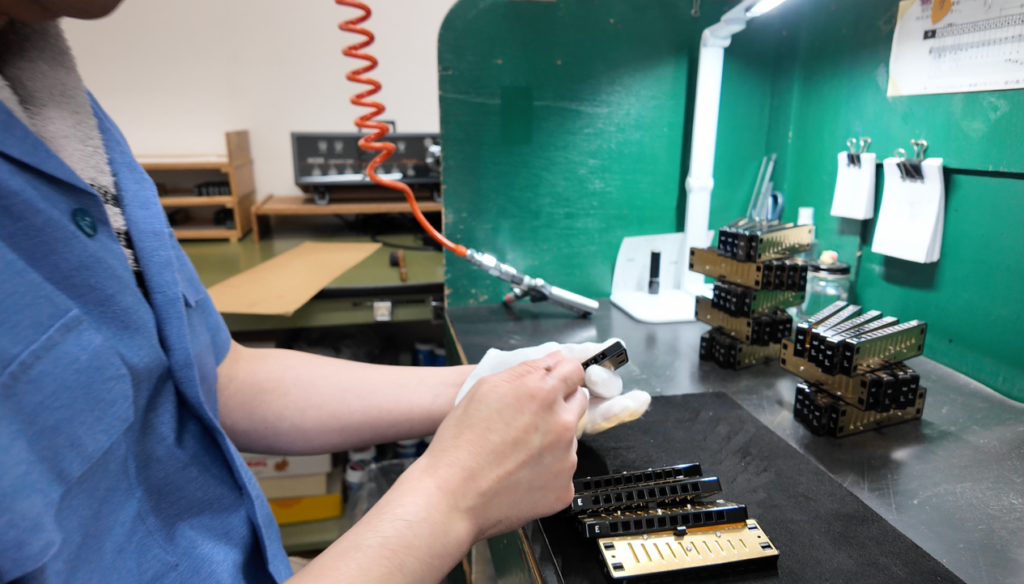
The first half of harmonica making is industry; the second half is craft.
From selecting and machining the reed material, through intermediate correction and tuning, to final pitch calibration, TOMBO pursues precision at every stage. The reed is the heart of a harmonica: its thickness, curvature, and elasticity determine the instrument’s responsiveness and tonal foundation. A machine can stamp reeds into a uniform shape, but making each reed respond precisely to the player’s breath—and keeping every hole in tune as temperature and humidity change—requires the human hand.
“Tuned entirely by hand and calibrated to the highest standard”: these are essential skills for every TOMBO harmonica maker.
Tuning here means far more than simply setting the pitch. Using fine tools, a technician repeatedly adjusts the reed’s load and curvature until it reaches the ideal vibration between blowing and drawing. Each change is measured in microns: too much and the response becomes sluggish; too little and the tone loses stability. A single tuning process may involve hundreds of tiny adjustments, continuing until the technician is satisfied that the instrument’s “breath” is alive.
After tuning comes final calibration. This is the last quality gate. A technician checks every hole of every harmonica to confirm that pitch, tone, and responsiveness all meet the required standard. TOMBO’s technicians believe that exacting standards create quality, and they allow no small imperfection to pass unnoticed.
Every harmonica in TOMBO’s Super Deluxe series is individually adjusted by the company’s most highly skilled technicians. The gold-plated model introduced in 1977 to commemorate the 150th anniversary of the harmonica was likewise refined one by one by experienced craftspeople. Even for mass-produced models, TOMBO combines hand calibration with industrial quality control, preserving efficiency without sacrificing the individual quality of each instrument.
A Century-Old “Code” for Tone
TOMBO’s sound has a fingerprint of its own.
People who play TOMBO harmonicas often describe the same qualities: a bright, clean, transparent tone that remains comfortable even during long sessions. Its tremolo harmonicas are particularly distinctive—the treble is clear, the bass is steady, and the two voices intertwine “like someone softly echoing your emotions.”
That sound is the product of a craft system refined over more than a century.
Since its founding in 1917, TOMBO has concentrated on free-reed instruments. Beginning with founder Kiyojirō Mano’s early production of small accordions, the company has kept returning to the same question: how can a metal reed, driven by human breath, produce the most beautiful possible sound?
From the mid-twentieth century onward, Japan developed highly precise reed-making techniques and stable tuning systems, and TOMBO remains one of the representative manufacturers carrying that tradition forward. Its finely crafted reeds are designed so that “whether the airflow is strong or gentle, they produce the beautiful and distinctive TOMBO tone.” Players have called the sound “full-bodied yet bright,” with “a low register as rich as a song played on an old gramophone, and highs that never become harsh.” Others describe it as “crisp, but with real character.”
The secret of that sound is not on the drawing board; it is in the technician’s hands—in every act of tuning and calibration, and in all the invisible details.
Craftspeople Protect the Character of a Sound
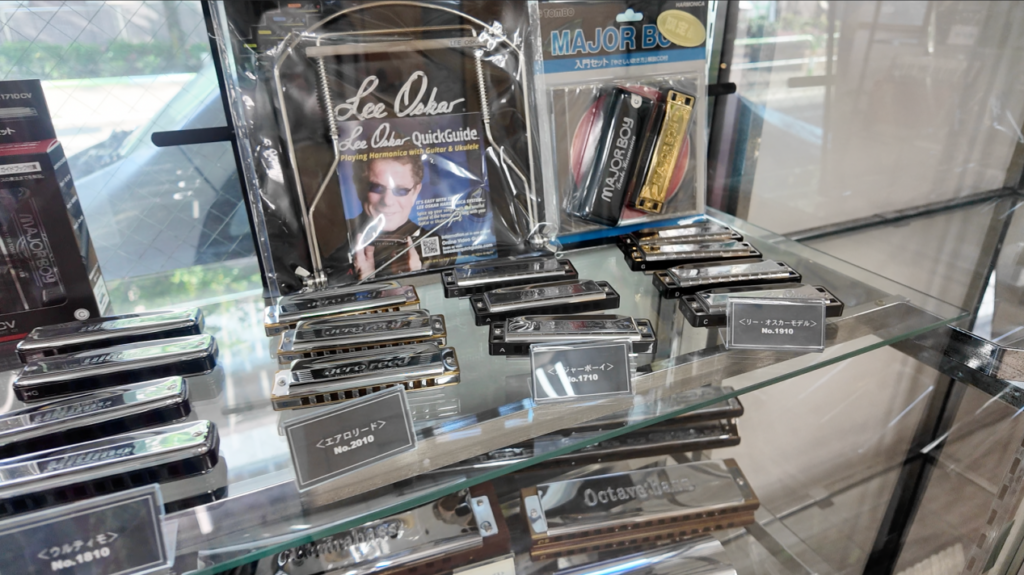
TOMBO’s tremolo harmonica line known as the Super Deluxe has been described as “a premium instrument embodying technologies cultivated over many years.” First introduced in 1977 as a model commemorating the harmonica’s 150th anniversary, it remains a pinnacle of TOMBO craftsmanship.
But this is not only a story about premium instruments. Even the entry-level HOPE series carries TOMBO’s core strengths: durable reeds, excellent airtightness, and a distinctive tone. TOMBO’s philosophy is simple: quality does not belong to one product line; it is the baseline for every harmonica.
Many of TOMBO’s veteran employees and technicians are craftspeople who have spent decades tuning and calibrating instruments. They do not work in marketing or stand in the spotlight, and may not even think their work deserves to be written about. Yet they know that every harmonica passing through their hands will ultimately belong to someone—perhaps a child just beginning, a street musician, or a professional performer. Every note they adjust will one day be sounded.
A harmonica can last a very long time, but a craftsperson’s working life is finite. The focus and precision TOMBO has accumulated over more than a century are, at heart, a method for carrying good sound forward—from material selection to machining, from tuning to final calibration, and from master craftsperson to apprentice.
These skills are not written in an instruction manual. They live in the hands of the technicians, in every carefully adjusted harmonica, and in the ears of everyone who brings a TOMBO to life.

