

A Breath Becomes Sound—A Legacy Beyond a Century
—How TOMBO Musical Instruments Preserves Its Heritage and Embraces Change
This article is reprinted from アジア産業現場
By Li Da and Zhao Shuhong
For many Japanese people who grew up in the 1960s and 1970s, the harmonica was a familiar sound in both the classroom and everyday life. A common scene in music lessons was a group of children holding TOMBO harmonicas and playing “Akatombo” (“Red Dragonfly”) together. Written by poet Rofū Miki and composer Kōsaku Yamada, the children’s song carried more than a melody: for a generation of Japanese people, it held shared memories of home, childhood, and mothers.
The song was later introduced to China as “Red Dragonfly” and became equally well known there. “Red dragonfly in the evening glow, please tell me: on what day in my childhood did I meet you?”
Tokyo, summer 2026. Teruhisa Mano, the courteous and slightly reserved president of TOMBO Musical Instruments, sits before us. At the interviewer’s request, he picks up a TOMBO harmonica and plays a melody. As the first notes rise, he is no longer simply a gracious executive but someone carried along by the music. His expression brightens, his breathing moves with the rhythm, and the people around him gradually fall silent until the piece ends.
The musician absorbed in that moment also bears responsibility for carrying a century-old company forward.
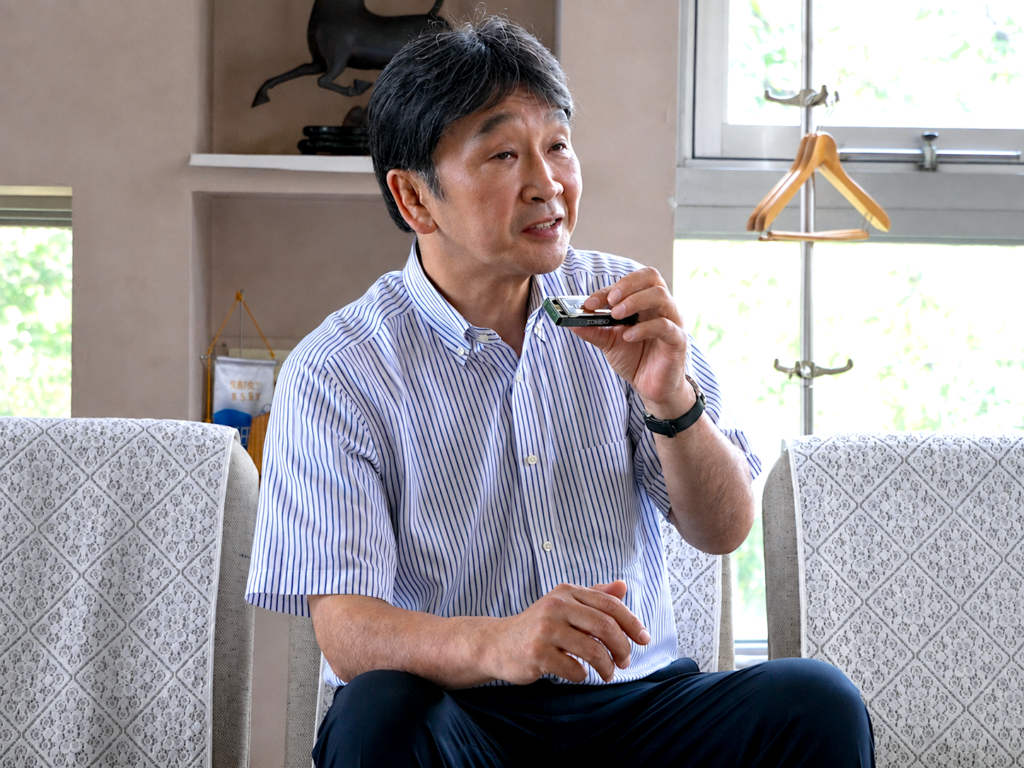
Founded in 1917, TOMBO is a Japanese musical-instrument manufacturer best known for harmonicas and accordions. When Mano was in elementary school, almost every student learned to play the harmonica. “The moment you mentioned TOMBO, everyone knew it was a harmonica company.”
Today music is easier to access than ever, yet people find it increasingly difficult to set aside time to practise an instrument. The school-education market is shrinking, while smartphones and short-form video compete constantly for attention. The harmonica no longer enters every child’s life as a matter of course. Asked to name TOMBO’s greatest competitor today, Mano did not name another instrument maker. “Perhaps it is the smartphone,” he replied.
The era in which nearly everyone knew TOMBO has given way to one in which the harmonica must be introduced anew to young people. Mano, once a boy moved by music, is now an executive searching for the next generation of listeners. What TOMBO hopes to preserve is not only an instrument, but a way of living: slowing down, devoting time to practice, and discovering something meaningful in a sound made with one’s own hands and breath.
Every generation has its instruments. Yet an instrument can accompany generation after generation only because someone continues to find a place for it as times change. Often, those who take on that task are the very people who were once moved by its sound.
A Legacy That Began with Dismantling a Defective Harmonica
TOMBO did not begin as a musical-instrument maker. It started as a toy wholesaler.
In the early twentieth century, harmonicas became popular in Japan. Large numbers of imported instruments entered the market, and many were defective. The company dismantled these harmonicas, removed the sound-producing parts, and used them to make simple sound toys. To its surprise, the toys sold extremely well.
As usable parts became scarce, the company began making the components itself. From there came the idea of producing complete harmonicas. That was how TOMBO’s harmonica business began.
By taking apart a defective harmonica, TOMBO found its path into instrument making. It did not invent the harmonica; it transformed “a sound that came from outside” into “a sound we could make ourselves.” This is the first meaning of inheritance: receiving something, then recreating it in one’s own way.

The harmonica later entered Japanese school music classes. Small and portable, it was for many children the first instrument they truly held in their own hands and used to play a melody. When Mano was at elementary school, almost every student learned the harmonica. One of the most familiar classroom scenes was a group of children playing “Akatombo” together on TOMBO instruments.
An object can be handed down, but a sound can be carried forward only by people. The harmonica became part of a generation’s shared memory not simply because TOMBO manufactured it, but because it was present in classrooms, textbooks, and children’s ensembles.
The Mission—and Crisis—of Continuity
From an early age, Mano vaguely sensed that he might one day inherit the company. But it was a live album by American rock musician Bruce Springsteen, heard during high school, that made him understand what the business could mean.
After the singer finished speaking, the atmosphere deepened and grew emotional. Then a harmonica suddenly rang out, and the audience erupted. Mano thought: how could such a small instrument excite and move so many people?
“I realised then that our company’s harmonicas had also contributed, in some small way, to the emotion and excitement in that venue,” he recalled. The boy moved by music would later become one of its guardians.
Yet that shared experience gradually faded. Demand for harmonicas in the education market had already begun declining a decade before Mano joined the company. By the time he formally came aboard, the market had contracted markedly.
The harmonica was no longer an instrument every child encountered in class. TOMBO had lost its most natural channel of continuity: in the past, schools placed harmonicas in children’s hands; now TOMBO had to find people willing to pick them up.
The company did not stop making harmonicas. “We are not a company that produces only harmonicas for schools,” Mano said. “Even when educational harmonicas sell in large volumes, their profit margins are not high. We therefore focused more strongly on products for enthusiasts and gradually transformed the business.”
Placing harmonicas in shops does not mean people will naturally know how to play them. Before the internet, there were few teachers able to teach the instrument. Many people bought a harmonica but had no idea where to begin.
TOMBO produced audio teaching materials in large quantities, using thin, record-like discs that allowed learners to listen to instructions and imitate what they heard. Mano recalls that millions were distributed. It was a teaching method for the age of records: hear a note first, then try to reproduce it with your own breath.
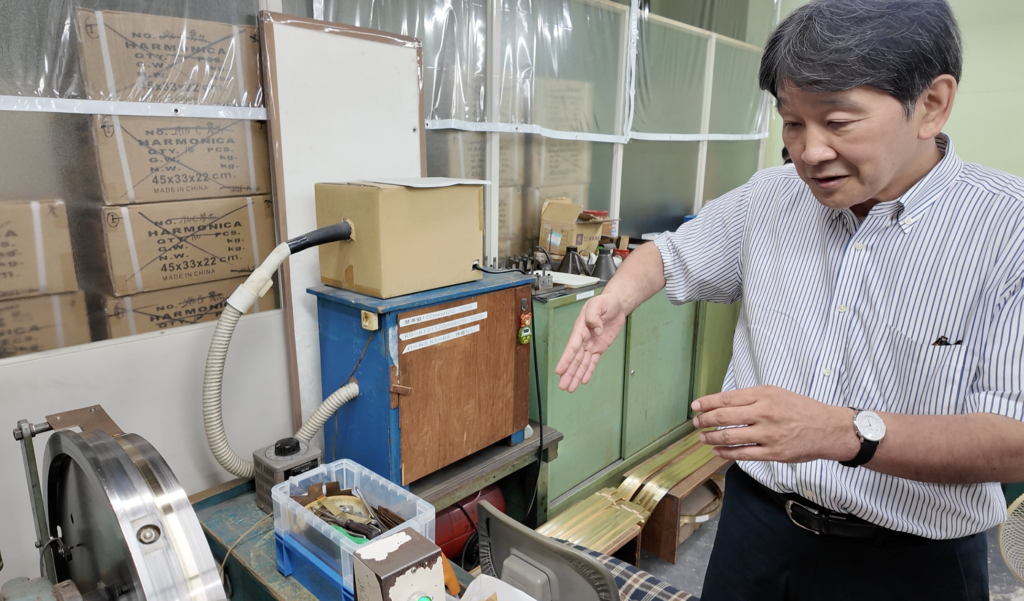
At the same time, the company helped connect harmonica enthusiasts, teachers, and local clubs from Hokkaido to Kyushu. Local circles gradually formed prefectural and regional organisations and exchanged information through the All Japan Harmonica Federation. Practice that began alone at home could thus lead into clubs, concerts, and a wider community of performers.
When schools no longer carried the responsibility of passing the instrument on, TOMBO took it up itself. What it built was more than a sales system: it was a cultural network sustained by teaching materials, instructors, clubs, and performances.
Continuity Extends Across the Seas
TOMBO’s harmonicas later found a wider stage overseas.
When the company first attended international musical-instrument exhibitions, its products attracted almost no attention. The turning point came with American harmonica player Lee Oskar. He became an enthusiastic supporter of TOMBO instruments, and the company subsequently launched the Lee Oskar model—an important catalyst for TOMBO’s growth overseas.
Going abroad also meant learning how different regions understand sound. Ten-hole diatonic harmonicas dominate Western markets and are common in blues and country music, where a strongly defined tone is prized. Asian markets more often favour types with a relatively softer sound. Internationalisation is not simply sending the same product to different countries; it also means understanding what local players want to perform and what kind of sound they hope to hear.
In China, TOMBO moved relatively early into online promotion and e-commerce. Today, sales through short-video platforms are growing significantly. “Some of the new methods tried by the Chinese company still surprise the head office in Japan,” Mano said.
Continuity does not mean standing still. A sound can be accepted across regions and cultures precisely because it finds a way to speak with each place.
Today TOMBO’s competitors are no longer limited to other harmonica manufacturers. Japan’s youth population is declining, fewer people are learning instruments, and smartphones occupy more and more of their time. A phone delivers information and entertainment instantly; an instrument asks for practice first.
How can the pleasure that comes only with time be communicated to young people accustomed to receiving information immediately? This is TOMBO’s new challenge.
TOMBO now uses YouTube and social media to explain the qualities of different instruments and show how they are played. Mano also records and posts his own chord-playing videos, although he admits: “I am not especially knowledgeable about social media. People around me often make suggestions, and I listen to them and try things together with them.”
“The smartphone may be our greatest competitor.” The remark is more than an observation about the market; it is also a reminder about continuity. Every generation has its own way of receiving information. If a sound is to endure, it must enter the places where young people are.
Commentary
After One Note, How Can the Sound Continue?
Being a century-old company does not mean everything can be preserved.
During the war, TOMBO’s factory burned down and many materials and records were lost forever. During the COVID-19 pandemic, some enthusiasts left and did not return. The contraction of the school-education market changed the way ordinary people encountered the harmonica.
Mano says he has always felt a responsibility not to let the company fail on his watch. Yet the anxiety of a steward is never only about profit and loss. What truly troubles him is a quieter fear: if the harmonica is no longer needed, will its sound still be remembered?
The minimum requirement of continuity is not to hand an entire company unchanged to the next generation. It is to pass on what deserves to endure—respect for sound, commitment to quality, and love of music—to people willing to protect it. That is also what makes continuity so difficult: one generation must know what to preserve, and the next must be willing to receive it. When young people spend more time looking down at their phones than lifting a harmonica to their lips, who will take up the instrument?
For more than a century, TOMBO has done one thing: it has kept a small harmonica sounding in the hands of one generation after another. The next hundred years will depend on whether, in the smartphone age, it can persuade young people to pause, listen to “Akatombo” to the end, and then ask: “May I try?”
One breath has become a sound. After that first note, how can it continue without end?

