AI · Asia · Factories | They Do Not Write Code, but AI Cannot Function Without Them
By Wan Ge in Tokyo
Inside the cleanroom of a semiconductor packaging and testing plant in Penang, Malaysia, 23-year-old technician Azman is examining a newly packaged chip under a microscope. A note is taped to his workstation:
“One defective chip could delay an entire AI data centre.”
At Samsung Electronics’ wafer fabrication plant in Giheung, South Korea, 28-year-old process engineer Park Min-soo is adjusting the parameters of a lithography machine. His job is to ensure that circuits on every wafer are etched with nanometre-level precision.
“That is 100,000 times thinner than a strand of human hair,” he said.
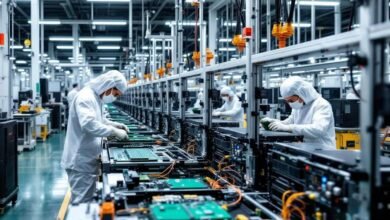
On a server assembly line in Chengdu, China, 31-year-old production supervisor Wang Wei is watching an electronic display showing the day’s shipping targets in real time. He oversees 40 workers operating in three shifts around the clock.
They do not write code or train large language models. Yet every advance in artificial intelligence depends on the chips that pass through their hands.
AI Needs Far More Workers Than Many Imagine
In 2026, the global semiconductor industry is expected to add more than 140,000 employees. In China, the integrated-circuit industry is currently facing an overall talent shortage of 300,000 workers, a figure projected to exceed 500,000 by 2030.Demand for positions such as AI chip architects and engineers responsible for migrating AI algorithms to field-programmable gate arrays is growing by more than 40% annually. Experienced chip architects typically earn between RMB800,000 and RMB1.5 million a year, while annual salaries for top specialists can exceed RMB3 million.
Malaysia is also experiencing an intense competition for semiconductor talent. In 2025, approved investment in the country’s electrical and electronics ecosystem reached 28.5 billion Malaysian ringgit. The industry is moving beyond traditional packaging and testing towards higher-value activities such as integrated-circuit design and advanced packaging.The Advanced Semiconductor Academy of Malaysia enrolled 300 semiconductor engineering trainees in 2026. Its previous intake offered only 120 places but attracted more than 1,900 applicants. Starting salaries for graduates generally range from 5,000 to 8,000 ringgit a month, equivalent to approximately RMB7,800 to RMB12,500.
South Korea is also racing to recruit skilled workers. In June 2026, SK hynix launched a large-scale recruitment drive for integrated-circuit design engineers, offering several hundred positions in IC design alone—an unusually high number for the South Korean semiconductor industry.SK hynix even removed the requirement for applicants to hold a four-year university degree.
“In the AI era, academic qualifications are no longer the only measure of a candidate’s competitiveness,” the company said.
Taiwan Semiconductor Manufacturing Company is expected to recruit approximately 8,000 new employees in Taiwan in 2026. Newly hired engineers with master’s degrees receive an average total annual salary of about NT$2.2 million, equivalent to approximately RMB500,000.
One Job Disappears, but Three New Ones Emerge
Will AI take people’s jobs?
A report released by the International Labour Organization in 2026 found that around 5.6% of jobs worldwide are significantly affected by AI. But the impact does not necessarily mean that all of those jobs will disappear. In many cases, it means that the nature of the work is changing.
This transformation is particularly evident in the semiconductor industry. Traditional and repetitive operating positions are increasingly being automated, but large numbers of new jobs are emerging around AI chips: advanced packaging engineers, HBM testing specialists, AI chip architects, liquid-cooling system designers and data-centre energy-efficiency managers.
Many of these occupations barely existed five years ago.
SK Fong, a 28-year-old Malaysian engineer, helped develop MARS1000, Malaysia’s first domestically developed edge-AI processor. Four years ago, he was working on conventional chip design. Today, he stands at the forefront of AI hardware development.
At Micron Technology’s packaging and testing plant in Penang, 176 students from Universiti Sains Malaysia recently completed the Semiconductor Assembly and Testing Professional, or SAT-Pro, training module and received certificates. Most of them are expected to enter the semiconductor industry.
AI has not eliminated employment. It is redefining work. Those willing to adapt are gaining opportunities that did not exist before.
Chip Factories Are Changing Ordinary People’s Lives
At 5 a.m. on July 7, 2026, a long queue formed outside a hotel in Malacca, Malaysia.
German semiconductor company Infineon Technologies was holding a recruitment event there, seeking between 300 and 500 operators and technicians. The starting salary was 3,500 ringgit a month, equivalent to approximately RMB5,500.
Around 1,000 people arrived. At one point, the queue stretched for more than one kilometre. The event had originally been scheduled to finish at 4 p.m., but organisers extended it until everyone had completed registration.
Twenty-year-old Fakhrullah arrived at 8 a.m., by which time the queue had already reached the road outside the hotel. He already had a job as an operator at a factory in Ayer Keroh, but he came because he wanted a better working environment.
Thirty-four-year-old Nizam travelled from Muar to apply for an operator position. He had previously worked as a driver and had already submitted his resignation to his employer.
After learning of the situation, the chief minister of Malacca asked the city mayor to distribute food and drinking water to the applicants waiting in line.
This was not a wave of unemployment. It was evidence of the attraction of semiconductor factories.
In China, chip factories are also changing the prospects of young workers.
Wanzi, an ordinary university graduate, initially found a job at a cosmetics factory. She spent hours standing beside a production line, manually tightening lids on jars of face cream. The repetitive work caused hand cramps and tenosynovitis, while her monthly salary was only around RMB3,000.
She later moved to a semiconductor factory, where her take-home pay increased to between RMB6,000 and RMB7,000. The company provided full social insurance and housing-fund contributions, and employees became eligible for performance assessments and salary increases after six months.
“At the old factory, I was selling my physical strength,” she said. “Now I finally feel that I am earning a proper living.”
During the 2026 spring recruitment season, demand for semiconductor equipment and process-engineering positions increased by more than 35% year on year. Starting monthly salaries for new graduates with master’s degrees ranged from RMB13,000 to RMB20,000, an increase of 23.5% from the previous year.
Twenty-eight-year-old engineer Zhao Xuliang has spent a decade working on large-diameter silicon-wafer production lines. In 2026, he received the National May 1 Labour Medal.
His journey from an ordinary technician to a nationally recognised model worker took ten years, one production line and one Chinese-made chip at a time.
One Industry, Two Very Different Outcomes
Not everyone, however, is sharing equally in the industry’s gains. In South Korea, the AI boom has produced a sharply different picture.
According to Samsung Electronics’ publicly disclosed performance-bonus arrangements for 2026, employees in the semiconductor memory division were expected to receive an average bonus of approximately KRW620 million, equivalent to around RMB2.8 million.
Employees in the foundry division, which is part of the same semiconductor business but has suffered prolonged losses, were expected to receive an average bonus of only KRW190 million, equivalent to around RMB860,000.
Employees in the Device eXperience division, which produces smartphones, televisions and home appliances, received shares worth only around KRW6 million, equivalent to approximately RMB27,000. The gap between their reward and that of memory-division employees exceeded one hundredfold.
Some employees in the DX division wore black clothing to work in protest and changed their internal account names to the slogan “One Company, Equal Rights.”
An employee who had worked in the division for five years said:
“We heard that the difference in performance bonuses between the Device Solutions and Device eXperience divisions could be as high as one hundredfold. It has destroyed my trust in the company.”
More seriously, employees in the packaging and testing division reportedly began working less actively because of the bonus disparity, while decisions on several major projects were delayed.
Yet packaging and testing is precisely the division responsible for one of the most critical parts of the supply chain: producing HBM4 chips for NVIDIA’s next-generation AI accelerators.
News Guide: Key Jobs in the AI Hardware Supply Chain
Wafer Engineers
Wafer engineers operate lithography and etching equipment inside cleanrooms, helping transform raw silicon into processed wafers. Their work requires nanometre-level precision, with virtually no margin for error.
Packaging and Testing Technicians
These technicians place individual dies cut from wafers into protective packages, connect their electrical contacts and conduct functional testing. In the AI era, advanced packaging has become a core factor determining chip performance.
Server Assembly Workers
They integrate chips, motherboards, cooling systems and power modules into complete AI servers. The components inside a single AI server may come from dozens of different factories.
Equipment Maintenance Engineers
They maintain lithography systems, packaging machinery and testing equipment. A high-end lithography machine can cost more than a Boeing 737, and engineers capable of maintaining such equipment can command substantial salaries.
IC Design Engineers
They design the circuit architecture of semiconductor chips. AI chips are several times more complex than conventional chips, and demand for qualified IC design engineers is rising rapidly.
Next in the Series
In the next report, “A Chip’s Journey Across Asia: Who Makes It, Who Packages It and Who Installs It,” we will use a supply-chain map to explain how Asia’s AI hardware industry is divided: Japan and South Korea produce key materials, Taiwan manufactures wafers, South Korea produces memory chips, Southeast Asia handles packaging and testing, and mainland China assembles servers.