Asia’s AI Computing Supply Chain Is on Edge — What Does Jensen Huang’s Apology Mean for the Region? (Part I)
By Wan Ge in Tokyo
On November 8, Jensen Huang published a letter to all NVIDIA employees on the company’s website.
“I was unfaithful to my wife. My actions hurt her and our children.”
On the same day, NVIDIA’s board announced an independent investigation, overseen by a committee of independent directors and assisted by outside counsel, into what it described as “security concerns.”
If this were only about an extramarital affair, the letter would have remained a family matter.
But by placing “security concerns” and questions of “national and economic security” at the center of its statement, the board pushed the issue far beyond Huang’s private life.
Huang apologized to his family and shareholders.
But the first people to receive the broader signal were those across Asia’s AI computing supply chain.
Seoul: The Signing Ceremony Was Cancelled, but the Contracts Remain
South Korea was the first market to show signs of disruption.
Huang’s eldest daughter, Madison Huang, a senior director of NVIDIA’s physical AI platform, had been scheduled to arrive in Seoul on November 8 and attend “NVIDIA AI Day Seoul” the following day.
Her itinerary included a meeting with South Korea’s Deputy Prime Minister and Minister of Science and ICT Bae Kyung-hoon, an MOU signing ceremony between NVIDIA and SK Telecom, and a joint appearance at a Korean AI startup partnership forum.
It was a packed schedule, centered on concrete business cooperation.
She did not go.
Yonhap reported that the reason was “family circumstances.” But it also noted speculation within the industry that the cancellation might be connected to recent foreign media reports alleging that Jensen Huang had contacts with individuals linked to Chinese intelligence.
Madison Huang was not the only one to withdraw from public appearances.
Jensen Huang himself pulled out of a closed-door Anthropic CEO forum and an ElevenLabs summit scheduled for the same week. His name and photo were removed from the agendas.
NVIDIA appears to be deliberately narrowing the radius of its public activities.
South Korean officials, however, drew a clear line between Huang’s personal controversy and existing business agreements.
Vice Minister of Science and ICT Ryu Je-myung told the National Assembly that Huang’s personal situation would not affect South Korea’s GPU procurement contracts with NVIDIA.
Signed contracts would continue to be implemented, and delivered GPUs would continue to be used.
That is rational.
A contract is a contract, and an individual is an individual.
But the cancellation of a signing ceremony still sends a signal.
At a moment like this, having the founder’s daughter photographed shaking hands with senior South Korean officials would create far more political risk than the ceremony itself could generate in commercial value.
The contract can be signed later.
A photograph, once taken, is harder to take back.
Washington’s Questions Are More Complicated Than Seoul’s Contracts
What is making Asia’s supply chain truly nervous is not the postponed ceremony in South Korea.
It is Washington’s response.
On November 4, House Foreign Affairs Committee Chairman Brian Mast, House Select Committee on the Chinese Communist Party Chairman John Moolenaar, and House Intelligence Committee Chairman Rick Crawford jointly sent a letter to Huang.
They requested that he appear at a closed-door briefing on November 18 to explain his dealings with Alice Huang, a former executive of Singapore-based company Megaspeed.
The letter was direct:
Congress, it said, needed to determine “the extent of the risks to U.S. national security.”
Who is Alice Huang?
According to a chain of events reconstructed by The New York Times, Megaspeed purchased AI chips from NVIDIA and provided computing services to developers.
While monitoring Alice Huang, U.S. intelligence agencies reportedly found that she had a close relationship with Jensen Huang.
A Malaysian sister company of Megaspeed purchased at least US$4.8 billion worth of equipment containing NVIDIA chips between June 2024 and February 2026.
Yet when U.S. Commerce Department officials visited the Malaysian data center in late 2024, they reportedly found equipment still sitting unopened in boxes.
NVIDIA’s response was that Jensen Huang’s interactions with Huang were “not unusual,” given that meeting customers is a routine part of a CEO’s job.
The company said it complies with the law and that there is no evidence its chips were smuggled into China.
But Congress is not asking for NVIDIA’s own conclusion.
The demand from the three Republican lawmakers signals a broader shift.
Previously, many Republicans had largely followed the Trump administration’s relatively non-interventionist approach toward the technology industry.
After the midterm elections, however, anti-Big-Tech sentiment has risen among voters, and Republicans have little incentive to leave the issue entirely to Democrats.
Huang’s private controversy has provided a ready-made entry point.
Beijing’s Variable: ByteDance and the Overseas Computing Route
For China, the core issue is not Jensen Huang’s private life.
It is whether the legal pathways through which Chinese companies access NVIDIA computing power overseas will become narrower.
Purchases inside mainland China remain constrained by U.S. export controls. That broader framework will not change simply because of a CEO’s personal scandal.
But another route is attracting increasing scrutiny: using NVIDIA chips through overseas data centers.
Reports have suggested that ByteDance has worked with Southeast Asian companies to deploy Blackwell systems in Malaysia for AI research conducted outside China.
Megaspeed appears to follow a similar model: chips are purchased through Singapore, deployed in facilities in Malaysia or Indonesia, and potentially used to serve clients with Chinese links.
If the congressional investigation expands from “Jensen Huang’s relationship with Alice Huang” to a broader question — whether NVIDIA performs sufficient due diligence on customers in its Southeast Asian distribution channels — the compliance cost of this route could rise significantly.
Chinese scholar Sun Chenghao has argued that the probability of tighter U.S. restrictions on advanced AI chip exports to China is increasing.
The first effects, in his view, would likely appear in tougher approval of new licenses and more intensive scrutiny of end users and third-party transshipment.
Whether ByteDance’s agreements can continue is therefore not something NVIDIA alone can decide.
It depends on whether political pressure in Washington turns a review of Huang personally into a broader review of NVIDIA’s transactions involving entities connected to Chinese customers.
Singapore: The Computing Distribution Model Faces New Scrutiny
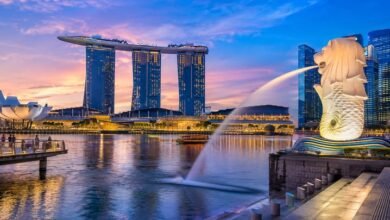
Megaspeed is registered in Singapore and reportedly has only two to ten employees.
It was formerly linked to Shenzhen-based gaming company 7Road and changed its name in 2023. Alice Huang previously served as a director, before transferring her stake to another Singapore company.
According to AFP, when reporters called the phone number listed on the company’s website, the person who answered said they did not know the company.
Yet an entity of this size was involved in billions of dollars of NVIDIA chip purchases within two years.
Its role was effectively that of a computing transit hub:
NVIDIA chips were purchased through a Singapore entity, deployed in Malaysia or Indonesia, and ultimately used to serve cross-border demand, potentially including customers connected to China.
If the U.S. investigation broadens from personal relationships to scrutiny of distribution channels, Megaspeed will not be the only company affected.
Singapore serves as an important hub in NVIDIA’s Southeast Asian computing distribution network.
The compliance threshold for a model based on buying chips in Singapore, deploying them in neighboring countries and serving cross-border customers could rise substantially.
That does not mean Southeast Asia’s data-center expansion will stop.
Projects in markets such as Thailand and Indonesia face their own constraints, including electricity shortages and local approval procedures.
But the density of regulatory scrutiny around regional chip distribution is likely to change.
Jensen Huang has said he will continue to devote himself fully to his work.
Washington, however, is not asking how hard he intends to work.
It wants his answers at the closed-door briefing on November 18.
Until then, Asia’s AI computing supply chain can do little but watch and wait.
The question is how far an investigation that began with an apology letter will ultimately reach.