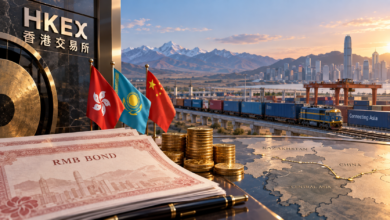
Hong Kong’s “Central Asia Chapter”: From Financial Gateway to Rules Interface
By Jiuri in Tokyo
The 11th Belt and Road Summit concluded in Hong Kong on September 10, bringing together more than 6,200 government and business representatives from over 70 countries and regions. The two-day event showcased more than 300 investment projects, arranged over 800 one-on-one business-matching meetings, and witnessed more than 60 memoranda of understanding and agreements, with projects and transactions worth over $3.1 billion.
This year, the Summit placed greater emphasis on Central Asia, building on Chief Executive John Lee Ka-chiu’s June visit to Kazakhstan and Uzbekistan. The shift matters because Hong Kong’s engagement with the region is moving beyond isolated deals toward a more institutionalized framework.
If Central Asia’s recent dim sum bonds and IPO plans represent companies using Hong Kong as a financing platform, the next stage is about something broader: building rules, channels and institutions that make that cooperation repeatable.
From Memorandum to Business: Standard Chartered’s RMB770 Million Deal
One example came from Standard Chartered and Uzbekistan’s state-owned Asakabank.
Standard Chartered acted as sole mandated lead arranger on Asakabank’s first RMB-denominated syndicated loan, raising RMB770 million to support cross-border trade between Uzbekistan and China. The two banks later signed a memorandum of understanding at the Belt and Road Summit to expand cooperation in RMB business and corridor opportunities.
The sequence is notable: the financing came first, and the memorandum followed.
That suggests the Summit is increasingly serving not simply as a place where future cooperation is announced, but as a platform where existing business relationships are formalized and expanded.
Hong Kong officials have also highlighted the city’s role in helping Central Asian issuers access offshore RMB markets. That function is becoming one of the clearest examples of Hong Kong’s effort to position itself as a financial bridge between China and Central Asia.
HKEX and AIFC: Building a Rules Interface
The more structural development lies in cooperation between HKEX, the Astana International Financial Centre (AIFC) and the Astana International Exchange (AIX).
In June 2026, HKEX signed separate memoranda with AIFC and AIX to deepen capital-market connectivity between Hong Kong and Central Asia. The cooperation covers areas including green finance, commodities, early-stage mining finance and cross-border listings. The AIX agreement also promotes dual primary and secondary listings, as well as cross-border debt listings.
HKEX Chief Executive Bonnie Y. Chan said the agreements would help unlock new opportunities for issuers and investors.
The significance goes beyond access to capital. AIFC operates under a legal framework based on English common law and is designed as an international financial hub for Central Asia. Cooperation with Hong Kong therefore creates a mechanism for two internationally oriented financial centers to align market practices and listing channels.
Hong Kong is increasingly acting not only as a destination for Central Asian capital, but also as a point where financial rules and market infrastructure can connect.
Uzbekistan Pushes a Digital Cooperation Platform
The emerging institutional network is not limited to finance.
At the Summit, Uzbekistan promoted the idea of an “Uzbekistan-Hong Kong digital cooperation platform,” extending an innovation relationship that had already begun earlier in the year.
During John Lee’s June visit to Uzbekistan, IT Park Uzbekistan reached cooperation arrangements with Hong Kong’s major innovation platforms, including Cyberport, Hong Kong Science and Technology Parks Corporation and the Hong Kong-Shenzhen Innovation and Technology Park, covering startup incubation, talent exchanges and joint research and development.
IT Park Uzbekistan brings together more than 1,000 technology companies and startup teams in areas including software development, AI and digital trade. The proposed digital platform is therefore a next step: moving from individual memoranda toward a more continuous channel for technology cooperation.
ASEAN Support for Hong Kong’s RCEP Bid
The Summit also carried a broader regional signal.
ASEAN Secretary-General Kao Kim Hourn reiterated ASEAN’s support for Hong Kong joining the Regional Comprehensive Economic Partnership (RCEP), while noting that accession still requires procedures and consensus among existing members.
That matters because Hong Kong is trying to expand regional links in several directions at once.
Central Asia represents a westward connection. ASEAN represents a southward one. Together, they illustrate how Hong Kong is seeking to move beyond the role of a single financial gateway and become a multi-directional platform connecting capital, technology and trade frameworks.
From Financial Gateway to Rules Interface
Hong Kong’s relationship with Central Asia can now be understood in three stages.
The first is finance: Central Asian issuers use Hong Kong for dim sum bonds, syndicated loans and potential IPOs.
The second is institutional connectivity: HKEX links with AIFC and AIX, while Uzbekistan and Hong Kong build technology and digital cooperation channels.
The third is physical and governmental connectivity.
Cathay Pacific plans to launch direct Hong Kong-Almaty passenger flights on January 9, 2027, while the Hong Kong government is exploring the establishment of an Economic and Trade Office in Kazakhstan.
These measures turn episodic deals into something more durable: a network of financing channels, listing mechanisms, technology partnerships, transport links and official representation.
Hong Kong’s “Central Asia Chapter” is therefore more than a new section in a conference agenda.
It reflects an emerging rules network extending westward from Hong Kong — one that is still being built, but is already moving from individual transactions toward institutional infra