One Precise Laser Beam Does the Work of Dozens
By Gao Fei in Tokyo
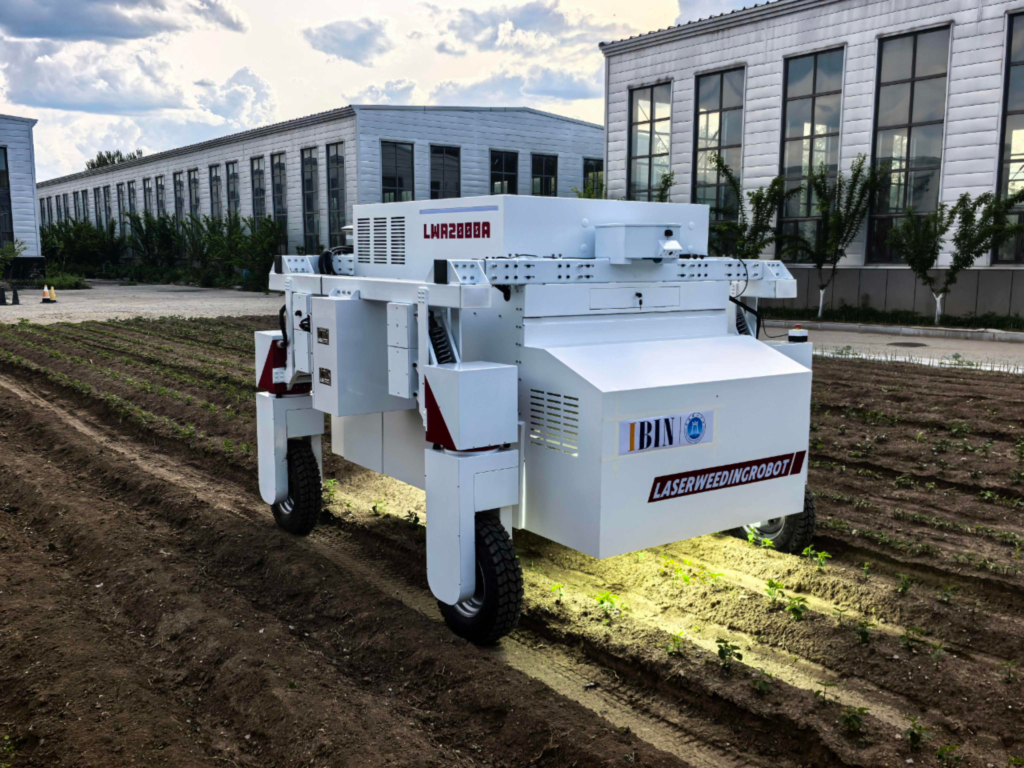
In the height of summer, in the test fields of the Gongzhuling National Agricultural High-Tech Industry Demonstration Zone, corn is jointing and soybeans are branching out. A white-and-red four-wheeled robot moves steadily along the furrows — beneath its body, a laser beam instantly locks onto a weed’s growing point, and the intense heat burns it into inactivity, while the corn seedlings right next to it remain completely unharmed.
“No spraying, no bending over. This ‘Iron Ox’ can finish dozens of mu of land in a single day,” marveled a farmer crouched at the edge of the field.
This “Iron Ox” has an impressive pedigree. A team led by Professor Wang Xiantao of Changchun University of Science and Technology, working together with Ningbo Yibin Electronic Technology Co., spent three years and four generations of iteration to crack this tough technical problem. As one of the earliest teams in China to begin developing laser-based physical weeding equipment, they drew on the university’s strength in optoelectronics to combine lasers, AI, and farm machinery — producing a domestically made smart agricultural machine suited to the black soil of Northeast China.
From “a Bottle of Chemicals” to “a Beam of Light”
Two real-world anxieties sat behind the project’s starting point.
The first was a technology blockade. Around 2020, the team’s research found that laser-based physical weeding had been identified by the Ministry of Agriculture and Rural Affairs as a key weak spot in China’s domestic farm-machinery capability, while comparable American equipment was priced as high as $1.8 million and subject to a technology export ban to China.
The second was an ecological crisis. Over 230 million mu of dryland farmland across Jilin, Heilongjiang, and Inner Mongolia have long depended on herbicides. When these chemicals seep into the soil, they damage microbial communities and cause the land to harden and compact; when crops absorb pesticide residue, it becomes a direct threat to food safety. Manual weeding, meanwhile, allows a single farmer to tend at most one mu a day, and labor costs keep climbing. Ordinary mechanical weeding lacks precision — even a slight jolt can damage seedlings, and every 1% of seedlings lost translates directly into a 1% drop in grain yield.
“To protect this ‘panda of farmland,’ we have to move away from the old, highly polluting, low-efficiency approach to weeding,” said Wang Xiantao.
Drawing on Changchun University of Science and Technology’s accumulated strength across optics, mechanical engineering, electronics, computing, and control systems, the team signed an agreement in July 2023 with Ningbo Yibin Electronic, a company listed on the Shenzhen Stock Exchange, with cumulative investment exceeding 20 million yuan. A team of more than a dozen people — university faculty along with master’s and doctoral students — threw themselves into the lab and the fields.
The iterations proceeded by growing season:
In July 2023, the team began development immediately after signing with Ningbo Yibin Electronic. By November of that year, a first-generation single-channel laboratory prototype was completed, but its tractor-towed design lacked flexibility, and any jolt in the vehicle’s motion caused significant drift in the laser’s aim.
A second-generation towed prototype arrived in the first half of 2024, equipped with eight laser modules and a four-row working width, suitable for large-scale farmland spanning tens of thousands of mu.
In September of that year, a third-generation autonomous, driverless model was introduced. Its dynamic positioning accuracy was compressed to 2–3 millimeters, and it could measure the three-dimensional height of weeds in real time.
In May 2026, the fourth-generation, fully electric self-propelled robot was formally finalized. The delay between AI recognition and laser strike was compressed to 10 milliseconds, and dynamic positioning accuracy was stabilized to within 2 millimeters. Mass production is expected to begin by the end of 2026.
The “Hard Tech” Chain Behind a Single Weed
Today’s smart laser-weeding robot is no longer simply a matter of bringing a laser out into the field. It represents a complete technical loop — seeing, aiming, striking, and moving, all working together.
Seeing accurately. An AI image-recognition system instantly distinguishes crops from weeds. Data models have already been built for more than ten types of crops, including corn, soybeans, potatoes, canola, and various medicinal herbs. Even when seedlings look highly similar in shape, the system can tell them apart precisely.
Aiming precisely. The system calculates a weed’s three-dimensional height and central position in real time, locking the laser spot onto the meristem (growing tissue) within 100 to 200 milliseconds. Dynamic positioning accuracy reaches ±2 millimeters.
Striking quickly. Operating speed adjusts automatically to weed density, reaching up to 3.6 kilometers per hour at maximum. The robot clears 50,000 to 100,000 weeds per hour — more than 50 times the efficiency of manual labor.
Moving steadily. Satellite navigation plans the optimal route for autonomous cruising, and a modular design lets farmers add or remove laser units depending on field width, making maintenance straightforward.
So far, the project has filed seven national invention patents in total, four of which have already been granted, covering four core areas: laser-module packaging, overall machine design, camera and galvanometer calibration, and precise weed positioning.
A Market Worth Hundreds of Billions, and a Greener Future
The team has already rolled out three classes of machines — large, medium, and small. The large towed model is suited to vast, contiguous farmland growing corn and soybeans in Northeast China, while the small self-propelled model serves vegetable greenhouses and medicinal-herb cultivation bases.
The mass-production timeline is clear: production is set to begin by the end of 2026.
In July, the equipment will be showcased at a national on-site observation event for fully mechanized fresh soybean production in Ningbo, Zhejiang, where it will be demonstrated to agricultural-machinery promotion and evaluation experts from more than a dozen provinces.
How large is the potential market? In Northeast China alone, corn is planted across more than 237 million mu. By a conservative estimate, demand for laser weeding equipment could reach 700,000 to 1.4 million units, with the industry’s scale surpassing hundreds of billions of yuan.
But the market is only one side of the story. The other side is green development.
In July 2026, the Harbin Municipal Bureau of Science and Technology announced that laser weeding robots have undergone multi-scenario field validation at major grain-crop bases growing soybeans and corn across the province, with cumulative application area surpassing 1,000 mu. The next step will be to accelerate the conversion of these results into practical use, providing technological support to help agricultural products access international markets and overcome green trade barriers.
Wang Xiantao puts it plainly: “Protecting the black soil can’t just be a slogan. Replacing pesticides with lasers, so that every single grain is clean — that’s the romance of us engineers.”
Starting from a single weed, the project solves a concrete problem; taken a step further, it answers to the era’s broader call for green agricultural development. Once the laser stepped out of the laboratory and into the black soil, technology truly gained the power to grow.