Chery’s Multi-Point Playbook: Weaving a Global Manufacturing Network Through ‘System Export’
Asian Econ | Send an email | 2026-07-08
Kelly, reporting from Tokyo
In June 2026, Chery made a string of overseas moves in quick succession — first signing a memorandum of understanding with Nissan, under which Nissan’s Sunderland plant in the UK will begin contract-manufacturing complete vehicles for Chery starting in fiscal year 2027; then, on June 22, Chery’s Spanish joint-venture plant brought online a brand-new M1 production line — 696 meters long with 97 workstations — to build various powertrain versions of the S400 and S700 models.
The same week, Chery released its latest overseas results: cumulative exports of 752,800 vehicles in the first five months of 2026, accounting for 68.38% of total sales — setting a new record for Chinese automakers of “over 700,000 exports in five months.” May alone saw 181,900 vehicles exported, up 80.5% year on year, another record for monthly exports by a Chinese automaker. As of early 2026, Chery’s cumulative exports had historically surpassed the 6-million-vehicle mark.
Chery’s overseas story is about more than selling cars. It is building a complete global network spanning R&D, manufacturing and sales — shifting from “exporting products” to genuinely “exporting an industrial system.”
A Manufacturing and R&D Network Spanning the Globe
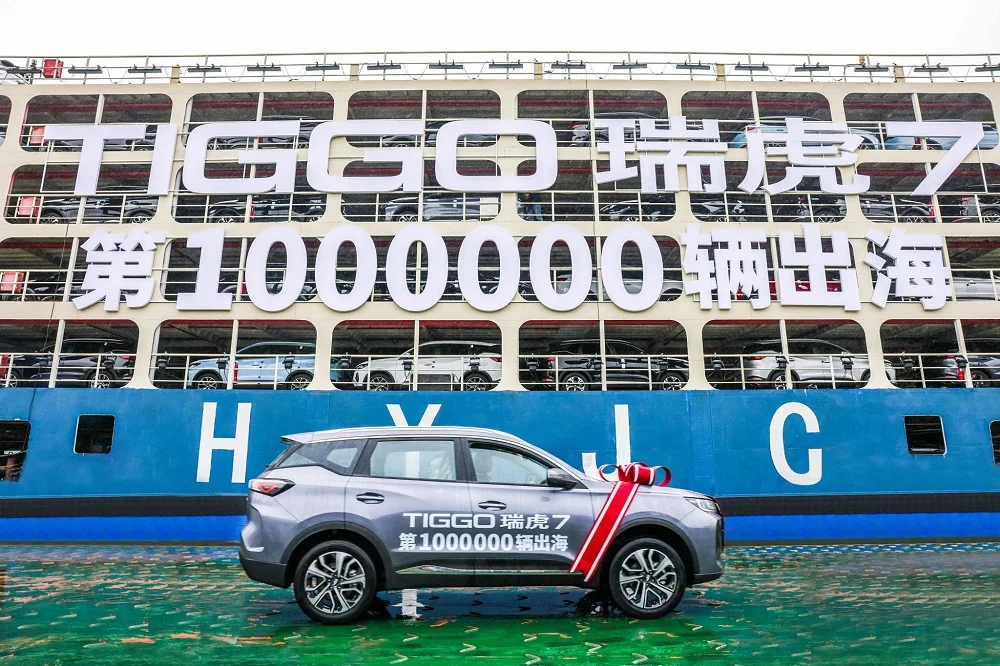
If BYD’s core playbook is “building factories,” then Chery’s core playbook is “building a network.” Rather than build one mega-factory in a single country, Chery lays out CKD/KD plants, R&D centers and sales networks simultaneously across multiple countries, creating regional synergy.
Chery has established a “1+7+N” global collaborative innovation network, with 8 major R&D centers and 16 KD plants worldwide. On the R&D side, Chery has built a global research network spanning its Wuhu headquarters, Europe, North America, the Middle East and beyond. On the manufacturing side, Chery’s overseas production bases already cover Southeast Asia, South America, the Middle East and Europe.
To date, Chery has exported to more than 130 countries and regions worldwide, and has entered 18 European national markets. Local staff account for more than 85% of its overseas workforce. In April 2026, Chery officially opened its first overseas regional operations center in Barcelona, Spain, alongside the launch of a Spain research institute focused on electrification, smart mobility and sustainability. Chery’s globalization is entering a new phase — moving from product exports to putting down roots as a full-fledged system.
Borrowing Ships to Go Global, Weaving a Worldwide Net
Chery’s global network isn’t a blueprint on paper — it is a series of footholds being established one by one. From Europe to Southeast Asia, from South America to Africa, Chery is putting down roots in every regional market through different means — some through self-built plants, some through joint-venture operations, and some through contract manufacturing. “Borrowing ships to go global” and “building its own ships” are proceeding side by side, forming a production network that covers the world’s major markets.
Europe: From ‘Borrowing Ships’ to ‘Building Ships’
Europe is the biggest highlight of Chery’s overseas push in 2026. In the first quarter of 2026, Chery exported 105,837 vehicles to Europe, up 215.6% year on year, making it the first Chinese brand to export more than 100,000 vehicles to Europe in a single quarter. From January to April, exports to Europe reached 147,771 vehicles, up 264% year on year.
In its European manufacturing layout, Chery has taken the path of “borrowing ships to go global.”
Barcelona, Spain is the “home base” of Chery’s European operations. The Ebro plant — a joint venture between Chery and Spain’s Ebro Motor Group — brought its new M1 production line online on June 22, 2026. The line is 696 meters long with 97 workstations, and takes about 75 minutes to produce a single vehicle. It is currently used to build various powertrain versions of the S400 and S700, and is designed to produce up to five different models, with capacity reserved for the Ebro plant’s pure-electric models due to launch in 2027. Bringing the line online is part of the Ebro Motor Group’s overall investment of more than €150 million. The plant already has more than 200 robots and is gradually introducing welding and painting processes. The Ebro plant plans to reach capacity of 50,000 vehicles a year by 2027, rising to 150,000 by 2029.
Sunderland, UK is Chery’s latest “borrowed ship.” In early June 2026, Nissan announced a non-binding memorandum of understanding with Chery International UK, under which, starting in April of fiscal year 2027, Nissan’s Sunderland Line 1 will be opened up for contract manufacturing of complete vehicles for Chery. The facility will continue to be owned by Nissan and staffed by Nissan employees. Nissan’s Sunderland plant is the UK’s largest vehicle manufacturing base, with peak annual capacity of up to 600,000 vehicles — but actual output in 2025 was only 273,000, with capacity utilization falling to 45.5%. Contract-manufacturing for Chery both revives Nissan’s idle capacity and lets Chery quickly acquire European production capacity with minimal capital outlay. This marks the first time a mainstream Japanese automaker has manufactured vehicles for a Chinese independent brand in a core European market.
Southeast Asia: Twin Engines for Right-Hand-Drive Markets
Southeast Asia is a major source of Chery’s overseas sales and the core region of its right-hand-drive strategy.
Malaysia is Chery’s right-hand-drive “engine” in Southeast Asia. Its plant in Shah Alam officially came online in June 2025. In January 2026, Chery’s Malaysia plant formally launched complete-vehicle exports to the Southeast Asian market, with the first batch of Jetour SUVs shipped to Vietnam; exports will subsequently expand to the Philippines, Thailand, Brunei and Singapore. Chery is steadily working to turn Malaysia into the brand’s Southeast Asian production and R&D hub. In addition, Chery has established the Chery Smart Vehicle Industrial Park in the Selangor high-tech automotive city, covering about 81 hectares, with initial capacity of 100,000 vehicles a year and room reserved to expand to 300,000.
Vietnam is Chery’s other pole in Southeast Asia. Chery plans to invest $800 million to build its largest ASEAN-region auto plant in Hung Yen Province, Vietnam, which will reach annual capacity of 200,000 vehicles once fully operational. Chery’s Vietnam plant is set to formally begin production in mid-2026. Once operational, the left-hand-drive models it produces will supply the Vietnamese domestic market while also serving other left-hand-drive countries in Southeast Asia, with potential exports to Europe down the line. Chery’s goal is to become the top-selling Chinese auto brand in Vietnam in 2026, and to rank among Vietnam’s top three overall auto brands in sales by 2030.
With Vietnam and Malaysia as twin engines, Chery is shifting from simply “entering” Southeast Asia to truly “integrating” into it.
South America and Africa: Deepening Roots in Emerging Markets
In South America, Chery operates a plant in Jacareí, São Paulo state, Brazil, with annual capacity of 150,000 vehicles. Since 2017, Chery has run a joint venture with Brazil’s CAOA Group, which operates a second plant in Anápolis, Goiás state. As of February 2026, Chery’s São Paulo KD plant in Brazil has officially begun production.
In Africa, Chery reached an agreement with Nissan in January 2026 to acquire the land, buildings and related assets of Nissan’s Rosslyn plant in South Africa, with the deal expected to close by mid-2026. Chery plans to begin production of its first SUV model at the plant by mid-2027, targeting annual output of 50,000 vehicles and creating more than 3,000 local manufacturing and supply-chain jobs in South Africa. Chery’s Jetour brand has also announced it will begin local production of its T-series models at the Rosslyn plant in 2027.
Russia and the Middle East: Multiple Fronts
In Russia, Chery operates four production bases. In January 2026, Chery’s Russia-exclusive brand Tenet ranked third in the Russian market with sales of 8,949 vehicles. In May, Tenet’s sales reached 11,511 vehicles, again ranking third in the Russian market.
In the Middle East, Chery has two joint-venture KD plants in Iran with combined annual capacity of 300,000 vehicles. In Egypt, Chery’s Jetour brand has partnered with Al-Qasrawi, investing $123 million to set up a plant producing the compact T1 and T2 SUVs.
Can the Network Withstand Global Storms?
The advantages of Chery’s “system export” model are clear, but its risks and uncertainties should not be overlooked.
A ‘stall-out’ risk in the domestic market. In May 2026, Chery’s overseas sales share reached 73.4%, a new monthly high, while domestic sales were only about 66,000 vehicles. Chery’s sales structure underwent a historic reversal in 2026 — overseas markets have shifted from being its past “growth pole” to now being its “lifeline.” With overseas sales exceeding 70% of the total, any regional trade friction would directly hit its full-year production and sales. Chery Chairman Yin Tongyue has repeatedly emphasized the principle that “without stability at home there is no strength abroad” — yet the current sales structure shows that while Chery has achieved ‘strength abroad,’ ‘stability at home’ remains insufficient.
Extremely high management complexity. Operating plants, R&D centers and sales networks simultaneously across more than a dozen countries — spanning different languages, regulations and cultures — places extremely high demands on management systems and organizational capability. From Spain to Malaysia, from Brazil to Russia, Chery must maintain unified brand standards while adapting to the unique conditions of each market.
Insufficient economies of scale. Unlike BYD, which has concentrated large-scale plants in Thailand and Brazil, Chery’s capacity is spread across multiple countries, with each base relatively limited in scale. The Malaysia smart-vehicle industrial park has initial capacity of 100,000 vehicles, while the Spain plant’s 2027 target is 50,000 — no single base can achieve the kind of cost advantage BYD enjoys.
Uncertainty in the European layout. The Spain plant’s 2029 target is 150,000 vehicles, but competition in the European market is intensifying. Nissan’s contract-manufacturing agreement for the Sunderland plant remains a “non-binding” memorandum of understanding, with nearly a year of negotiation still ahead before formal mass production begins. The EU’s countervailing duties on Chinese electric vehicles, the electrification counter-offensive from local brands, and European consumers’ acceptance of “Made in China” are all variables.
A long-term challenge on brand premium. Despite its massive export volumes, Chery’s brand recognition in higher-end markets such as Europe still lags behind Volkswagen, Toyota and others. Its higher-end sub-brands Exeed (Xingtu) and iCAR (Zhijie) — on which Chery has pinned high hopes — sold only 5,882 and 3,428 units respectively in May, down sharply by 47.2% and 31.4% year on year. Moving upmarket requires not just product strength, but brand accumulation and time.
Chery’s “system export” is a marathon that will require time, patience and sustained investment. Once this global manufacturing-and-R&D network is truly up and running, Chery will hold a ‘distributed advantage’ that would be hard for BYD to replicate. But before that, it must first clear three hurdles: management complexity, economies of scale, and brand premium.