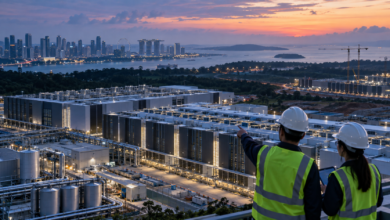
Winners of the “China Plus One” Strategy | Malaysia: The Ambitions of a Semiconductor Safe Haven
By Kelly in Tokyo
In a public speech in June 2026, Liew Chin Tong, Malaysia’s Deputy Minister of Investment, Trade and Industry, made an unusual assertion:“This is the only complete ecosystem in Southeast Asia, and it exists only in Malaysia.”
He was referring to semiconductors.
Malaysia currently accounts for approximately 13% of the global semiconductor packaging and testing market. The industry contributes around 40% of the country’s export value. Malaysia is already the world’s sixth-largest semiconductor exporter and is involved in the production of 23% of the chips supplied to the United States.
How has a Southeast Asian country gained such weight in one of the most precise back-end segments of the semiconductor supply chain? And how has it become a critical safe haven amid the global relocation of semiconductor production?
The answer lies in two factors: decades of industrial accumulation and the “China Plus One” strategy.
“China Plus One” Strengthens the Semiconductor Supply Chain
Malaysia’s semiconductor industry has long been connected to the “China Plus One” strategy.
Several semiconductor companies have told analysts that concrete “China Plus One” measures are becoming increasingly common. More importantly, the strategy is moving beyond simple geographic relocation and expanding into a broader restructuring of supply chains. Companies are not only moving factories to Malaysia; they are also replacing Chinese-made equipment, materials and components with products sourced from other countries.
The data support this trend. Bilateral trade between Taiwan and Malaysia reached a record 233 billion ringgit, or approximately US$57.4 billion, in 2025.In its 2026 outlook, Hong Leong Investment Bank Research stressed that diversification under the “China Plus One” strategy would benefit multiple areas of Malaysia’s technology sector, including outsourced semiconductor assembly and testing, the global semiconductor capital-equipment supply chain and selected electronics manufacturing services.
Analysts noted that Malaysian OSAT and semiconductor-equipment companies generally issued positive guidance for 2026. Their growth prospects are being supported by structural tailwinds, particularly “China Plus One” diversification and the localisation of supply chains by global equipment manufacturers.
With the additional momentum generated by “China Plus One,” some brokerages now regard 2026 as a potential turning point for Malaysia’s semiconductor industry.
The Emergence of “Malaysia Plus N”
The foundations of Malaysia’s semiconductor industry were laid in Penang.
Beginning in the 1970s, multinational companies including Intel, AMD, Hewlett-Packard and Hitachi established packaging and testing operations in the state. More than half a century of industrial development has resulted in nearly 50 semiconductor factories concentrated in Penang, Kulim and surrounding industrial parks.
Today, multinational companies such as Intel, AMD, Lam Research, Infineon, SanDisk and Micron Technology are expanding their involvement in Penang and Kulim. Analysts say these companies are not only maintaining growth in their existing operations but also reallocating production capacity and investing more resources in Malaysia.
This is strengthening the country’s position as a central node in their global manufacturing and research-and-development networks.
“China Plus One” was the first major force driving the recent rise of Malaysia’s semiconductor sector. A second force is now emerging from partners in Taiwan and mainland China. The “N” in “Malaysia Plus N” includes Taiwan, mainland China, the United States, Japan and other critical participants in the semiconductor supply chain.
Taiwan is Malaysia’s closest semiconductor partner.
In February, Taiwan-based display-driver IC packaging and testing company Chipbond Technology officially opened a new factory in Penang. Taiwan’s representative in Malaysia said that Taiwan possessed world-leading advanced semiconductor process technologies and had complementary advantages with Malaysia.
“Taiwan is an indispensable partner in Malaysia’s efforts to develop its semiconductor industry and achieve its goals for AI-driven digital transformation,” the representative said.The head of Taiwan’s economic division in Malaysia further noted that Taiwan holds a leading global position in semiconductor design and manufacturing, while Malaysia plays an equally important role in packaging and testing. The two sides are also deepening cooperation in data centres and robotics.
Chinese semiconductor packaging and testing companies are accelerating their expansion in Malaysia as well.
In January 2026, Forehope Electronic announced plans to invest up to RMB2.1 billion in an integrated-circuit packaging and testing production base in Malaysia. The project is scheduled to be developed over 60 months.China Wafer Level CSP increased its investment in Malaysia-based WaferTek by US$30 million to finance equipment purchases and production-line construction. A production line for advanced sensor packaging has already entered the construction stage.
Tongfu Microelectronics established a manufacturing base in Penang by acquiring 85% stakes in both AMD Suzhou and AMD Penang. In the first half of 2026, Tongfu Microelectronics forecast net profit attributable to shareholders of between RMB1.6 billion and RMB1.8 billion, representing year-on-year growth of 288% to 337%.The increase was supported by concentrated deliveries of advanced computing packaging orders, as AMD’s next-generation Zen 6 server processors and MI350 and MI400 AI chips continued to increase production.
Taiwan contributes chip-design and manufacturing capabilities, Malaysia provides packaging and testing, and mainland Chinese companies are becoming deeply integrated into the network through investment and factory construction.
“Malaysia Plus N” is developing into a cross-regional semiconductor cooperation network.
The Winner’s Greater Ambition
Malaysia’s ambitions extend beyond packaging and testing.
“Our goal is no longer merely to execute manufacturing blueprints created by other countries,” Liew said. “We want to create, own and jointly develop the intellectual property that will drive the next generation of global technology.”The government is promoting this transition through its National Semiconductor Strategy, or NSS.
From the strategy’s launch in January 2024 through March 2026, the NSS attracted a total of 91.9 billion ringgit in semiconductor investment, including 82.9 billion ringgit in foreign investment.
Through the Arm–Malaysia strategic partnership, the NSS also plans to train 10,000 Malaysian engineers in integrated-circuit design over four years. By 2030, the government aims to create 700,000 new jobs and raise the median monthly wage in manufacturing to 4,510 ringgit.
Malaysia is attempting to make the leap from a manufacturing base to a creator of value. It wants to move beyond the questions of who packages and who assembles, and towards who designs and who defines the technology.
The winner, however, also faces challenges.
For Malaysia, the largest immediate variable is the strengthening ringgit. The currency has appreciated by approximately 4.6% against the US dollar since the beginning of 2026. Because Malaysian semiconductor companies earn most of their revenue in dollars, the stronger ringgit directly reduces their reported profits.Strong industry growth has partially offset this pressure. Analysts say the sector’s improved growth trajectory has “largely neutralised the impact of the ringgit’s significant appreciation.”
Another challenge is Malaysia’s position within the AI value chain. Historically, Malaysian listed companies have lagged behind their global peers because of their limited direct exposure to AI supply chains.
That situation is beginning to change. The expansion of AI data centres is driving demand for optical and power semiconductors. Even so, the transition from packaging and testing to chip design requires more than capital. It also depends on the accumulation of talent and expertise over time.
Despite these challenges, the foundations of Malaysia’s confidence remain clear.
Its geopolitical neutrality supports its role as a semiconductor safe haven. More than half a century of industrial development has given it the foundations of a major manufacturing base, while the National Semiconductor Strategy is helping the country develop its own design capabilities.Caught between the United States and China in an intensifying technology rivalry, Malaysia is attempting something unusual: absorbing relocated production capacity while simultaneously moving upstream in the value chain.
The journey ahead remains long, but Malaysia has already been travelling this road for 50 years.