From Shinjuku to the Big Techs: 900 International Students Who Chose to Grind Code at This One School
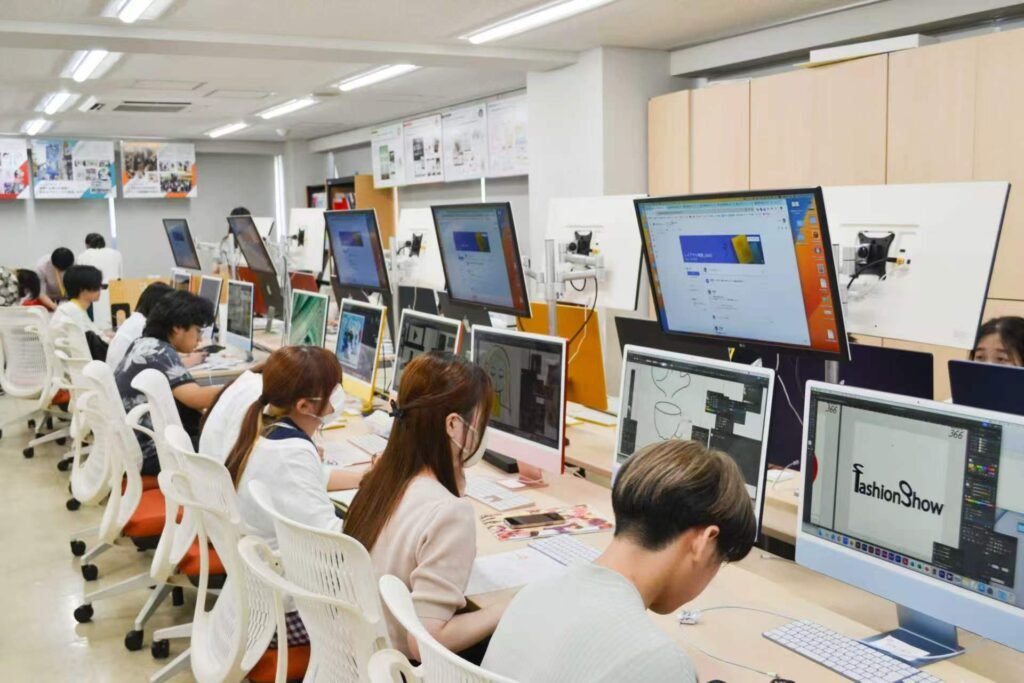
Nine o’clock in the morning, in Tokyo’s Shinjuku district. Inside a classroom at Japan Electronics College, two dozen students are frowning at the lines of code scrolling across their screens. At the front of the room, a gray-haired instructor explains the algorithms behind a game physics engine in Japanese tinged with a Kansai accent. Down in the seats, a Chinese international student we’ll call Mr. Ge is scribbling notes as fast as his hand will move. Lately he’s been so absorbed in his coursework and his own creative projects—digging deeper into the material every day—that he barely makes it to Akihabara anymore, even though it used to be one of his favorite places to go. Between shifts at his part-time job, he finds ways to keep up his studies every single day.

“One day, my name is going to show up in the credits of an anime or a game,” he says. When he says it, there’s a spark in his eyes.
He’s one of roughly 900 international students at this school, about half of them from China. They’ve walked away from comfortable lives back home, cleared the hurdles of a new language and culture, and come to this Japanese vocational college to do something they’ve chosen willingly: grind it out on the technical side. And the thing that draws them is refreshingly practical—graduate, and you’ll very likely land a job, with strong odds of joining one of Japan’s top-tier IT or gaming companies.
A high placement rate, a laser focus on technical tracks, and a clear path to upgrade your credentials—what kind of educational philosophy lies behind those results? After 76 years of going deep in a single vertical, what’s the secret to this school’s success as a placement powerhouse? With those questions in mind, our reporter recently sat down with Mr. Yu Kimura, who heads up the school’s student recruitment office.
Beating the Bias Against “Vocational Schools“: 76 Years of Focus Is the Best Answer
For many Chinese parents, the term “vocational school” carries a faint sting. It sounds like a junior college, a trade school—the place you end up after you fail to get into a real university.

But the history of Japan Electronics College starts back in 1951. That year, it was nothing more than a training program for radio repair technicians. Seventy-six years later, it has become one of the oldest and most established vocational schools in Japan’s computing and electrical engineering fields.
“Some vocational schools run a lot of different programs all at once—computing, fashion, sports, animal care, you name it,” Kimura emphasized during the interview. “But that’s not the kind of school we are. We’ve always focused on education in computing and electronics.” The two broad areas he’s talking about: first, digital content creation—CG, video, games, animation, design—the industry that uses computer technology to bring people entertainment and joy; and second, the engineering side—AI, information processing, web, app development,cybersecurity, and electrical and electronic engineering—the world of engineers who use technology to make society more convenient and a little bit better.
They don’t chase the trendy-sounding programs that are hard to master in depth. For 76 years they’ve done one thing: feed front-line technical talent into Japan’s IT, anime, and gaming industries. That kind of focus is exactly what counters the worry Chinese parents have about “vocational schools.” While other universities are still training students for “generalist” roles in sales, administration, and HR, students at Japan Electronics College know from day one roughly which desk at which major company they’re aiming to sit at.
Where Do Graduates Land? A 90% Placement Rate Means “One Foot Already Inside Japan‘s IT World“
Over the past decade, the school’s placement rate for international students has held steady above 90%.
On its own, that number might not be impressive enough. But consider this: the overall employment rate for Chinese students studying in Japan is 44%. Suddenly that 90% means something very specific—make it through two years of focused technical training, and you’ve essentially already got one foot inside Japan’s IT world.
“We don’t just care whether students find a job,” Kimura said. “We care more about whether they end up working in the industry they actually trained for.”
Among Japan’s vocational schools, not many can pull that off. And the secret at Japan Electronics College is baked into its system of corporate partnerships.
Japan has a designation called the “Practical Vocational Education Program.” It’s a certification granted by the Ministry of Education, Culture, Sports, Science and Technology to vocational departments that build their curricula in partnership with industry. At Japan Electronics College, every daytime department that has already produced graduates holds this certification.
What does that mean in practice? It means that names like Capcom, NTT, and Fujitsu aren’t “partner organizations” hanging decoratively on a wall—they’re actually walking into the classroom as instructors.
“The teacher showing us how to make games is sometimes one of the people currently working on Monster Hunter or Resident Evil. And we’ve had creators who used to work in Hollywood come give lectures,” one current student said. For Chinese students desperate to break into the gaming industry, that’s about as good as resources get.
The school also hosts company information sessions built specifically for its own students. Plenty of companies come to recruit on campus directly rather than casting a wide net on job boards. For the animation and gaming programs, the school even holds portfolio review events where company representatives see student work firsthand.
“You don’t have to compete in the same pool as students from the University of Tokyo or Waseda,” one graduate said. “Because companies know that what we studied is exactly what they need.”
Worried About Your Credentials? The “iU Transfer“ Card Is Pure Gold
Every Chinese parent sending a child abroad asks the same question: “If they only finish vocational school, is that the end of the line for their degree?”
At Japan Electronics College, the answer is no.

Denshi Gakuen, the educational group that operates the school, founded a university in 2020: the Information and Management Innovation Professional University, known as iU. It’s a four-year institution designed to give students balanced grounding in three areas—ICT technology, business, and going global—with the goal of producing “innovators who can create new value.”
Here’s the key part: the “Diploma” (専門士) qualification you earn after finishing Japan Electronics College lets you transfer directly into iU as a third-year student. In other words, two more years at iU, and within four years total you can hold both the Diploma and a government-recognized Bachelor’s degree.
Vocational school → transfer into iU → earn a Bachelor’s degree. You learn the technical skills, you fill in the credential gap, and you don’t waste any time doing it. It’s a shortcut with double insurance: skills *and* a degree.
For Chinese students and parents who want the hard technical training but worry their credentials won’t be recognized, this card pretty much erases every last reservation.
Clearing the Language Hurdle: No N2? You Can Still Get Into a Top Company
What scares Chinese international students most? That their Japanese won’t be good enough, that they’ll bomb the interview, that the job offer will slip away.
But at this school, the recruiting logic runs the other way around.
Kimura laid out the three things companies care about, in order: technical ability, the quality of your work, and then Japanese.
Japanese matters, of course. But at Japan Electronics College, you only need to sit the school’s entrance exam—if the school judges you to be at roughly JLPT N2 level and you pass the interview, you can be admitted. One student who got an acceptance letter quickly offered some encouragement to those coming up behind, drawing on his own experience: “It’s honestly not that hard overall. The instructors keep their wording basic—instead of長所(‘strong points’) they’ll just say “good points” (いい点, ‘good points’). When you’re writing your interview script, work with your own Japanese level and lean on basic vocabulary and simple grammar. It makes answering easier and a lot more natural.”
More to the point: rather than how polished your Japanese sounds, companies care about what you can build—whether your code runs, whether your game actually makes people want to play it.
“Japan cares more about skill than credentials,” summed up Ms. Li, a Chinese international student who secured an offer from Capcom. In her interview, she walked them through it in detail: how she had studied from the moment she enrolled, what kind of games she’d made, and what kind of games she wanted to make once she joined the company. What the company wanted wasn’t an employee who could speak polite Japanese—it was someone who could make games.
“Build a solid foundation in your major courses, earn your certifications, and there’s really nothing to worry about.” In the student group chat, a senior student we’ll call Mr. Tan—a been-there-done-that voice—had this to say to underclassmen anxious about job hunting: “The real key is your own effort. My advice is to lower your expectations of vocational school, or honestly any university or grad program, and just put your head down and do what you’re supposed to do. The results will come.”
A senior who goes by the handle “momo” had one piece of advice she really wanted to drive home: getting that “final qualification certificate” matters most—it carries real weight when you’re job hunting.
And here’s what’s even more important: the school understands the shift happening inside Japanese companies. “Japanese people tend to be more reserved overall, while international students are often more proactive,” Kimura said. “A lot of them speak not just Japanese but other languages too. And since they usually came to Japan specifically to find work, their motivation to study and work is incredibly strong.”
What does that add up to? It means Chinese students’ willingness to speak up, ask questions, and put themselves out there actually becomes an advantage. In a Japanese workplace built on collectivism and seniority, that outgoing streak is turning into a scarce and valuable resource.
Mr. Chen’s story is the perfect illustration. At a “study exchange event” the school hosted, he seized the chance to have a real conversation with a company president. Afterward, he followed up by email on his own initiative. The result: he was hired on the very day of his interview.
“A proactive attitude matters a lot.” His takeaway is simple, but it lands.
They Did It: Five Chinese Students Who Found “the Light in the Crack“
You can talk theory all day, but nothing is as convincing as real stories.
Ms. Li’s road from Japan Electronics College to a Capcom offer was steady the whole way. Her homeroom teacher was available anytime to answer her questions about studying or job hunting. At the school’s dedicated service window for international students, she could get help with visas, daily life, part-time work, and finances. At the support center she could dig up a wealth of company intelligence—interview content, how many alumni had been hired, salary figures—so she could prepare for everything in advance. “Japan cares more about skill than credentials. If you’ve got something you want to do and you want to sharpen your skills here, then come to vocational school.”
Ms. Huang, a graduate of the Game Production program, has already joined CyberConnect2, the studio famous for developing the Naruto game series. She started from a Japanese language school and worked her way all the way to the development front lines at one of Japan’s top game companies.
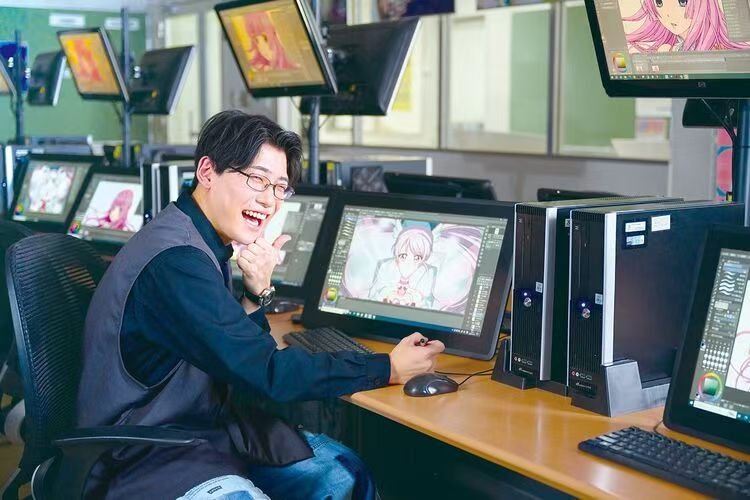
After finishing a software technology program at a junior college back in China, Mr. Ge came to Japan out of love for Japanese ACG culture. The vocational school’s workload was heavy enough that he “had no time to go to Akibahara,” but he stuck it out. His dream is a humble one: “One day, my name shows up in the credits of an anime or a game.”
While at the school, Mr. Chen jumped on the chance offered by the “study exchange event,” struck up a conversation with a company president, followed up by email, and was hired the same day as his interview. “The teachers are just as strict with international students as with Japanese students—and that’s exactly why I was able to push myself to really study.”
Mr. Lin studied cloud computing operations at the school and returned to China in 2023. His starting point wasn’t glamorous—an outsourcing company in the Jinan High-Tech Zone, earning 6,000 yuan a month. But in his fourth month on the job, the company landed a contract to migrate a legacy Japanese system, and his Japanese plus his hands-on experience made him stand out from a six-person team. Six months later he jumped to a company in Shanghai, where his pay climbed to 16,000 yuan a month plus an allowance for business trips to Japan.
Mr. Lin’s summary may be the most precise footnote there is for the path through vocational school: “Sure, your diploma holds you back—but the right technical specialty plus good Japanese, that’s the light in the crack.”
Who Is This Path For?
Japan Electronics College isn’t a cure-all. It’s not for people who want a brand-name diploma, a career in finance or consulting, or a spot at one of Japan’s big general trading houses.
But it’s an excellent fit for three kinds of people:
First: tech-obsessed people who want into a top Japanese gaming or IT company. If the job you dream of is programmer, engineer, or game developer—not sales or administration—this school offers the most direct route there.
Second: people with ordinary academic backgrounds but real passion and a portfolio.** Nobody’s checking whether you went to an elite “985” or “211” university—or even whether you have a bachelor’s degree at all. What they look at is your code, your work, and your ability to learn.
Third: people at roughly JLPT N2 who don’t want to spend two more years in a language school or a grad-school prep course. Two years of vocational school, then straight to employment. The time cost is about as low as it gets.
Mr. Kimura closed with this:

“Japan is a safe country full of opportunity. That’s especially true in IT and computing—an industry that’s going to keep growing well into the future. If you want to study in Japan and build a career here, this is a great opportunity.”
For Chinese students, this may be an underrated track. It isn’t loud, it isn’t flashy, and it’s even a little off the beaten path. But it offers something deeply practical: let your skills do the talking, let your work clear the way, and trade two years for an offer from a top company.
From Shinjuku to the big leagues, from the classroom to the development front lines. Every year, nearly 400 Chinese students make this choice.

And their stories might just be your next one.