Good Cultural Products Let Young People Tell Their Own Stories — Local Storytelling in Asian Creative Industries (III)
By Jiuri in Tokyo
In Bangkok, there is a space called Se—ri Studio. The ground floor houses a Zine Shop selling handmade publications by independent artists. Upstairs, there is a Risograph printer, a small library and an open communal area where people can sit down and talk at any time.
Its three founders — Pim (Pin-Panita Siriwongwanngam), Tian (Tian-Preechaya Osathanon) and Rada (Rada Musikarat) — all studied for master’s degrees in the UK. While there, they encountered Asian independent publishing communities. After returning to Thailand, they realized Bangkok lacked a similar space: somewhere independent creators could express themselves safely.
So they rented an old building in Charoen Krung Soi 43 and founded Se—ri Studio.
The studio’s focus is clear: queer creators and independent artists from Southeast Asia. It does not try to appeal to everyone. Instead, it gives specific communities a place to be seen and heard.
Zines: Expression That Does Not Try to Please Everyone
A zine is a small, self-published work that may contain comics, photography, experimental writing or deeply personal material that is difficult to categorize.
Se—ri co-founder Pim has described zines as free, tactile and capable of exploring social issues and personal identity in depth. In the zine world, creators do not have to chase algorithms, traffic or topics that “everyone must understand.” They may use a Risograph printer, photocopier or long-arm stapler to produce only a handful or a few dozen copies, place them on a table and wait for the people who genuinely connect with them.
Another Bangkok example is Spacebar Zine Store, founded by Wimolporn and Wisarut in 2025. The physical shop carries more than 300 zines from around the world. Its atmosphere is somewhere between a studio and a living room, with low shelves and plenty of space between books.
Foreign visitors may not even understand the language of the zines they browse, yet some still leave with a copy.
The value of a zine is not how many people see it.
It is who sees it.
Chiang Mai’s “Reverse Cross-Border Shopping”: Youth Taste Across Borders
If Bangkok’s zine culture represents local youth expression, a Chinese-style stationery shop in Chiang Mai shows another form: cross-border aesthetics.
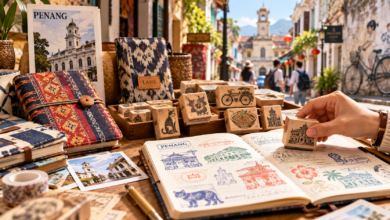
In Chiang Mai’s old city, a Chinese entrepreneur living locally opened a small stationery shop after noticing that local creative products were dominated by Southeast Asian styles, while Chinese-style bookmarks, ink-wash notebooks, metal stamps and traditional-pattern tapes were relatively difficult to find and often expensive when imported.
She began using a “reverse cross-border shopping” model, synchronizing new products with Chinese creative brands and replenishing stock frequently in small batches.
The store introduces more than ten new items each month and has become a popular destination in the old city. Some foreign tourists make a special trip to buy Chinese-style stationery as souvenirs. Its customers fall broadly into two groups: Chinese residents abroad, for whom the products provide familiarity, and foreign visitors interested in East Asian aesthetics, for whom they provide novelty.
The logic is similar to that of Bangkok’s zine spaces: neither is trying to serve a mass market. Both create a specific form of expression for a clearly defined audience.
Making Local Brands Young Again
In Okayama, Japan, a large stationery retailer called Usagiya has taken another “reverse” approach: instead of selling local products mainly to tourists, it tries to make local people fall in love with familiar hometown brands again.
Usagiya collaborates with local companies and turns familiar regional names into stationery. Products have featured the waffle of Okayama confectionery brand Hakujyuji, the logo of Kurashiki Udon, and local milk brands such as Ohayo Milk.
Usagiya representative Kyoko Izawa has noted that more people now see stationery as something that enriches everyday life, rather than merely as a practical necessity.
That is the key. Usagiya is not treating local brands as souvenirs. It is repositioning them as objects worth using every day.
When a young person uses a pen printed with the Kurashiki Udon logo, the value is not simply “this is from Okayama.”
It is “this is part of my life.”
Museums: Giving Young People a Reason to Walk In
The Busan Museum in South Korea shows how museums can use character IP to bring younger audiences closer to traditional culture.
The museum collaborated with HOZO (Kwon Sun-ho), a character creator associated with Kakao Friends, to develop two IP characters: Heunggu and Maegi.
Heunggu is based on a tiger painting exported to Japan through Choryang Waegwan during the late Joseon period. At the time, painters often imagined tigers and leopards as closely related creatures, so the character combines leopard spots on the face and tail with tiger stripes on the body. Maegi was inspired by a hawk painting from the same period.
The two characters appear on stationery, bags and color-changing cups that react when filled with cold drinks. According to the museum, the products combine approachable design with practical use, giving younger people an opportunity to engage with museum culture more closely.
The museum is no longer only a place that displays artifacts.
It also produces characters, tells stories and builds everyday connections with younger audiences.
Commentary | Let Young People Tell the Story Themselves
Placed together, Se—ri Studio, the Chiang Mai stationery shop, Usagiya and the Busan Museum reveal a common shift: local culture is moving from being told about to being told by people themselves.
Zine creators at Se—ri are not objects being displayed; they are active voices. The Chiang Mai shop owner is not passively selling souvenirs; she is actively choosing an aesthetic direction. Usagiya’s collaborations do not package local brands as “regional specialties”; they redefine them as everyday objects. The Busan Museum’s IP characters are not decorations attached to artifacts; they are vehicles for cultural storytelling.
The shared direction is clear: young people are no longer satisfied with simply consuming culture.
They want to use culture to express themselves.
A zine may last a few months. A traditional-style notebook may last half a year. A locally branded pen may last several years. A museum character may last for decades.
But once people begin telling culture in their own way, that process does not easily stop.
The future of culture may depend less on how well it is preserved, and more on how many people are willing to use it to tell their own stories.