Cultural & Creative Products | The “Not One-Off” Philosophy — What Can an International Event Leave Behind for a City?
By Yuanyin in Tokyo
In September 2026, with just over 100 days to go before the Changchun Winter Universiade opens, nearly 50 offline retail points for licensed merchandise had already been established nationwide, while more than 360 products had passed review.
The event’s commercial performance is already taking shape. But the more important question is what remains after the Games end, when temporary shelves are removed and licensed merchandise is no longer tied to the event calendar.
For consumers, the legacy may be a canvas bag, a badge, a mascot toy or a blind-box collectible. For the companies that produced and sold them, the legacy could be something more valuable: design capability, quality-control standards, channel management and brand awareness.
“Not One-Off”: A Shift in Product Logic
The Winter Universiade has planned 16 categories and more than 760 licensed products, with retail locations across key commercial and tourism areas including Changchun’s historic districts, Xinmin Avenue, Jingyuetan and the Museum of the Imperial Palace of Manchukuo. A dedicated store has also opened at Beijing Olympic Park. Han Mingfei, general manager of Jilin Provincial Culture and Tourism Group, described the retail strategy as “core leadership with multiple points of expansion.”
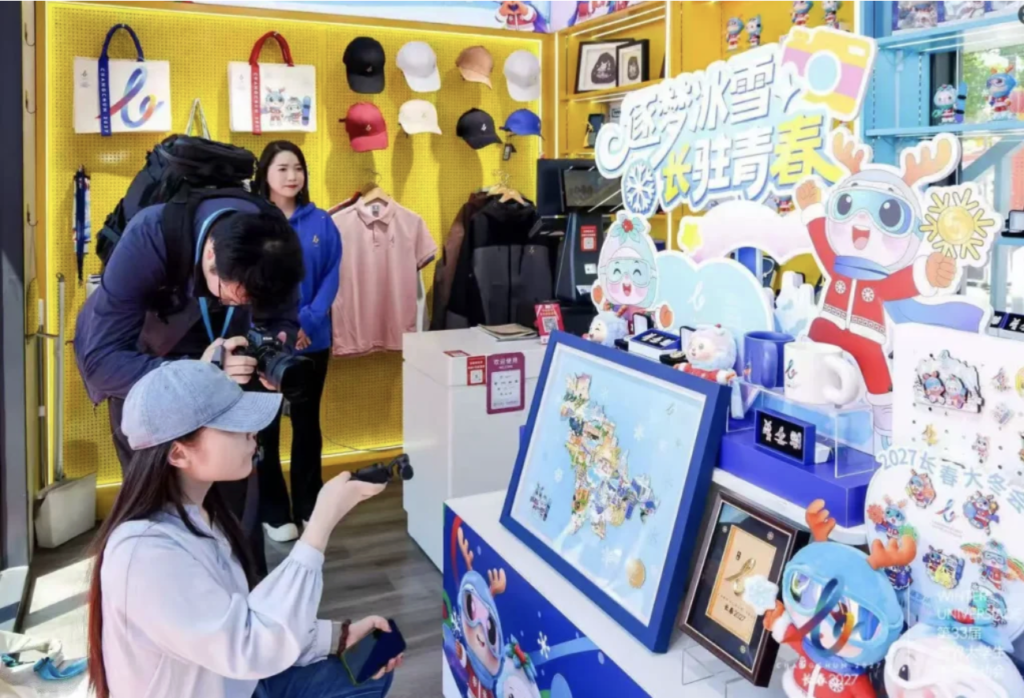
What matters more than volume, however, is how products are being designed. A reversible eco-friendly canvas bag, for example, carries the Games emblem on one side and hand-drawn Changchun landmarks on the other. Local crafts such as Songhua stone teacups and carved stone ornaments are positioned not merely as event souvenirs, but as carriers of Jilin’s regional culture. Store operators have put the goal simply: products should enter everyday life rather than remain display pieces.
That logic is similar to the sustainability approach now seen in major sports venues. At the Milan-Cortina Winter Olympics, temporary or existing facilities accounted for 85% of venues, while reusable systems and post-Games functions were built into venue planning from the start. The same idea applies to merchandise: do not create something that loses its value the moment the event ends.
Low-Barrier Access: How Event IP Reaches Small Businesses
If “not one-off” addresses product sustainability, the deeper question is whether event IP can leave behind business capability.
Major event licensing has traditionally favored large brands, leaving small companies outside the system. But recent domestic sports events are experimenting with lower entry barriers.
The inaugural Northeast Super League introduced a zero-fee licensing support program for local SMEs and intangible cultural heritage businesses, waiving both licensing fees and deposits. Under supervision from the Liaoning Provincial Notary Office, three small companies obtained free single-category IP licenses through a lottery. One winner, Liaoning Zixiatang Cultural Communication Development Co., plans to combine national-level Songhua stone inkstone craftsmanship with football-themed cultural products. By June 15, the league had signed 44 licensed companies across more than 120 product categories, with 83% of licensed firms producing locally.
The Jiangsu Football Super League went further. It offered small-business sponsorship slots priced at RMB50,000, attracting more than 3,000 applicants, with 32 eventually selected. In Wuxi, 42 sponsorship packages were priced at just RMB5,000, giving restaurants and neighborhood businesses exposure alongside national brands. One Nanjing braised-food shop reported selling more than 200 additional fan meal sets per day after becoming a sponsor.
The significance is not how little these companies paid. It is that event IP began to flow into the smallest units of the local economy. For the Changchun Winter Universiade, this raises a useful question: while major partners such as FAW, Jilin Bank, Quanyangquan and JD.com already occupy the top of the sponsorship structure, will local cultural-product makers, craft workshops and specialty food companies also have a low-barrier way in?
Capability Transfer: From Making Products to Building Brands
Lower barriers answer the question of who can participate. Capability transfer answers what companies gain from participating.
The 15th National Games of China offers a useful example. Dongguan Wenbo Arts & Crafts Co., a licensed producer of trendy toys for the Games, incorporated Lingnan lion-dance culture into mascot designs and created blind-box products inspired by Canton Tower. During bidding, the team submitted a proposal of more than 400 pages, detailing its production systems, quality-control capability and design innovation. Another Dongguan company, Konda Toys, embedded AI modules into plush toys to enable voice interaction and eventually launched 25 products.
This matters because Dongguan’s toy industry has long been known for manufacturing scale. Around a quarter of the world’s animation derivatives are produced there, while close to 85% of China’s trendy toys are manufactured in the city. But becoming a licensed event supplier requires more than the ability to manufacture. Companies must demonstrate original design, higher quality standards and stronger brand management. A 400-page bid is, in effect, evidence of a shift from supplier thinking to brand-owner thinking.
For the Changchun Winter Universiade, Beijing Huajiang Culture Group is one of the key licensed producers. The company previously participated in the development of Beijing Winter Olympics merchandise, including Bing Dwen Dwen products, and in April 2026 opened a Changchun Winter Universiade store at Beijing Olympic Park. Founder Chen Shaoshu said the company aimed to use professional operations and high-quality products to communicate the Games’ winter-sports spirit, youthful energy and regional culture, while creating merchandise that combines “commemorative significance with practical value.”
That phrase captures the core of the “not one-off” philosophy. More importantly, Huajiang’s experience in quality control, licensing and retail channels can be transferred to local companies working alongside it. This kind of capability transfer may be one of the most valuable, yet least visible, legacies of event merchandise.
From Selling Products to Leaving Capabilities Behind
Seen together, the legacy of event merchandise has at least three levels.
The first is the product itself: canvas bags, badges, Songhua stone teacups and other items that remain in consumers’ daily lives after the Games. The second is methodology: quality standards, design processes and channel management that stay with local manufacturers and retailers. The third is brand awareness. When a local craft workshop or small cultural retailer receives an official event license for the first time, produces under official quality standards and appears alongside major brands, it is forced to operate at a higher level of brand discipline.
That process may matter more than short-term sales.
The Changchun Winter Universiade’s IP will eventually become part of the city’s cultural assets, but the production and branding capabilities built during the event can remain inside local companies for much longer. That is the more important account to keep when calculating the legacy of cultural and creative products.
There is a historical precedent. During the 1964 Tokyo Olympics, Seiko supplied official timing equipment and used the Games to strengthen its international reputation. Its brand upgrade did not come simply from sponsorship spending, but from proving its capabilities under the highest international standards.
For Changchun, the real question is therefore not just how many licensed products are sold.
It is whether the Winter Universiade can become a “Seiko moment” for one or more local companies.